

Giving it away for free
- Written by: Caitlin Vincent, Lecturer in Creative Industries, University of Melbourne
There’s a long-running adage about working for free in the performing arts. “The problem with working for exposure,” it goes, “is you can die from exposure”.
Only partly a joke, the saying is also a sober warning to performers. Work in the cultural industries is precarious, and performers rely on a combination of short-term gigs, casual contracts, and “day jobs” to make ends meet. Unpaid work is a common feature of the market, and performers often find themselves working without remuneration in order to make connections or add a line to their resume.
COVID-19 has exposed the true insecurity of the cultural workforce, and now we’re seeing the double-edged sword of “exposure” also extending to arts organisations.
Read more: The government says artists should be able to access JobKeeper payments. It's not that simple
All the web’s a stage
Since March 2020, there has been a worldwide influx of digital arts content. Forced to shutter live seasons, performing arts organisations collectively jumped on the digital bandwagon. From live-streaming events to archival production footage, audiences are inundated with virtual performance events.
In most cases, this content has been offered for free. The Melbourne Symphony Orchestra, Opera Australia, New York’s The Metropolitan Opera, and the UK’s National Theatre, among many others, have streamed live or prerecorded performances on digital platforms for no charge.
Companies without access to archival footage have posted free offerings of different kinds. The Melbourne Theatre Company, for example, has posted behind-the-scenes features, play readings, and artist interviews.
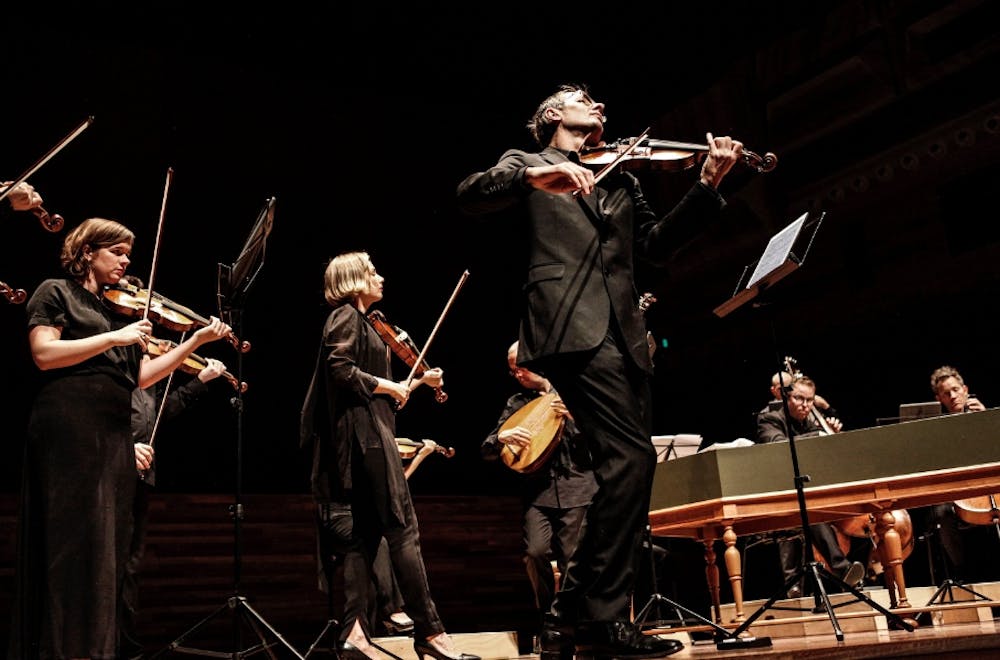 The Australian Chamber Orchestra has announced a new digital season commemorating 30 years of artistic direction under Richard Tognetti.
ACO
The Australian Chamber Orchestra has announced a new digital season commemorating 30 years of artistic direction under Richard Tognetti.
ACO
At the beginning of the shutdown, digital platforms were a critical tool for audience engagement. Arts organisations could communicate the importance of the arts as a source of comfort and inspiration during a time of crisis, while simultaneously reaching a far wider audience than their physical spaces could ever hold.
But it’s increasingly clear the return to live performance may be a matter of months or even years.
For starters, safety is a major concern. A number of genres, including opera and musical theatre, pose particular risks to both performers and audience members due to singers’ potential role as super-spreaders. The risks posed by, and to, dancers, instrumentalists, and spoken theatre artists remains uncertain.
From a business perspective, financial viability is also of grave concern. Under social distancing guidelines, performing arts venues will be limited to a fraction of their standard audience capacity. In a sector reliant on box office sales to maintain the bottom line, theatres may find it cheaper to simply stay closed.
Read more: Home of the Arts – inside an arts centre keeping body and soul together
A problematic precedent
In this climate, digital content may be the only means for sustaining the sector in the medium-term. But a problematic precedent has been set.
In the initial panic of moving their artistic offerings online, companies have undervalued their own product. In this regard, we can see clear parallels with the newspaper industry’s shift to online platforms over the last decade. After initially offering online news for free, the industry is still struggling to shift consumer expectations, with major repercussions for both journalists and papers.
To survive, arts organisations must establish a monetised business strategy for online performances and presentations. But this shift must be navigated carefully, particularly by companies that began with an open-access model and now risk alienating audience members.
 Claire Foy and Matt Smith will perform a socially distanced version of Lungs at London’s Old Vic.
Twitter/The Old Vic
Claire Foy and Matt Smith will perform a socially distanced version of Lungs at London’s Old Vic.
Twitter/The Old Vic
Several arts organisations have already experimented with different ways of monetising digital content. In the UK, the Old Vic theatre is live-streaming a socially distanced version of Lungs for £10-65 (A$18-120) per “ticket”. In Australia, the Melbourne Digital Concert Hall is producing virtual concerts for a paid audience, with all ticket proceeds going to the performers.
Many companies, like New Zealand’s Tempo Dance Festival, are making shows available online but asking for donations. Red Line Productions’ online readings have featured marquee names like Alec Baldwin and Rose Byrne, and also asked for donations. Based out of New York, Bang on a Can’s June marathon promises six hours of streamed live music with a request to “consider” purchasing a ticket or paying extra to commission a new piece. But voluntary contributions can’t sustain the operating costs of these companies long term.
Depending on how various models develop, there will be unavoidable impacts on performers. At present, there are no standardised rates for artist compensation for digital work, whether participating in a prerecorded performance or generating new content for a company to post online.
We’ve already seen how artists’ passion for their craft can be exploited for a cause. The Metropolitan Opera cancelled contracts for its principal singers and union orchestra and chorus in March 2020, only to have them perform for free as part of the company’s digital fundraising gala a month later. The Melbourne Symphony Orchestra similarly stood down its instrumentalists in April 2020 but has since asked them to participate in social media marketing campaigns without pay.
Bottom line
While involvement in promotional activities is standard practice for contracted artists, it’s impossible to ignore the problematic power dynamic now at play. Companies are asking unemployed artists to provide free labour to support organisations that may or may not employ them in the future. And because performers love what they do and want to support the struggling sector, they agree.
While there are reports the government is working on an arts rescue package, the message being sent is one the sector has heard time and again. The arts are important, and artists should be compensated … but only when it’s financially convenient.
Arts organisations cannot survive from digital exposure and goodwill alone. They must develop new business models for online platforms. But companies must also tread carefully to ensure they don’t ultimately undermine the value of the arts – or their artists.
Authors: Caitlin Vincent, Lecturer in Creative Industries, University of Melbourne


















