

Friday essay: on the trail of the London thylacines
- Written by: Penny Edmonds, Associate Professor, Australian Research Council Future Fellow, University of Tasmania
On a cold, dark night in the winter of June 2017, hundreds of people gathered on the lawns of Hobart’s parliament house to join a procession that carried an effigy of a giant Tasmanian tiger (thylacine) to be ritually burnt at Macquarie Point.
In an act called “the Purging”, part of the Dark Mofo festival, participants were asked to write their “deepest darkest fears” on slips of paper and place them inside the soon-to-be incincerated thylacine’s body. This fiery ritual, a powerful cultural moment, reflects the complex emotions that gather around this extinct creature.
More than a spectacle, the Dark Mofo event can be read as a strange memorialisation of loss and a public act of Vandemonian absolution in response to the state’s deliberate role in the tiger’s extinction. It led us to ask: what remains of the thylacine and what does it mean to come face-to-face with thylacine remains in the age of mass extinction?
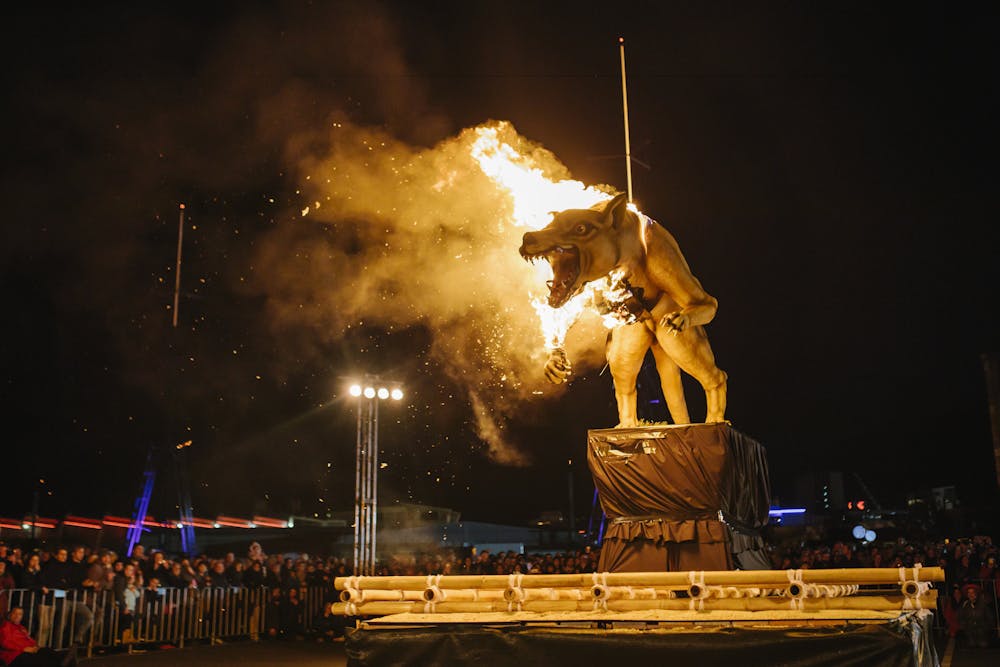 The Purging at Dark Mofo 2017.
Courtesy of Dark Mofo/Lusy Productions
The Purging at Dark Mofo 2017.
Courtesy of Dark Mofo/Lusy Productions
Numerous “sightings” - and scientific research that seeks to resurrect the thylacine - attest to our longing to bring this species back from the dead. Our research takes a different path. We want to look for the traces of the thylacine in this time of great environmental uncertainty, in which species are becoming extinct at a rate never before experienced by humans. Facing our past losses is an important project in the Anthropocene, the age defined by humanity’s impact on the earth.
We have hunted for some of the 750 thylacine specimens in museum collections scattered around the world. These are a legacy of the period when Tasmania was a British colony, and the network of global trade that connected this small island state to the centres of colonial power.
In September 2017 we went in search of some of the creatures who had made the perilous journey to the United Kingdom: the London thylacines.
An archive of bodies
In search of what remains, we visited the Natural History Museum of London, one of the premier repositories of natural science collections in the world. In the storeroom, we were able to look through a cabinet containing trays of thylacine specimens, many with their original 19th century tags attached.
Amongst these remains were the preserved skins of Tasmanian tigers as well as skulls, bones and one thylacine pup. Stuffed and sewn, with a blind eye of cotton wool, this baby in its white protective tray was the tiniest of thylacine young.
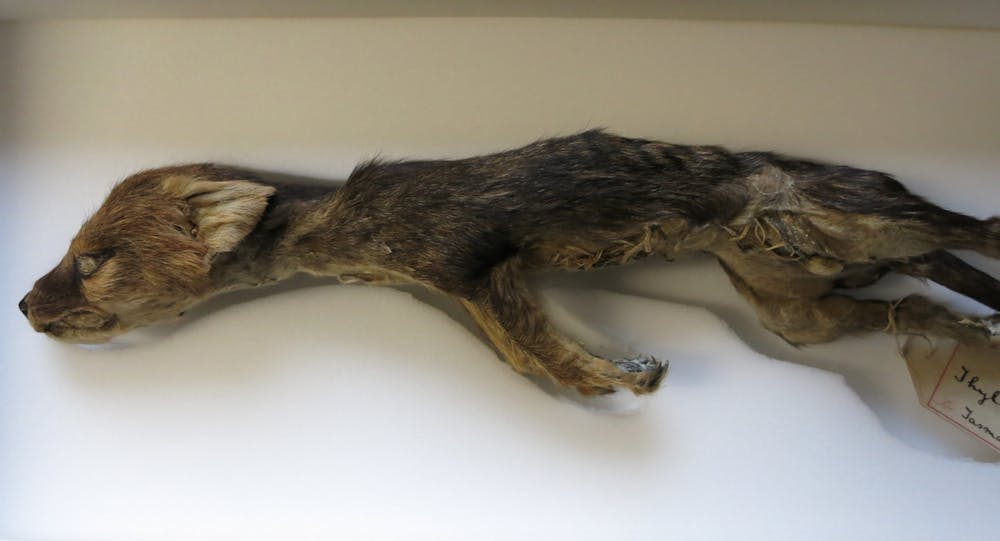 Thylacine joey, from the collections of the Natural History Museum, London.
Penny Edmonds
Thylacine joey, from the collections of the Natural History Museum, London.
Penny Edmonds
While our photographs of the visit to the museum show us smiling in the storeroom - as travelling Australians we were pleased to be there after our long journey - we were, in fact, overwhelmed with cross-currents of emotion. The palpable shock of seeing so many thylacine bodies in trays in this and several other collections was a profound recognition of loss.
Some 167 specimens of Tasmanian tigers reside in museums in the UK alone. As such, this small joey is made more poignant by the scale of what we saw. A museum visitor might see a single thylacine on display, where one body stands in for its entire species.
Yet in the storerooms of the museum we came face-to-face with the sheer volume of animal bodies that were evacuated from Tasmania. In a world where extinction is becoming all too mundane, the individual lives and deaths of these animals were palpable.
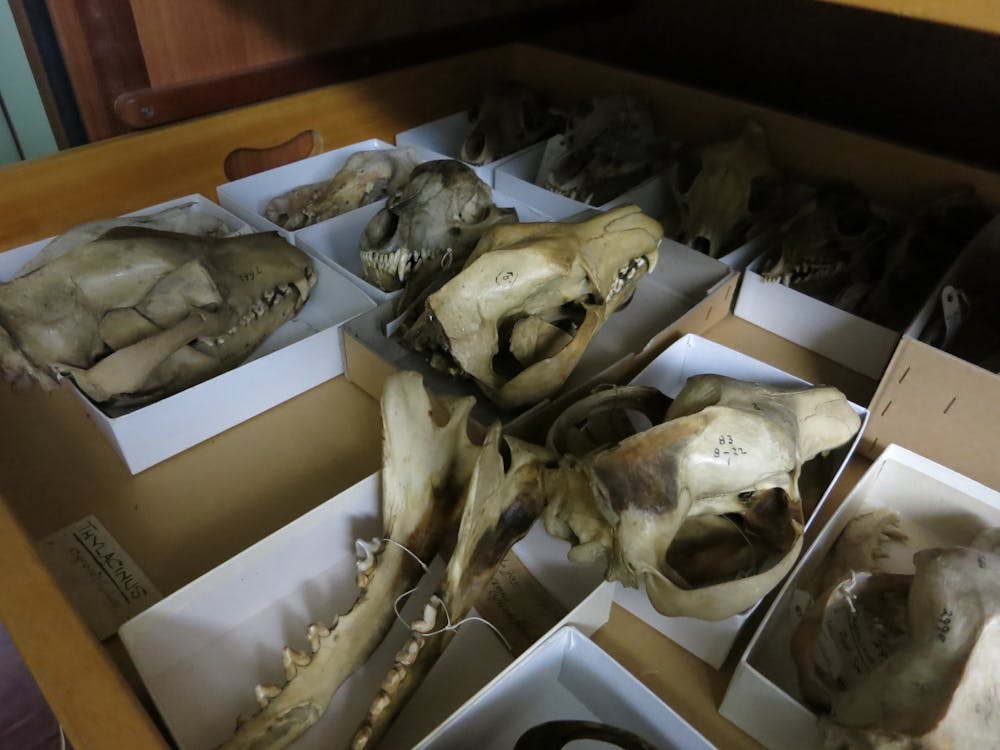 Thylacine skulls, from the collections of the Natural History Museum, London.
Penny Edmonds
Thylacine skulls, from the collections of the Natural History Museum, London.
Penny Edmonds
From the late-18th century, the new Antipodean colonies in Australia and New Zealand were homes for the strangest of new creatures, at least to European eyes. A furious trade began between the colonies and Europe. New animals of scientific curiosity were avidly collected and discussed at meetings of the Royal Society of Tasmania, founded in 1843.
Here, animals such as black swans, wombats, and thylacines were exhibited, examined, and circulated. The society members responded enthusiastically to requests from Europe’s elite scientists to send specimens from the colonies. In 1847, for instance, the society’s committee minutes show that members attempted to source an “impregnated Platypus or Echidna preserved in spirits. Also the brains of the Thylacinus [Tasmanian Tiger] and Dasyurus [Tasmanian Devil]”. These were to be collected for for the eminent British comparative anatomist and fossil hunter Professor Richard Owen, one of the forces behind the creation of the Natural History Museum in London.
The bodies of animals shipped from the colonies and held in museums have always been important for scientific research; they constitute vast repositories of natural heritage material of immense value. In the Anthropocene age, the value of these animal archives as arks of genetic material has become more apparent, but they are also repositories of loss.
 Echidnas in jars, from the collections of the Natural History Museum, London.
Penny Edmonds
Echidnas in jars, from the collections of the Natural History Museum, London.
Penny Edmonds
Moreover, many collecting institutions the world over face financial difficulties and struggle to look after their collections. Some collections are deteriorating due to lack resources and staff, and this may ultimately lead to the final disappearance of the thylacine.
Dead on arrival
We visited the London Zoo Archives to find out more about the thylacines displayed there over the 19th and early-20th centuries. The London Zoo was the place to which the first and last recorded Tasmanian tigers were exported - the former in 1850 and the latter, purchased for the princely sum of 150 pounds, in 1926. The very last thylacine outside of Australia died at the London Zoo in 1931.
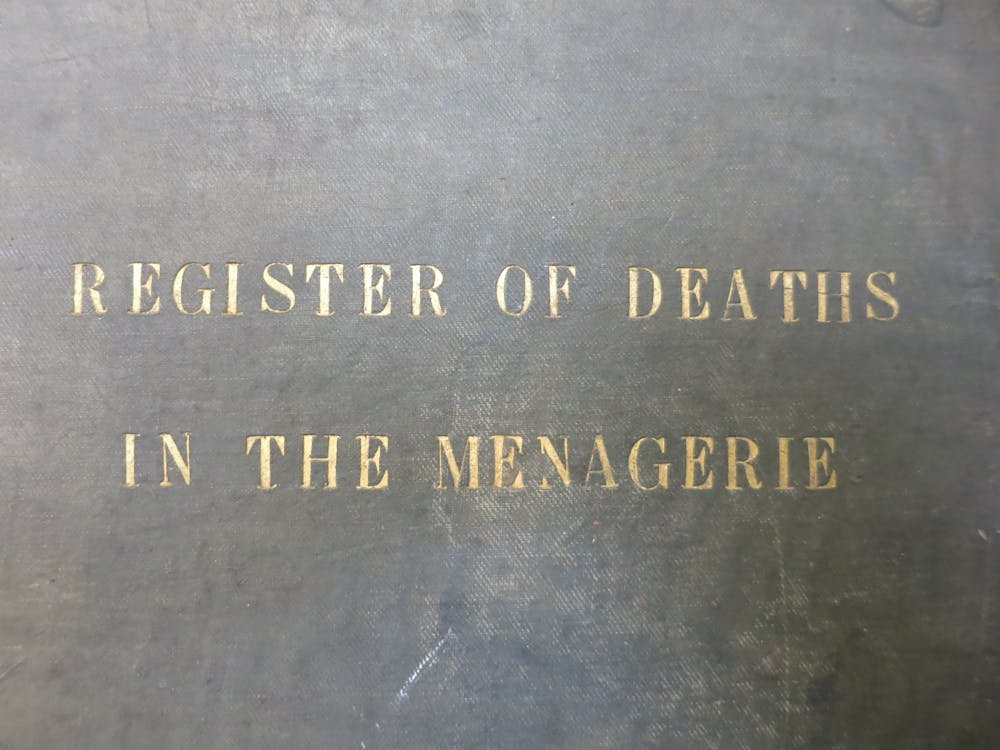 ‘Register of Deaths in the Menagerie’, London Zoo Archives.
Penny Edmonds
‘Register of Deaths in the Menagerie’, London Zoo Archives.
Penny Edmonds
The long sea journey was harsh, and many of the thylacines shipped from Van Diemen’s land were simply declared “dead on arrival”. One animal died just eight days after arriving in 1888. In the hope of offspring, many thylacines were shipped in breeding pairs. Yet these hopeful reproductive futures were often foreclosed when one of them died in transit, as was the case of the final shipment in 1926.
We were lured to the London Zoo archives by the librarian’s mention of the “death books”, a remarkable set of “Registers of Death in the Menagerie.” Within these weighty volumes we found page after page of neat, looping cursive script listing the dates, names, “originating habitat”, “cause of death” and “how disposed of” for all the animals that died in the London Zoo, beginning in 1904.
As we turned the pages and moved through the years, we witnessed the deaths of the “Tasmanian wolf” amongst a veritable menagerie of animals from all over the globe and especially from Britain’s colonies - Egypt, South Africa, India, Ceylon, the west coast of Ireland, and Australia - reflecting the imperial networks of exchange and transportation through which these animals were shipped.
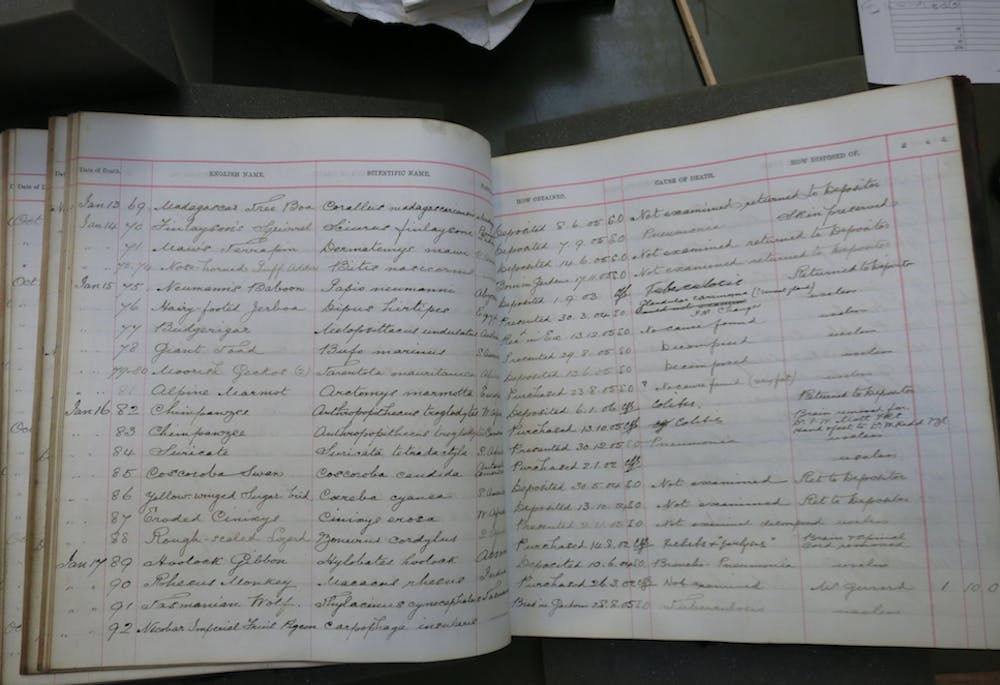 Pages from the ‘Register of Deaths in the Menagerie’, London Zoo Archives.
Penny Edmonds
Pages from the ‘Register of Deaths in the Menagerie’, London Zoo Archives.
Penny Edmonds
Among two black swans found dead within days of each other, budgerigars found “worried to death”, and a “black-faced kangaroo” that died of pneumonia in the cold, wet English weather, was the thylacine that died on January 17 1906. This was “Specimen 91”, a female purchased on March 26 two years before.
Yet while there is little information on the cause of her demise, the death books note she was “not examined” but was “disposed of” to “W Gerrard (of Gerrard and Sons taxidermist)” and “sold for 1 pound, 1 shilling.”
Armed with the 1869 plans of the zoo, we went looking for the thylacines’ cage. From the map we could see that thylacines had been kept in a far corner of the zoo, near the banks of a rivulet. Due to more recent building and development, pinpointing the exact location was a challenge. What we did find was a nondescript, brutalist building and an asphalt service road. Of the thylacine enclosure, nothing remained.
This site resonates with the abandoned Beaumaris Zoo in our home city of Hobart, the location of the “final” thylacine death, which sits on the banks of the River Derwent in Hobart behind locked gates. Both of these spaces are forgotten sites of death. They are where thylacines began and ended their journeys, places which link the colony and London through circuits of scientific trade and esteem, where animal lives and deaths were managed by bureaucratic processes, and where humans and thylacines came face-to-face. But what remains at these sites? Nothing that would tell the sad story of the thylacine.
Deliberate extinction
The “last” thylacine died of exposure after it was locked out of its sleeping enclosure on September 7 1936 at Beaumaris Zoological Gardens on the Hobart Domain. This death, now so weighted with significance, went unremarked at the time. There were no news reports to record the animal’s passing and its remains were thrown away.
The extinction of the thylacine is particularly resonant because it was annihilated through human actions; its death was sanctioned by government policy and deliberately and systematically enacted.
The thylacine was demonised by Tasmanian graziers as a blood-thirsty carnivore that liked to feed on sheep. While the Van Diemen’s Land Company had placed a bounty on the head of the thylacine in 1830, it was the parliament that signed the species’ death warrant. Between 1888 and 1909 the government paid one pound per adult and ten pence per young, during which time 2,184 bounties were rewarded. The public knew what it was doing. In 1884 a group of farmers on Tasmania’s east coast set up the “Buckland and Spring Bay Tiger and Eagle Extermination Society” with the explicit purpose of eradicating the species.
The cultural guilt that attends the thylacine is perhaps why it is such an important international symbol for extinction and why the date of the death of the last thylacine is now National Threatened Species Day.
The thylacine’s legacy
The spectre of the thylacine haunts the public imagination and there is significant scientific focus on the physical remains of this now infamously extinct creature. In 2017 there was a spate of highly publicised “sightings” in Queensland and Tasmania.
In December of the same year, scientists reported that they had sequenced the genome of a one-month old thylacine pup or joey, a curious and pale creature preserved in alcohol from Museum Victoria. In February 2018, researchers announced they had for the first time completed full CT scans of rare pouch young.
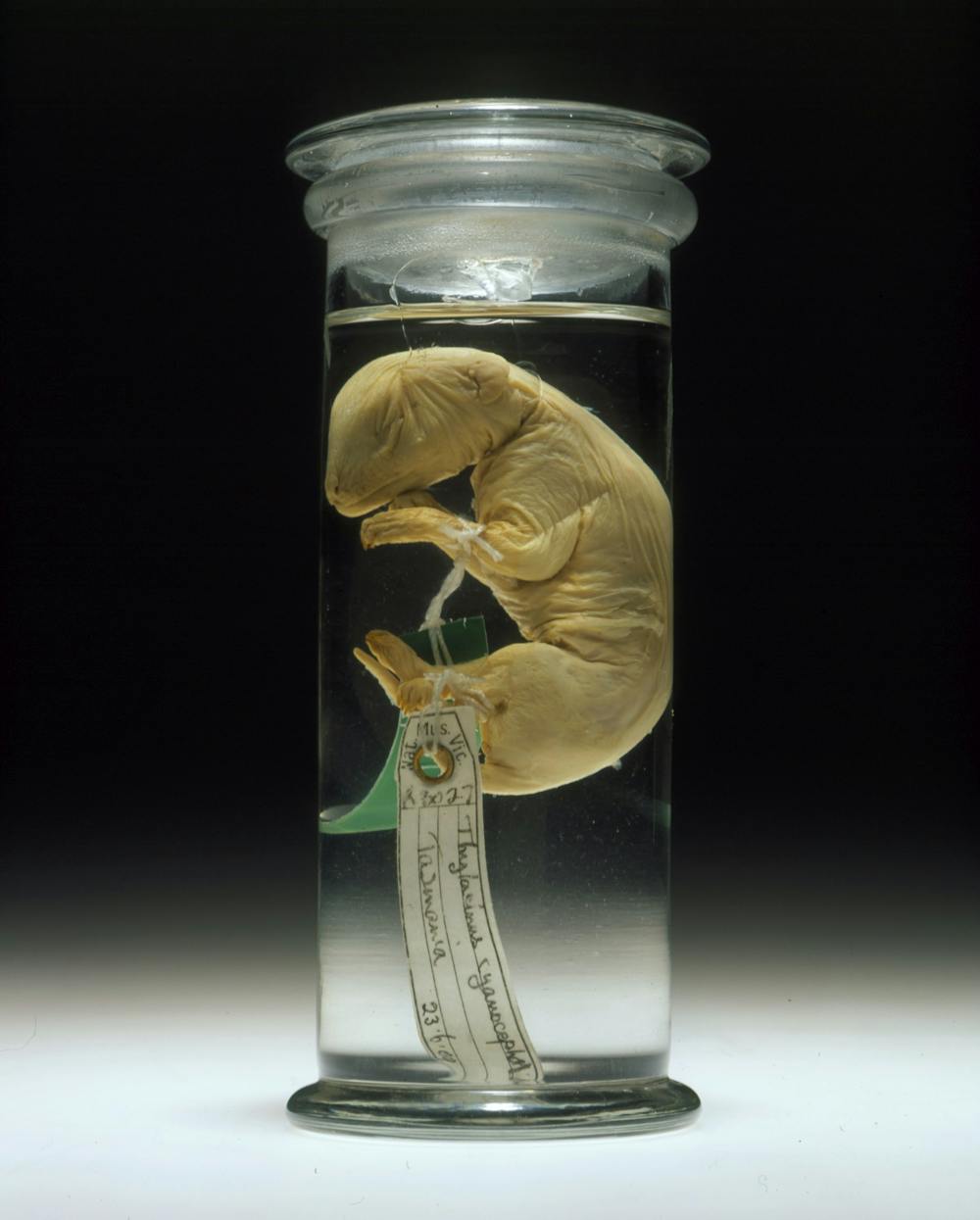 Thylacine joey preserved in ethanol in the collection of Museums Victoria.
Healley, Benjamin/Museums Victoria
Thylacine joey preserved in ethanol in the collection of Museums Victoria.
Healley, Benjamin/Museums Victoria
Indeed, they found a mix up: some specimens were tiny quolls or Tasmanian devils, not thylacine joeys at all. As an article in The Guardian noted, the research “all contributes to the ultimate end goal of bringing back a thylacine, a project that is technologically distant but theoretically possible.”
However, for scholars Thom van Dooren and Deborah Bird Rose, de-extinction projects blind us to the finality of extinction. They advocate actively grieving extinction because it does important political work. They write: “The reality is that there is no avoiding the necessity of the difficult cultural work of reflection and mourning. This work is not opposed to practical action, rather it is the foundation of any sustainable and informed response.”
Australia has the worst mammal extinction rate in the world. The thylacine is one of 30 mammals that have been lost here since European settlement. Thinking through the meanings and politics of the loss of the thylacine is crucially important in this context. Rare thylacine remains, housed in museum collections around the world, are precious archives that are part of our global heritage. We must take care of them. Moreover, facing this loss directly in the age of extinction is a political act.
This collaborative interdisciplinary project, “Extinction Afterlives”, brings together Associate Professor Penny Edmonds, Dr Hannah Stark and Adjunct Associate Professor Katrina Schlunke, University of Tasmania, to consider the cultural life of the extinct thylacine and other creatures in the Anthropocene.
We wish to thank Roberto Portela Miguez, Senior Curator in Charge of Mammals, The Natural History Museum, London, for hosting our visit to the museum and for his helpful discussions on this essay topic. Also, Mathew Lowe, Collections Manager, University Museum of Zoology, Cambridge University, Kathryn Medlock, Senior Curator Vertebrate Zoology, Tasmanian Museum and Art Gallery, and Tammy Gordon, Collections Officer, Natural Sciences, Queen Victoria Museum and Art Gallery, Tasmania.
Authors: Penny Edmonds, Associate Professor, Australian Research Council Future Fellow, University of Tasmania
Read more http://theconversation.com/friday-essay-on-the-trail-of-the-london-thylacines-91473


















