

How Paul Keating transformed the economy and the nation
- Written by: Carol Johnson, Emerita Professor, Department of Politics and International Relations, University of Adelaide
The Conversation is running a series of explainers on key figures in Australian political history, examining how they changed the country and political debate. You can read the rest of the series here.
Paul Keating was one of Australia’s most charismatic and controversial prime ministers.
Born in Bankstown, New South Wales, into an Irish-Catholic, working-class and Labor-voting family, he left school before he turned 15. Keating joined the Labor Party as a teenager, quickly honing the political skills that would serve him so well in later life. He entered parliament as MP for Blaxland in 1969 at just 25 years old, and briefly served as minister for Northern Australia in the ill-fated Whitlam government.
He subsequently served as a very high-profile treasurer in the Hawke government from 1983-1991, before defeating Bob Hawke in a leadership ballot in December 1991. In doing so Keating became Australia’s 24th prime minister, serving until John Howard defeated him in the 1996 election.
To Keating’s supporters, he is a visionary figure whose “big picture” ideas helped transform the Australian economy, while still pursuing socially inclusive policies. To his conservative critics, Keating left a legacy of government debt and rejected “mainstream” Australians in favour of politically correct “special interests”.
He was a skilled parliamentary performer, renowned for his excoriating put-downs and wit.
Keating played a major role in transforming Australian political debate. He highlighted the role of markets in restructuring the economy, engagement with Asia, Australian national identity and the economic benefits of social inclusion.
Economic rationalism
Keating is remembered most for his eloquent advocacy of so-called “economic rationalism” both as treasurer and later as prime minister.
Under Hawke and Keating, Labor advocated free markets, globalisation, deregulation and privatisation, albeit in a less extreme form than the Liberals advocated. For example, while Labor introduced major public sector cuts, it attempted to use means tests to target the cuts and protect those most in need. Nonetheless, Hawke and Keating embraced the market far more than previous Labor leaders had.
Along with New Zealand Labour, Australian Labor became one of the international pioneers of a rapprochement between social democracy and a watered-down form of free-market neoliberalism. Years later, British Prime Minister Tony Blair, who had visited Australia during the Hawke and Keating years, was to acknowledge the influence of Australian Labor on his own “Third Way” approach to politics.
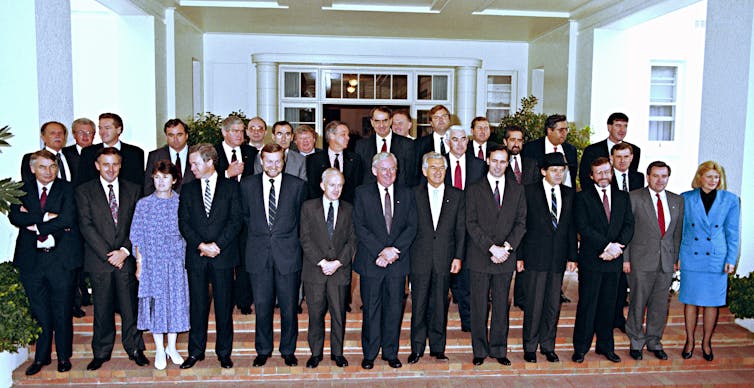 The Hawke cabinet in 1990, with Keating again as treasurer.
AAP/National Archives of Australia
The Hawke cabinet in 1990, with Keating again as treasurer.
AAP/National Archives of Australia
Keating justified his economic rationalism on the grounds that the Australian economy needed to transform to be internationally competitive in a changing world. To avoid becoming one of the world’s “economic museums” or “banana republics”, in Keating’s view, there was no alternative but to embrace his economic rationalist agenda.
Trade unions and the ‘social wage’
At the same time, Keating argued that his economic policies would avoid social injustices. This contrasted with the outcomes of the extreme economic rationalism of the Thatcher and Reagan governments.
Unlike in the UK or US, where anti-union policies were pursued, the Labor government was prepared to work with the trade union movement to introduce its economic policies. Under the Accord agreements, trade unions agreed to wage restraint, and eventually real wage cuts, in return for government services and benefits.
Read more: Australian politics explainer: the Prices and Incomes Accord
Hawke and Keating referred to this as the “social wage”. They claimed the resulting increased business profits would encourage economic growth and rising standards of living.
Social inclusion and economic growth
Keating saw his economic policies and progressive social policies as compatible. Increased social inclusion would contribute to economic growth.
Drawing on Hawke-era affirmative action legislation, Keating argued improved gender equality would mean women could contribute their skills to the economy.
Keating was also a passionate advocate for reconciliation with Indigenous Australians, including acknowledging the injustices of Australia’s colonial past and facilitating Native Title. He envisaged an Australia where Indigenous people would benefit from sustainable economic development, cultural tourism and could sell their artworks to the world.
National identity, Asia and the republic
In Keating’s ideal vision, Australia would engage more with Asia and benefit from the geo-economic changes occurring in the Asia-Pacific region.
Then Opposition Leader John Howard accused Keating of rejecting Australia’s British heritage. In fact, Keating acknowledged many positive British influences on Australian society. However, he argued that Australia had developed its own democratic innovations such as the secret ballot long before Britain accepted these. He also suggested Australian values had become more inclusive as a result of diverse waves of immigration.
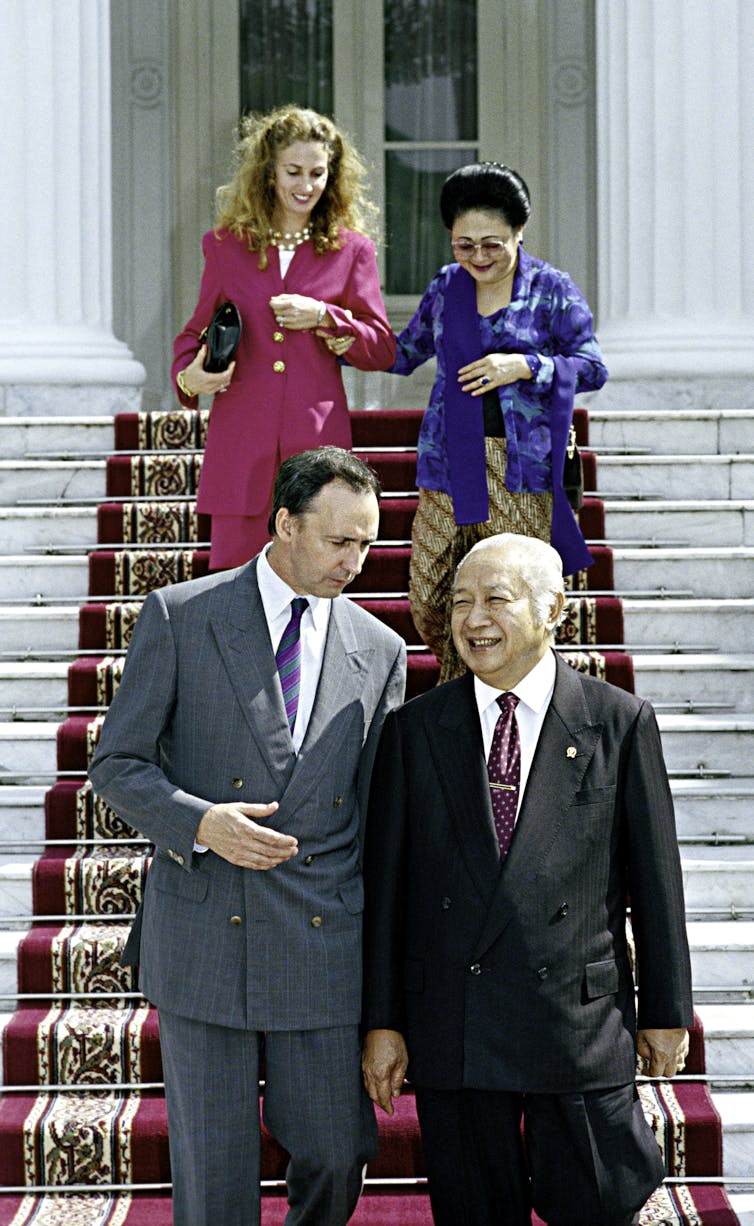 While Keating maintained cultural and economic links with the US and Europe, he also sought to improve relations across the Asia-Pacific.
AAP Image/National Archives of Australia
While Keating maintained cultural and economic links with the US and Europe, he also sought to improve relations across the Asia-Pacific.
AAP Image/National Archives of Australia
Consequently, it was time for Australia to throw off its colonial heritage, including the British monarchy, and become a republic. Keating believed that doing so would enable Australia to be more easily accepted as an independent nation in the Asian region. He established a Republic Advisory Committee as part of preparations for a referendum on becoming a republic.
Keating’s legacy
Australia’s greater relationship with Asia has had major benefits for the economy, although Keating underestimated the downsides of increased competition. Recently, he complained about what he sees as excessive security fears in relation to China and their impact on Asian engagement. The republic remains unfinished business.
Keating’s vision has also left some unintended consequences for Labor today. Despite his patchy record in achieving them, Keating argued that both tax cuts and budget surpluses were important, even at the expense of public sector cuts.
Read more: Vale Bob Hawke, a giant of Australian political and industrial history
Consequently, it became harder for Labor leaders to make a case for deficit-funded stimulus packages when needed (as Kevin Rudd tried to do during the Global Financial Crisis). Similarly, it became harder for Labor leaders to argue for increased taxes to fund a bigger role for government, as Bill Shorten attempted during the 2019 election.
In addition, as I argue in a recent book, Keating-era policy contributed in the longer term to poorer wages and conditions for workers. Labor is predictably loath to acknowledge this. Keating also underestimated the detrimental impacts of economic rationalism on other vulnerable groups in the community.
The 2019 election result suggests many Australians no longer believe Labor governments will improve their standards of living.
Rather than the prosperous brave new world he envisaged, parts of the Keating legacy may have made things harder for subsequent Labor leaders. Nonetheless, Keating remains a revered figure in the Labor Party and one of its most memorable leaders.
Authors: Carol Johnson, Emerita Professor, Department of Politics and International Relations, University of Adelaide
Read more https://theconversation.com/how-paul-keating-transformed-the-economy-and-the-nation-131562

















