

Australia's devotion to coal has come at a huge cost. We need the government to change course, urgently
- Written by: Judith Brett, Emeritus Professor of Politics, La Trobe University
Because we are rich in coal and gas, Australia has been plagued with two decades of wars over climate policy. The wars have claimed three prime ministers: Kevin Rudd, Julia Gillard and Malcolm Turnbull. They have also, in the words of journalist Alan Kohler,
ruined Australia’s ability to conduct any kind of sensible discussion about economic policy and to achieve consensus on anything.
The response to the pandemic shows that consensus and effective, evidence-based policy are not impossible for Australia’s politicians. Faced with a crisis of life and death, they can put aside ideology and stare down vested interests.
The optimists among us hope they can do this with the life and death crises humanity is facing as the planet heats, and that the terrible fires last summer will have convinced our leaders climate change is real, and effective action urgent. So far, the calls for urgent action are louder from business than from political leaders. Innes Willox, the chief executive of the Australian Industry Group, has linked restoring growth after the pandemic to the achievement of net-zero emissions by 2050.
The federal government, by contrast, is championing gas as a “transition fuel” between coal and renewables. Prime Minister Scott Morrison’s handpicked chair of the National COVID-19 Co-ordination Commission, Nev Power, has strong links to the gas industry.
Calling gas a “transition fuel” at least admits the need for a transition. But gas also contributes to the planet’s heating, and the federal government has no plausible plan to meet Australia’s Paris target, nor to ramp it up, which must be done for a safe future.
Read more: A single mega-project exposes the Morrison government's gas plan as staggering folly
The grip that coal and gas has on our political elites goes back to the 1960s, when minerals replaced wool as the mainstay of our commodity exports. Iron ore and coal led the way.
About the same time, mining’s social licence was being challenged by Indigenous Australians, who objected to mining on their traditional lands, and by environmentalists concerned about mining’s destructive impact on natural habitats. The miners’ response was a concerted public relations campaign to align their interests with the national interest by convincing Australians their prosperity depended on mining and should not be curtailed.
In this, the miners have been spectacularly successful. First, in the 1980s, they stymied the implementation of the Hawke Labor government’s plan for uniform land rights legislation, which would include protection of sacred sites, the right to royalties and a veto over mining on Indigenous land.
In Australia, unlike other common law countries, the Crown owns the minerals, so the veto would have given Indigenous owners more rights than freehold owners. Miners launched a furious public campaign centred on the argument that Indigenous Australians should not have special rights.
A decade later, after the High Court determined in the Mabo and Wik judgements that forms of native title had survived European settlement, the miners fought again to make sure the resulting legislation did not include any veto over mining; and it didn’t.
Second, they have delayed effective government action on climate change. At the end of the century, as pressure mounted for a reduction in the burning of fossil fuels, Australia’s coal producers organised to prevent the federal government from signing international agreements to reduce carbon emissions. Their core argument was that mining underpinned Australia’s wealth, but they also spread scepticism about climate change amongst conservative elites, turning it into an identity marker for the Australian right.
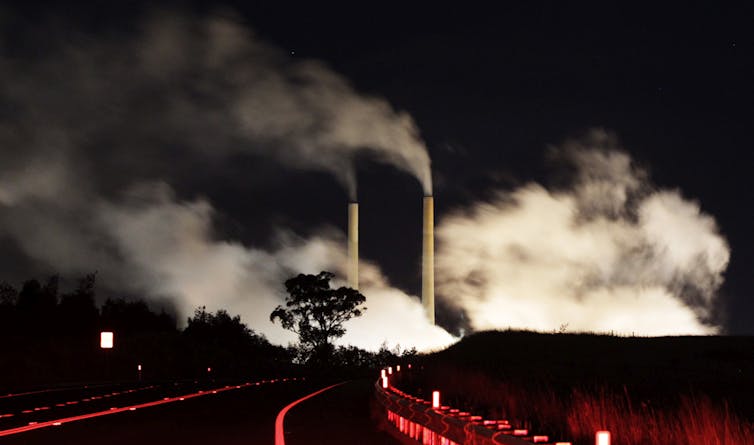 A coal-fired power station in western NSW. The mining industry has delayed climate action.
Daniel Munoz/AAP
A coal-fired power station in western NSW. The mining industry has delayed climate action.
Daniel Munoz/AAP
Under John Howard, fossil fuel advocates gained extraordinary access to government decision-making on climate and energy policy. This access was not given to environmental non-government organisations (NGOs) or climate scientists. So much for balance.
The power of the fossil fuel lobby was weaker after Howard lost the 2007 election. Later, it was unable to prevent the Gillard government from implementing a price on carbon and establishing a series of agencies to advance action on climate change.
But with Tony Abbott as prime minister, the industry’s power was back. Scepticism about climate science spread to science and expertise generally, undermining the federal government’s commitment to innovation and research. The fossil fuel lobby is not solely to blame for the Coalition’s philistinism under Abbott, but it bears some responsibility for its self-interested spreading of climate scepticism.
Read more: Morrison government dangles new carrots for industry but fails to fix bigger climate policy problem
The mining lobby’s third success has been to capture the National Party and turn it into the party of coal and coal seam gas, even when extracting these destroys the good agricultural land on which our food security depends. This is an astonishing achievement.
In March 2019, on Network 10’s The Project, Waleed Aly asked Nationals leader Michael McCormack
Could you name a single, big policy area where the Nats have sided with the interests of farmers over the interests of miners when they come into conflict?
Off the top of his head, McCormack could not name one. Mining has so successfully aligned itself with perceptions of the national interest that the National Party now champions the jobs of miners more energetically than the livelihoods of the farmers it once regarded as the heart of the nation.
The biggest lesson from the pandemic is that governments are our risk managers of last resort. Ours, both state and federal, have been prepared to inflict massive economic pain on businesses and individuals to protect our health, and we are grateful.
As we face the much larger but more slow-moving crisis of the heating planet, governments must stare down the fossil fuel industry and its supporters, for all our sakes, even if this inflicts on them some economic pain.
If they can do it for the pandemic, they can do it for climate change.
Judith Brett’s Quarterly Essay, The Coal Curse, is out today.
Authors: Judith Brett, Emeritus Professor of Politics, La Trobe University


















