

Pauline Hanson built a political career on white victimhood and brought far-right rhetoric to the mainstream
- Written by: Kurt Sengul, Doctoral Researcher, University of Newcastle
The Conversation is running a series of explainers on key figures in Australian political history, looking at the way they changed the nature of debate, its impact then, and it relevance to politics today. You can also read the rest of our pieces here.
Pauline Hanson and her party have only achieved modest electoral successes. Yet, she is undoubtedly Australia’s most successful populist politician and has had a profound impact on the way the country talks about issues like multiculturalism and immigration.
Hanson’s entire political career can be seen as a denial and rejection of the realities of whiteness in Australia – that is, the unearned benefits and privileges afforded to white people in settler-colonial countries.
Hanson has benefited from – and helped to shape – the normalisation of racism and xenophobia in Australia. She has pushed the boundaries of what can be “acceptably said” in public discourse and has had a disproportionate influence on the national debate.
In doing so, she has also created the political space for other far-right figures like Fraser Anning to emerge and become more a part of the political mainstream.
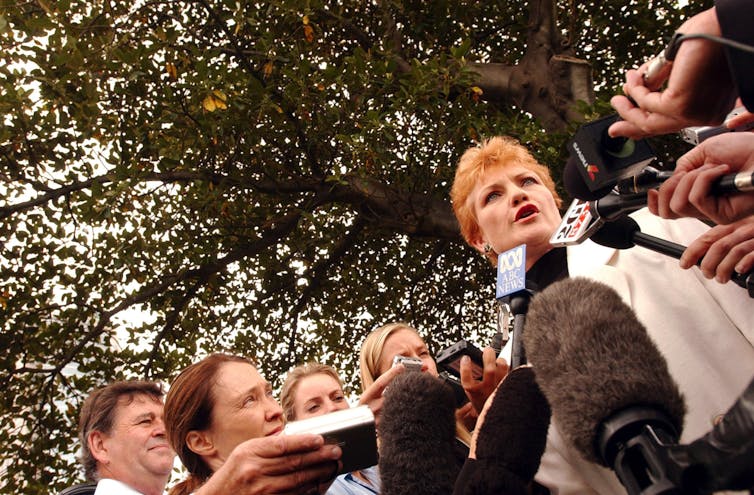 Hanson’s political fortunes have come and gone, but she’s remained a fixture in the public consciousness.
Dean Lewins/AAP
Hanson’s political fortunes have come and gone, but she’s remained a fixture in the public consciousness.
Dean Lewins/AAP
The birth of One Nation
Hanson first emerged on the political landscape in 1996 when she was disendorsed as the Liberal Party candidate for Oxley following racist comments she made about Indigenous people in a letter to the Queensland Times.
She contested the election anyway, running as an independent on a self-described nationalist, populist and protectionist platform, and won the seat with a large swing against the Labor incumbent.
In her maiden speech to the House of Representatives, Hanson claimed to speak on behalf of “mainstream Australians” and promised a “common sense” approach to politics.
Most controversially, Hanson warned Australia was “in danger of being swamped by Asians”, called for the abolition of multiculturalism and railed against Indigenous rights, so-called “political correctness” and “reverse-racism”.
The times suited Hanson. After 13 years of Labor government, John Howard and the Liberal Party looked to exploit a sense of resentment and grievance on the issues of multiculturalism and immigration, which arguably opened up the space for Hanson and helped to legitimise her views.
Indeed, in a 1996 speech delivered to the Queensland Liberal Party, Howard celebrated the idea people felt able to speak a little more freely and could do so
without living in fear of being branded as a bigot or racist.
Hanson’s One Nation party was formed the following year and performed well at the 1998 Queensland state election, winning 11 seats.
Hanson’s downfall and political resurrection
One Nation’s initial success, however, was short-lived. Hanson failed to win the newly redistributed seat of Blair at the 1998 federal election. Her party then began to suffer from internal divisions, poor leadership and Hanson’s personal and financial scandals.
She was subsequently convicted of electoral fraud in 2003. (It was later overturned on appeal.)
After a number of failed federal and state campaigns (including under the rebranded Pauline’s United Australia Party), Hanson finally succeeded in being elected to the Senate in 2016, along with three other One Nation candidates.
This represented a high point for the party at the federal level and gave it considerable influence over government policy.
Read more: Henry Parkes had a vision of a new Australian nation. In 1901, it became a reality
Hanson’s populist, nativist beliefs
Hanson can best be described as a populist radical right politician, alongside such figures as Donald Trump, Nigel Farage, Marine Le Pen and Viktor Orbán.
For populist figures, politics are seen as a struggle between everyday, ordinary people and a corrupt, illegitimate and out-of-touch elite.
But more importantly, the populist radical right also uses the language of “us-versus-them” and portrays immigrants and refugees as existential threats to the safety, security and “culture” of a particular society.
In Hanson’s view, non-natives must either assimilate and embrace “Australian culture and values” or “go back to where they came from”.
Hanson has consistently drawn on a sense of grievance and victimhood – in particular, white victimhood. She has espoused a belief in the existence of so-called “reverse-racism” or “anti-white” racism since the outset of her political career.
Hanson has even gone so far as to claim the
most downtrodden person in this country is the white Anglo-Saxon male.
The mainstreaming of the far-right
Hanson’s resurgence in 2016 occurred in a very different political climate than her first stint in parliament in the late 1990s.
Political scientist Cas Mudde refers to the 21st century as the “fourth wave of the far-right”. It is a time when far-right ideas are becoming increasingly tolerated, debated and normalised in the mainstream and the boundaries of what can be said are shifting.
Emboldened by years of normalised Islamophobia in Australia and the electoral successes of far-right parties globally, Hanson’s maiden Senate speech warned Australia was now
in danger of being swamped by Muslims, who bear a culture and ideology that is incompatible with our own.
She called for a “Trump style” immigration ban, a Royal Commission into Islam and the “banning of the burqa”.
Hanson’s resurgence has clearly cemented Muslims as the new “dangerous other”, though her racist attitudes towards First Nations people and Asian immigrants have also remained a constant.
Her claims of “anti-white racism” have also gained traction in the mainstream. For example, when Hanson put forth a Senate motion declaring “it’s OK to be white” in 2018, a surprising number of Coalition members voted for it and later defended it on Twitter.
It was only later, after a vocal outcry, that the Coalition backed down and claimed the votes were made in error.
The media have played a key role in the mainstreaming of Hanson and One Nation by consistently giving them a platform to voice far-right ideas.
Hanson’s legacy and impact on society
There are a couple of ways to think about Hanson’s legacy and impact on society.
The first is to gauge her direct influence on government policy through her role as a parliamentarian. There’s no doubt she has wielded considerable influence as one of a number of senators to hold the balance of power in recent years.
Yet, despite some success in influencing legislation and her recent appointment as deputy chair of the family law inquiry, Hanson has been largely unsuccessful in seeing her signature policies realised.
Read more: How Julia Gillard forever changed Australian politics - especially for women
And while acknowledging Hanson’s role in mainstreaming far-right ideas, it’s important to note these ideas have existed before her maiden speeches and will exist well beyond her time in politics.
Exclusively focusing on Hanson’s individual acts ignores the systemic nature of racism and the role of the mainstream political class in reproducing and upholding these racist structures.
When assessing Hanson’s legacy, it may be comforting to view her as an aberration and reflection of a bygone era, but she remains very much a product of the Australian settler-colonial story.
It’s perhaps more accurate to think of Hanson as a symptom of racism and xenophobia in Australia, rather than its cause.
Authors: Kurt Sengul, Doctoral Researcher, University of Newcastle


















