

Fifteen years after looting, thousands of artefacts are still missing from Iraq's national museum
- Written by: Craig Barker, Education Manager, Sydney University Museums, University of Sydney
On April 10 2003, the first looters broke into the National Museum of Iraq. Staff had vacated two days earlier, ahead of the advance of US forces on Baghdad. The museum was effectively ransacked for the next 36 hours until employees returned.
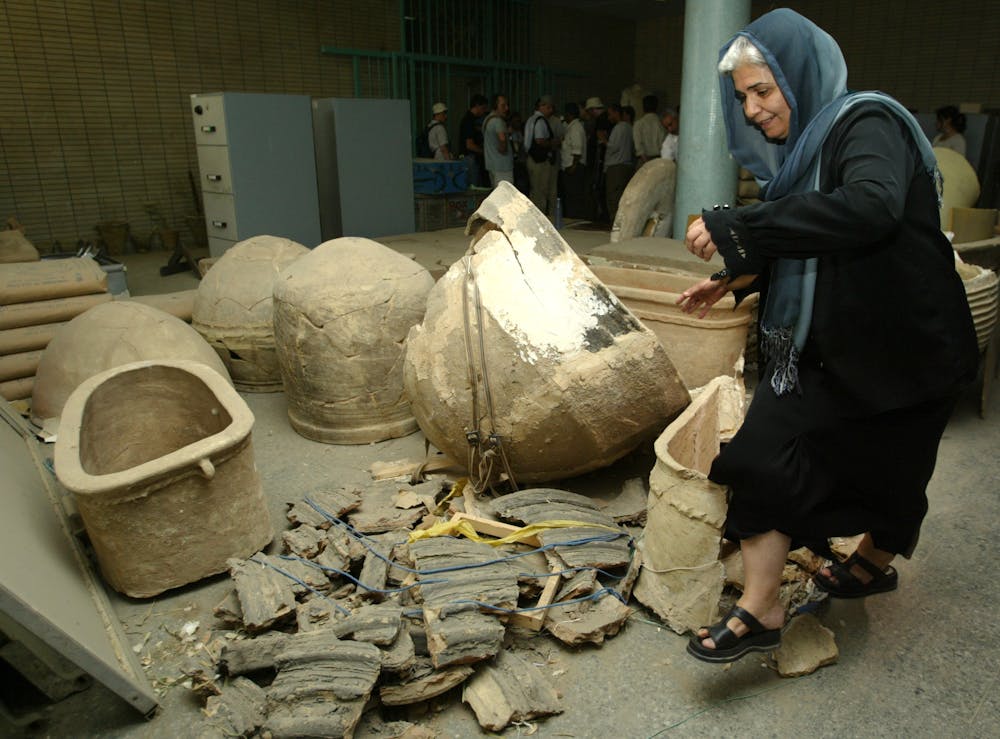 The National Museum of Iraq in the wake of looting in 2003.
Jamal Saidi
The National Museum of Iraq in the wake of looting in 2003.
Jamal Saidi
While the staff - showing enormous bravery and foresight - had removed and safely stored 8,366 artefacts before the looting, some 15,000 objects were taken during that 36 hours. While 7,000 items have been recovered, more than 8,000 remain unaccounted for, including artefacts thousands of years old from some of the earliest sites in the Middle East.
The looting is regarded as one of the worst acts of cultural vandalism in modern times, but much more of Iraq’s rich cultural history has been destroyed, damaged or stolen in the years since. Indeed the illegal trade in looted antiquities is growing.
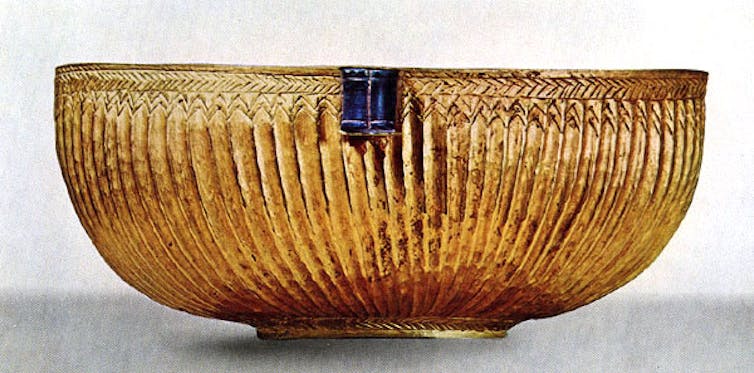 Gold and lapis bowl from Ur, Iraq Museum IM8272. Current statue is unknown.
Oriental Institute Lost Treasures from Iraq database
Gold and lapis bowl from Ur, Iraq Museum IM8272. Current statue is unknown.
Oriental Institute Lost Treasures from Iraq database
One of the museum objects that remains lost is a black stone weight shaped like a duck made around 2070 BC and excavated from the ancient city of Ur. Another is a fluted gold and lapis bowl from a royal cemetery in the same city.
The museum’s collection of cylinder seals (used to print images, usually into clay) was hit especially hard as they were easy to conceal and transport and had a ready market overseas. Of the 5144 taken, just over half have been returned. The museum reopened in 2014, somewhat a shadow of its former self.
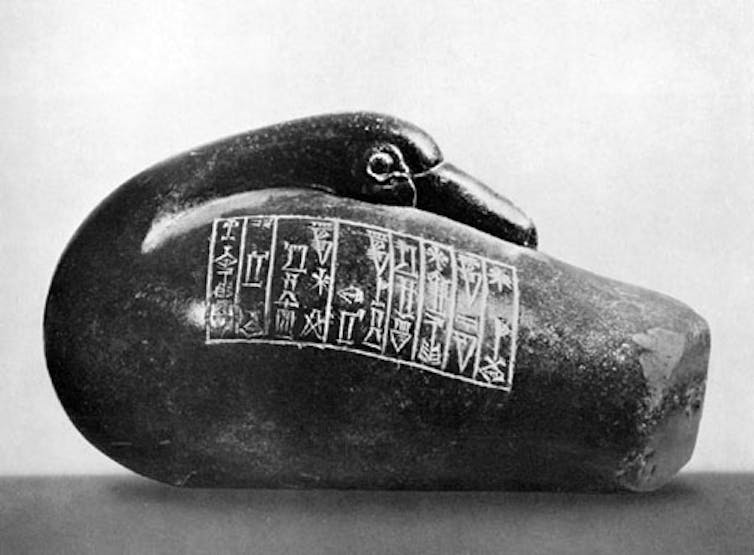 Duck-shaped weight from Ur, Iraq Museum IM3580. Current status unknown.
Oriental Institute Lost Treasures from Iraq database
Duck-shaped weight from Ur, Iraq Museum IM3580. Current status unknown.
Oriental Institute Lost Treasures from Iraq database
Some high value items looted from the museum were so recognisable that they could not possibly appear on the open market, suggesting they were taken with buyers already lined up. In contrast to this was the opportunistic looting undertaken by locals: in some galleries copies were stolen but genuine pieces ignored.
Global outrage at the looting did lead to immediate action. One of the most successful programs was an amnesty granted by authorities that saw almost 2,000 items returned by January 2004, and a further thousand items seized by Iraqi and US investigators.
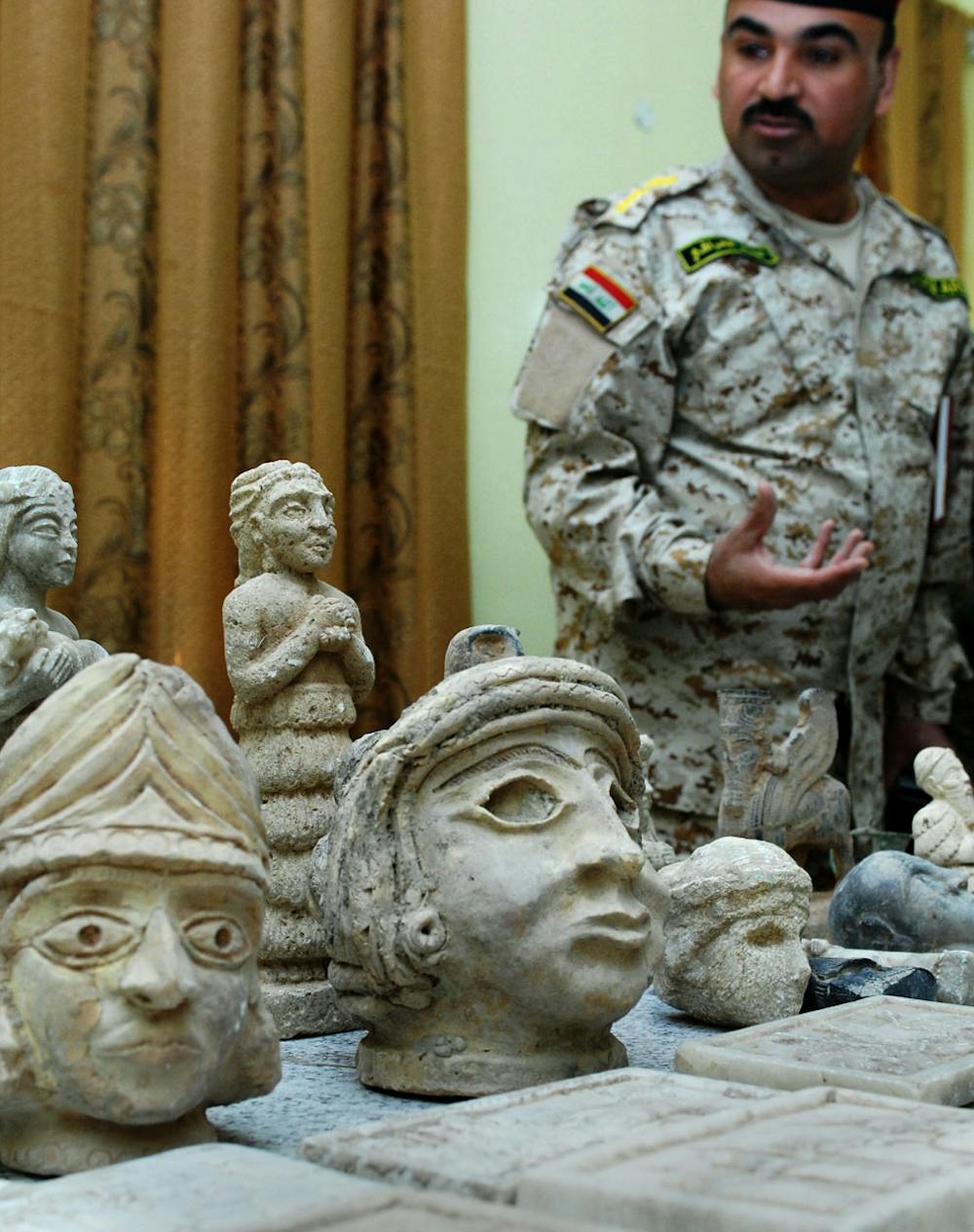 Iraqi Col. Ali Sabah, displays ancient artefacts Iraqi Security Forces discovered in 2008, during two raids in northern Basra.
Wikimedia commons
Iraqi Col. Ali Sabah, displays ancient artefacts Iraqi Security Forces discovered in 2008, during two raids in northern Basra.
Wikimedia commons
Initial returns were largely local. One early success was the famous Lady of Warka, dated to around 3100 BC; she was recovered by investigators at a nearby farm following a tip off.
Others have come home following international investigations (a large number of objects seem to have travelled through London and New York in the aftermath), such as a statue of Assyrian king Argon II seized in New York in 2008 and returned to the museum in 2015.
Likewise the heaviest item stolen, a headless statue of the Sumerian king Entemena of Lagash was recovered in New York in 2006 with the help of an art dealer. Interpol and the University of Chicago have fastidiously maintained databases for objects looted from museum.
While destruction and looting of cultural heritage has been a by-product of war for thousands of years, the scale of the looting of the Iraq Museum was staggering. Particularly frustrating were the neglected warnings that such an incident could happen, and the immediate response from the Bush administration that “stuff happens”.
The museum looting should have been a clarion call for the need for better protection of antiquities in conflict zones, both from combatants and local populations. Sadly, this has not been the case. There has been subsequent destruction of archaeological sites and museums in Syria and Libya, ISIS selling antiquities to finance weapons, and increases in thefts from both private and public collections and from archaeological sites.
Part of the problem with halting the illegal global trade of stolen antiquities is the scale of the market. In late 2017, an investigation by the Wall Street Journal presented the sobering assessment that over 100,000 antiquities are offered for sale online daily, of which up to 80% are likely to be faked or looted.
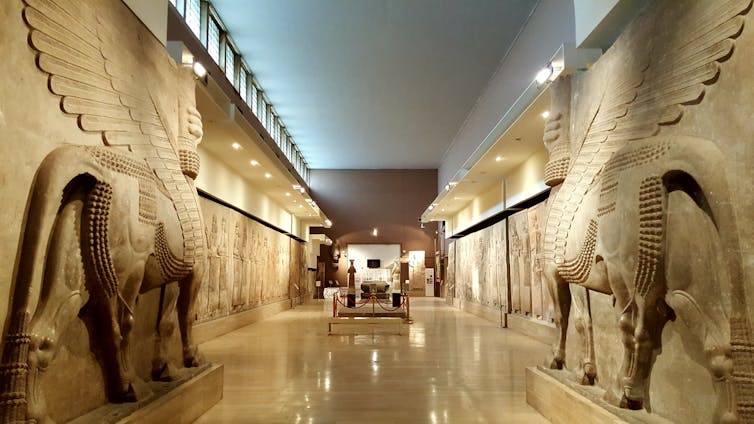 National Museum of Iraq in 2018.
MohammadHuzam/Wikimedia commons
National Museum of Iraq in 2018.
MohammadHuzam/Wikimedia commons
The industry is estimated by Neil Brodie of the University of Oxford to have a turnover of US$10 million a day. Today’s antiquities black market is using social media platforms and messenger apps to reach buyers in a way that would have been inconceivable to looters in 2003. There has been a surge in antiquities originating in Syria available online since the outbreak of the civil war.
In order to halt looting, it is essential that private collectors and institutions only purchase antiquities with a legal provenance to dry up the demand.
Ironically, centuries after many of the remains of these ancient cultural entities were looted by European colonial forces in order to fill grand national museums, we are seeing a 21st century version of cultural colonialism. Private collectors are enabling an entire economy of illegal activities.
The loss of these sites and artefacts is disastrous for humanity. The Baghdad looting has shown that in times of conflict, not even a museum can necessarily provide a sanctuary, without meaningful policies of protection. Sadly, it appears we have not learnt the lessons of April 2003.
Authors: Craig Barker, Education Manager, Sydney University Museums, University of Sydney



















