

Lidia Thorpe wants to shift course on Indigenous recognition. Here's why we must respect the Uluru Statement
- Written by: Dani Larkin, Associate Lecturer in Law, University of Newcastle
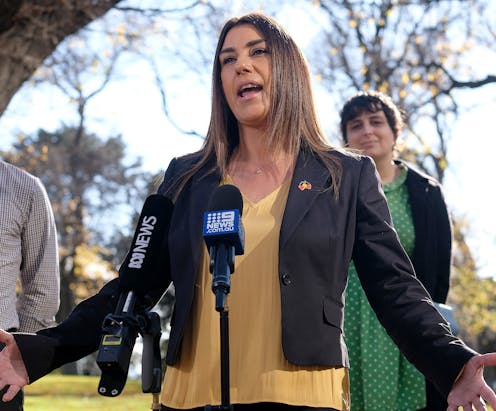
Gunnai-Kurnai and Gunditjmara woman Lidia Thorpe was recently elected by Greens party members to replace the former party leader, Richard Di Natale, as senator for Victoria.
Thorpe is the first Indigenous woman to represent the Greens in federal parliament. She brings a welcome diversity of experiences and perspectives. There is understandable interest in her views on Indigenous issues.
Since entering the Senate, Thorpe has renewed her public engagement with the reform proposals of the Uluru Statement from the Heart. The statement calls for the constitutional entrenchment and protection of
a First Nations Voice to Parliament to advise government on laws and policies that impact on Indigenous affairs
a Makarrata Commission to supervise processes of treaty-making and truth-telling.
Most First Nations representatives championing the Uluru Statement are focusing first on the co-design of the Voice to Parliament proposal with government. They see the Makarrata Commission and its goals as the next step in the sequence.
The Greens have endorsed the Uluru Statement, but Thorpe has a different take on what she believes should be priorities for Indigenous leaders. She argues a treaty should come first – not the Voice to Parliament.
However, a Voice to Parliament as a first step is a practical way forward, enabling First Nations to guide treaty-making processes. A change like this would be significant.
The path to Uluru
The Uluru Statement was the outcome of an extensive consultation process. It emerged from 13 regional dialogues and the subsequent First Nations National Constitutional Convention of 2017. This process was key to reaching a First Nations consensus embedded with elder and community authority.
Throughout that process, First Nations people affirmed the immediate need for practical and meaningful changes to Australia’s governance structure. The most immediate proposed change was for a representative First Nations political voice.
The Voice to Parliament would give First Nations people a say on the laws and policies that affect their affairs. This is essential given the history in Australia of forgetting, marginalising or silencing First Nations perspectives, which continues today.
The Uluru proposal would also entrench the Voice in the constitution to protect against the possibility of being extinguished. This was the fate of the Aboriginal and Torres Strait Islander Commission (ATSIC) – the only previous Indigenous representative agency with substantial program and policy responsibilities.
A majority of the 250 First Nations leaders at the convention agreed to the Uluru Statement. But that does not mean all Indigenous people agree with its proposals.
Thorpe was among a small group of delegates who walked out of the convention in protest. Other Indigenous people have also challenged the Voice proposal, preferring a treaty process.
Why follow the Uluru sequence of reform?
Yet, preserving the sequence proposed in the Uluru Statement respects the cultural authority of the reform process.
And diverging from a consensus outcome undermines the integrity of the consultative process that led to it. It can also devalue the standing of those elders who together designed the proposed reforms.
Read more: The Voice to Parliament isn't a new idea - Indigenous activists called for it nearly a century ago
Following the Uluru sequence ensures the word “self” remains key to the concept of self-determination for Indigenous peoples.
To put this in global perspective, all people around the world are recognised by the UN as having the right to self-determination:
By virtue of that right they freely determine their political status and freely pursue their economic, social and cultural development.
Since 2009, Australia has affirmed its support for the UN Declaration on the Rights of Indigenous Peoples. This declaration does not create new human rights, but puts universal rights in the context of Indigenous peoples’ lives and aspirations.
Article 4, for instance, states
Indigenous peoples, in exercising their right to self-determination, have the right to autonomy or self-government in matters relating to their internal and local affairs, as well as ways and means for financing their autonomous functions.
And Article 5 says
Indigenous peoples have the right to maintain and strengthen their distinct political, legal, economic, social and cultural institutions, while retaining their right to participate fully, if they so choose, in the political, economic, social and cultural life of the State.
In the Australian context, First Nations people are not seeking to exercise self-determination by forming an independent nation state. They are, however, calling for respect for their never-ceded sovereignty.
This is a challenge for the Australian legal and political system, and for Australian society. It does not square neatly with the idea of a single political unit. It unsettles the assumption that a majoritarian democracy (in which a majority of voters decide the outcome of elections) can ensure equitable representation of citizens.
This takes us back to the idea of a Voice. The Voice to Parliament provides a platform for First Nations people to work in partnership with parliament. The Voice will challenge parliament to confront the hurdles preventing Indigenous people from exercising self-determination and other human rights.
One such hurdle – the over-policing and disproportionate incarceration of Indigenous people – is at the centre of the current protest movement.
Does the Voice limit further reform potential?
We acknowledge Thorpe’s position that constitutional reform is a distraction from the main aim of achieving a reckoning through treaty.
We agree, as lawyers, that only treaty-making can fundamentally shift the foundations of a legal system built on dispossession and denial of First Nations sovereignty.
Where we diverge from Thorpe is in our view that the Voice to Parliament can be a pragmatic first step in the deeper reform process Australia needs.
A political voice and standing – if constitutionally entrenched – can bring many more First Nations voices into the political arena and progress the unsettling of the Australian legal system.
Authors: Dani Larkin, Associate Lecturer in Law, University of Newcastle


















