

Which species will win and lose in a warmer climate? It depends where they evolved
- Written by: Luciano Beheregaray, Professor in Biodiversity Genomics, Flinders University
As the global climate shifts, it’s important to know which species have adaptations to survive. Our research published today in PNAS found it largely depends on where they evolved.
We looked at the capacity of life to respond to future climates in three different regions: temperate and subtropical regions, and in deserts. We did this by studying rainbowfishes from Australia.
Read more: How animals are coping with the global 'weirding' of the Earth's seasons
The “winners” – those best at adapting to projected summer temperatures – evolved in the warm, subtropical regions. Those that evolved in cooler temperate ecosystems – the “losers” – risk becoming extinct.
This research is the first of its kind. It helps identify the types of biodiversity and ecosystems most vulnerable to climate change.
When migration is not an option
As local temperatures rise, some animals and plants might migrate from their native homes to colonise more favourable climatic regions elsewhere.
However, human activities, such as agriculture and urbanisation, are destroying and fragmenting habitats around the world. And this makes it impossible for many species to migrate away to safety.
This is where evolution comes in. Evolution creates adaptations over time that make organisms resilient to environmental changes. Species with higher “adaptive resilience” are more likely to keep up with changes in climate and survive.
Read more: How Australia's animals and plants are changing to keep up with the climate
The problem is, we don’t know which types of organisms might have evolved resilience, and which might be more vulnerable to projected climate change.
We know even less about how patterns of resilience vary across different climatic regions. This is what our research explored.
Using rainbowfish to study climate change adaptation
We studied three similar species of rainbowfishes from different climatic regions of Australia: the subtropics, the desert and the temperate region.
Rainbowfish are diverse, small and beautiful freshwater fishes that can be kept in captivity. Rainbowfish do not migrate, so we can compare populations that evolved in different climatic regions.
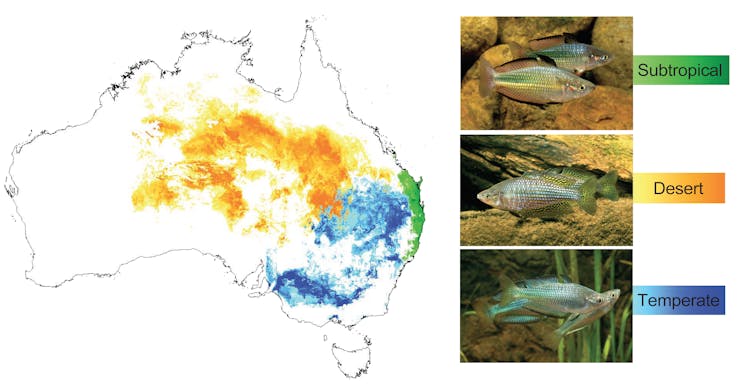 The ecological range of our study species of rainbowfishes (genus Melanotaenia). Photos by Gunther Schmida.
We used wild rainbowfishes separated in two groups. One group was kept at a contemporary average summer temperature (21℃). In the other, the temperature was slowly increased until it reached a summer temperature projected for 2070 under a high emission scenario (33℃).
After 14 days in these conditions, we humanely killed the fishes and removed their livers. This organ plays a central role in the body’s metabolism, including during heat stress. We used the liver samples to test how gene expression (which genes are activated within a cell) changed because of our experiments.
Read more: Explainer: what is a gene?
The results were striking. Although the three species activated thousands of identical genes in a contemporary climate, they used very different sets of genes to respond to a future climate.
They also showed different levels of response in a future climate. Subtropical rainbowfish built a much larger response (with 109 genes activated) than the desert (84 genes) and the temperate rainbowfish (27 genes).
Strong association between genetic responses and heat tolerance
Alongside, we did another experiment to measure how much heat each species could tolerate (their “upper thermal tolerance limit”).
Here, rainbowfishes were exposed to increasing temperature until they showed loss of balance. As expected, the subtropical rainbowfish showed the highest tolerance, with their upper limit at 38℃. Desert rainbowfish could tolerate up to 37℃, while the temperate rainbowfish could tolerate up to 35℃.
With both experiments, we discovered a strong association between number of genes responding to projected temperatures and heat tolerance. In other words, “winners” can regulate the expression of a larger number of genes in future climates than “losers” can.
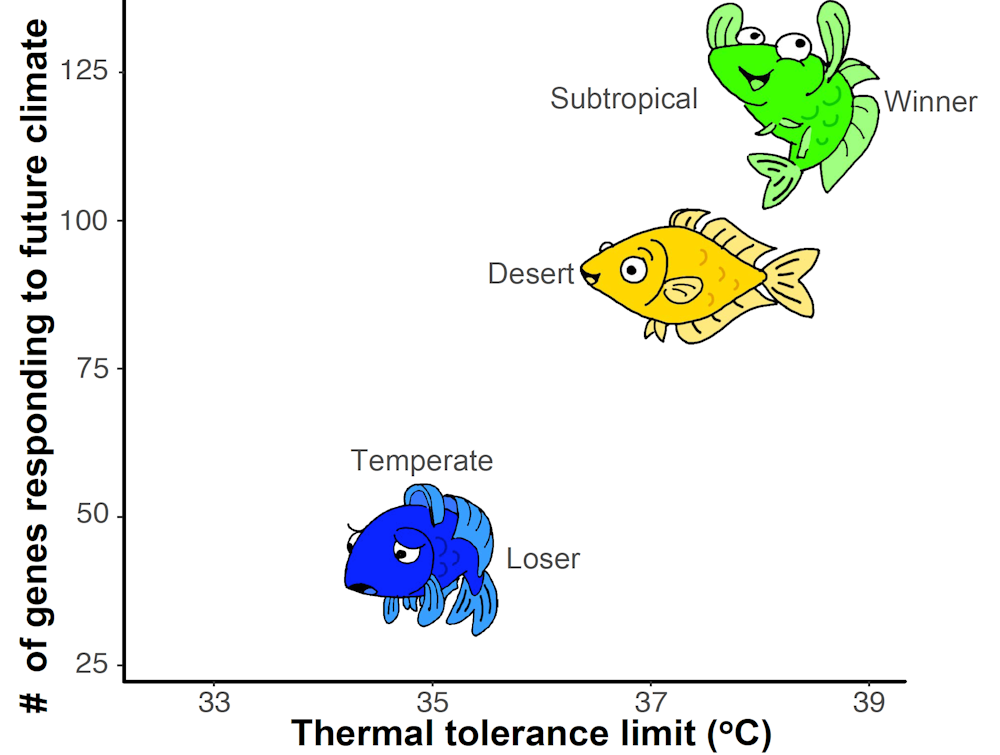 The capacity to respond to projected climates in rainbowfishes.
Author provided
The capacity to respond to projected climates in rainbowfishes.
Author provided
The signal of evolution on heat stress genes
It is difficult to determine whether a gene is responding just because of the environment, or because of a genetic constraint that came about from evolution.
Another fascinating discovery of our study is that evolution left a strong signal on many heat stress genes. These genes are known to play a central role in dealing with heat stress and allowing survival in a variety of vertebrates. This attests to their importance in providing long-term resilience to future climates.
Read more: Biodiversity and climate change: size matters, and it depends on the region
What this means for other species
Our findings indicate that resilience or vulnerability to rising temperatures is expected to be influenced by geographic factors, such as the climatic region where species evolved.
Subtropical species showed greater capacity to adapt to future climates, with temperate species being the most vulnerable. Desert species, which are predicted to be exposed to more extreme heatwaves and longer droughts in the future, are also vulnerable.
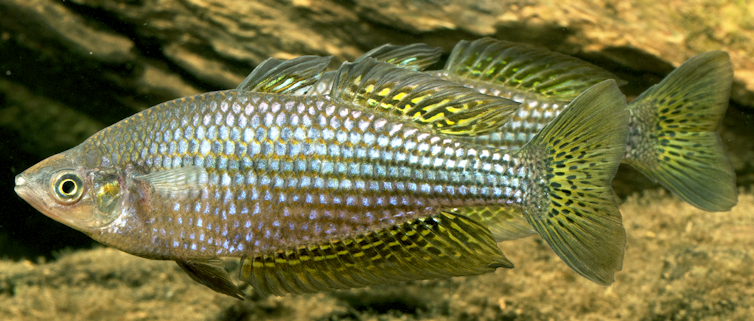 Habitat of the desert rainbowfish is predicted to shrink due to climate change. Photo by Gunther Schmida.
This information will help identify the types of biodiversity and ecosystems at high risk of extinction and to develop ways to help them to adapt and survive. This includes restoring lost habitat and actively moving populations to more favourable climatic locations.
The implications of our study can be extended to many non-migratory animals and plants – aquatic and terrestrial – under pressure due to climate change.
Read more: The world endured 2 extra heatwave days per decade since 1950 – but the worst is yet to come
Authors: Luciano Beheregaray, Professor in Biodiversity Genomics, Flinders University


















