

Hidden Hand – Exposing How the Chinese Communist Party is Reshaping the World
- Written by Andrew Podger, Honorary Professor of Public Policy, Australian National University
In Hidden Hand, China scholars Clive Hamilton and Marieke Ohlberg examine the Chinese Communist Party’s influence in Europe and North America in a similar way to how Hamilton dissected the CCP’s influence in Australia in his 2018 book, Silent Invasion.
In my review of the 2018 book, I wrote
Perhaps Hamilton’s book is a useful reminder that we must not be naïve about our relationship with China. But his prescription, premised on China being our enemy and determined to achieve world domination, is precisely the wrong direction for addressing the genuine issues he raises.
The new book warrants a similar conclusion, though President Xi Jinping’s continued strengthening of CCP controls and pursuit of hegemony in our region add to the importance of not being naïve.
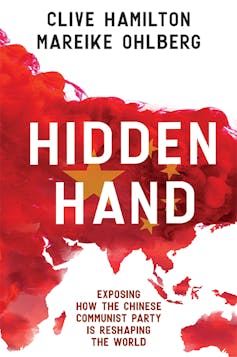 Hamilton and Ohlberg chronicle the various ways the CCP has attempted to wield influence in North America and Europe, from political and business elites to the Chinese diaspora, media, think tanks and academia, as well as through espionage and diplomacy.
Central to the book’s thesis is the diagram on pages 124-5 summarising most of the channels of influence from Chinese institutions (particularly party institutions) to various groups and organisations in Western nations. This is a one-direction diagram and assumes a totally coordinated strategy.
The book’s presentation is extremely detailed, including not just the names of Chinese institutions but the individuals said to be directing the strategies of influence. Similarly on the receiving end, the authors describe not only the groups and organisations in the West they claim are being influenced, but many of the individuals involved.
This level of detail is highlighted by the book’s 113 pages of footnotes and a 24-page index.
Read more:
Politics with Michelle Grattan: Clive Hamilton and Richard McGregor on Australia-China relations
Despite this, the book is not a balanced, scholarly document. The narrative centres on a single-minded Communist Party that has always sought a Leninist world and is now taking advantage of its increased economic power to advance that objective more effectively.
There is little recognition of the huge shifts in Chinese economic, social and strategic policies over the past 50 years, or of the scale of the changes to its institutional arrangements and the role of government.
The authors also do not allow those in the West who they claim have been successfully (and naively) influenced the opportunity to respond, let alone to present evidence of their influence in the other direction.
Containment vs. ‘engage and constrain’
Hidden Hand is right to remind people that:
China and the CCP are not one and the same
China has a party-state system of government that is authoritarian and not democratic
China does not have Western-style rule of law
it does not recognise universal human rights in the way we understand them.
What is missing is a balanced discussion of the central debate about the appropriate approach to be taken in the West’s relations with China.
As Peter Varghese, the former head of DFAT, recently put it, the choice for Australia is between trying to “contain” China or “engage and constrain”.
Containment, he argues, is gaining traction in the US and among cheerleaders in Australia, but risks dismantling the global economic system and the supply chains that support it. For Australia, Varghese says, decoupling from our largest trading partner would be “sheer folly” irrespective of legitimate complaints about China’s behaviour.
The “engage and constrain” approach he favours involves expanding areas of cooperation where mutual interests are served, while holding firm to our values and strengthening our capacity to resist Chinese coercion through increased investment in defence and diplomacy.
This would show Beijing that “leverage is a two-way street” and that, with others, we are willing to “push back” if China pursues its interests in ways that do not respect our sovereignty.
While increasing investment in defence may well be justified, boosting our spending in diplomacy is even more important.
Read more:
Why do we keep turning a blind eye to Chinese political interference?
In this light, viewing China as our “enemy” is counterproductive and ignores the mutual benefits and increased sharing of interests that have resulted from China’s opening up since 1978. (Hidden Hand does not repeat the explicit description of China as our enemy found in Hamilton’s earlier book, but it comes close, saying for the past 30 years China has viewed both sides of the Atlantic as its enemies).
Diplomacy may influence China’s perceptions of its national interests and, where significant differences remain, help to forge important alliances elsewhere.
Hamilton and Ohlberg seem to favour the “containment” strategy, warning on page 96 that “in fact, today it (the party-state) is more powerful than ever because of market forces” (emphasis in original).
Engagement can still have a positive effect
The implication, presumably, is that we should no longer contribute to China’s economic growth. This dismisses the remarkable benefits involved in China’s growth, including not only massive reductions in poverty, but also, for most Chinese, freedoms that were unimaginable in the Mao Zedong era. There have also been flow-on benefits for the rest of the world.
China’s opening up has of course not led to Western-style democracy, and is unlikely to do so in the foreseeable future. Indeed, under Xi, the CCP’s position has been consolidated and many of the reforms of the 1990s and 2000s have been wound back. Human rights have been seriously curbed, most recently in Hong Kong.
But Hidden Hand’s presentation of a single, continuous CCP Leninist agenda ignores the existence of different views among the leadership and elsewhere in China, including those who favour further liberal reform (as described in Richard McGregor’s 2019 book, Xi Jinping: The Backlash).
And it fails to appreciate the underlying contradictions of China’s “socialist market economy” and Xi’s “China Dream”, which offer avenues for Western leaders and academics to influence debates in China through engagement – as has happened over the past 30 years.
As the main coordinator of the Greater China Australia Dialogue on Public Administration, which organises annual workshops of scholars and practitioners from across the PRC (including Hong Kong and Macau) and Taiwan, I have witnessed some of the winding back of academic freedoms since Xi’s 2016 restrictions on social science teaching and research. This includes some of the specific CCP restrictions mentioned in Hidden Hand.
Read more:
The world has a hard time trusting China. But does it really care?
But this surely makes it even more important to continue the engagement while resisting the pressures involved.
Similarly, I am not at all convinced by the book’s attacks on any cooperation with the Belt and Road Initiative.
While the Asian Infrastructure Investment Bank has more sound governance, there are similar arguments for participation in BRI, providing support from the inside for transparency, proper cost-benefit analysis of projects and good understanding of debt obligations. It would also limit opportunities for China to pursue improper methods of influence.
How the West should respond to Chinese influence
The book’s afterword provides a slightly more moderate position on what should be done to counter Chinese influence moving forward. It still overplays its hand in promoting an “active pushback strategy” and its recommendation the Western
elites who acquiesce to or actively support Beijing deserve public scrutiny and robust criticism.
But the other recommendations have merit: defending democratic institutions through greater transparency and foreign interference laws, addressing the underfunding of universities and financial challenges facing our media, reducing vulnerability of our industries to CCP pressure and promoting more alliances, including with developing countries.
We cannot lose faith in liberal economics as Hamilton and Ohlberg seem to suggest, relying only on democratic forces to ensure freedom. The truth is, we need both.
Hamilton and Ohlberg chronicle the various ways the CCP has attempted to wield influence in North America and Europe, from political and business elites to the Chinese diaspora, media, think tanks and academia, as well as through espionage and diplomacy.
Central to the book’s thesis is the diagram on pages 124-5 summarising most of the channels of influence from Chinese institutions (particularly party institutions) to various groups and organisations in Western nations. This is a one-direction diagram and assumes a totally coordinated strategy.
The book’s presentation is extremely detailed, including not just the names of Chinese institutions but the individuals said to be directing the strategies of influence. Similarly on the receiving end, the authors describe not only the groups and organisations in the West they claim are being influenced, but many of the individuals involved.
This level of detail is highlighted by the book’s 113 pages of footnotes and a 24-page index.
Read more:
Politics with Michelle Grattan: Clive Hamilton and Richard McGregor on Australia-China relations
Despite this, the book is not a balanced, scholarly document. The narrative centres on a single-minded Communist Party that has always sought a Leninist world and is now taking advantage of its increased economic power to advance that objective more effectively.
There is little recognition of the huge shifts in Chinese economic, social and strategic policies over the past 50 years, or of the scale of the changes to its institutional arrangements and the role of government.
The authors also do not allow those in the West who they claim have been successfully (and naively) influenced the opportunity to respond, let alone to present evidence of their influence in the other direction.
Containment vs. ‘engage and constrain’
Hidden Hand is right to remind people that:
China and the CCP are not one and the same
China has a party-state system of government that is authoritarian and not democratic
China does not have Western-style rule of law
it does not recognise universal human rights in the way we understand them.
What is missing is a balanced discussion of the central debate about the appropriate approach to be taken in the West’s relations with China.
As Peter Varghese, the former head of DFAT, recently put it, the choice for Australia is between trying to “contain” China or “engage and constrain”.
Containment, he argues, is gaining traction in the US and among cheerleaders in Australia, but risks dismantling the global economic system and the supply chains that support it. For Australia, Varghese says, decoupling from our largest trading partner would be “sheer folly” irrespective of legitimate complaints about China’s behaviour.
The “engage and constrain” approach he favours involves expanding areas of cooperation where mutual interests are served, while holding firm to our values and strengthening our capacity to resist Chinese coercion through increased investment in defence and diplomacy.
This would show Beijing that “leverage is a two-way street” and that, with others, we are willing to “push back” if China pursues its interests in ways that do not respect our sovereignty.
While increasing investment in defence may well be justified, boosting our spending in diplomacy is even more important.
Read more:
Why do we keep turning a blind eye to Chinese political interference?
In this light, viewing China as our “enemy” is counterproductive and ignores the mutual benefits and increased sharing of interests that have resulted from China’s opening up since 1978. (Hidden Hand does not repeat the explicit description of China as our enemy found in Hamilton’s earlier book, but it comes close, saying for the past 30 years China has viewed both sides of the Atlantic as its enemies).
Diplomacy may influence China’s perceptions of its national interests and, where significant differences remain, help to forge important alliances elsewhere.
Hamilton and Ohlberg seem to favour the “containment” strategy, warning on page 96 that “in fact, today it (the party-state) is more powerful than ever because of market forces” (emphasis in original).
Engagement can still have a positive effect
The implication, presumably, is that we should no longer contribute to China’s economic growth. This dismisses the remarkable benefits involved in China’s growth, including not only massive reductions in poverty, but also, for most Chinese, freedoms that were unimaginable in the Mao Zedong era. There have also been flow-on benefits for the rest of the world.
China’s opening up has of course not led to Western-style democracy, and is unlikely to do so in the foreseeable future. Indeed, under Xi, the CCP’s position has been consolidated and many of the reforms of the 1990s and 2000s have been wound back. Human rights have been seriously curbed, most recently in Hong Kong.
But Hidden Hand’s presentation of a single, continuous CCP Leninist agenda ignores the existence of different views among the leadership and elsewhere in China, including those who favour further liberal reform (as described in Richard McGregor’s 2019 book, Xi Jinping: The Backlash).
And it fails to appreciate the underlying contradictions of China’s “socialist market economy” and Xi’s “China Dream”, which offer avenues for Western leaders and academics to influence debates in China through engagement – as has happened over the past 30 years.
As the main coordinator of the Greater China Australia Dialogue on Public Administration, which organises annual workshops of scholars and practitioners from across the PRC (including Hong Kong and Macau) and Taiwan, I have witnessed some of the winding back of academic freedoms since Xi’s 2016 restrictions on social science teaching and research. This includes some of the specific CCP restrictions mentioned in Hidden Hand.
Read more:
The world has a hard time trusting China. But does it really care?
But this surely makes it even more important to continue the engagement while resisting the pressures involved.
Similarly, I am not at all convinced by the book’s attacks on any cooperation with the Belt and Road Initiative.
While the Asian Infrastructure Investment Bank has more sound governance, there are similar arguments for participation in BRI, providing support from the inside for transparency, proper cost-benefit analysis of projects and good understanding of debt obligations. It would also limit opportunities for China to pursue improper methods of influence.
How the West should respond to Chinese influence
The book’s afterword provides a slightly more moderate position on what should be done to counter Chinese influence moving forward. It still overplays its hand in promoting an “active pushback strategy” and its recommendation the Western
elites who acquiesce to or actively support Beijing deserve public scrutiny and robust criticism.
But the other recommendations have merit: defending democratic institutions through greater transparency and foreign interference laws, addressing the underfunding of universities and financial challenges facing our media, reducing vulnerability of our industries to CCP pressure and promoting more alliances, including with developing countries.
We cannot lose faith in liberal economics as Hamilton and Ohlberg seem to suggest, relying only on democratic forces to ensure freedom. The truth is, we need both.
Authors: Andrew Podger, Honorary Professor of Public Policy, Australian National University

















