

Fire-ravaged Kangaroo Island is teeming with feral cats. It's bad news for this little marsupial
- Written by: Rosemary Hohnen, Adjunct associate, Charles Darwin University
When I visited Kangaroo Island for the first time after the summer bushfires, I thought I knew what to expect. But what really hit me was the scale.
The wild western end of the island, once a vast mallee woodland peppered with wildflowers and mobs of roaming roos, had been completely erased. An immense dune field covered with sharp blackened sticks now stretched beyond the horizon, to the sea, hollow and quiet.
While fire is a fundamental process in many Australian ecosystems, the size and severity of this fire was extreme, and the impacts on the island’s wildlife has been immense.
Read more: Summer bushfires: how are the plant and animal survivors 6 months on? We mapped their recovery
For the many threatened species on Kangaroo Island, such as the critically endangered Kangaroo Island dunnart, their fight for survival still isn’t over. High numbers of feral cats roaming the landscape now pose a huge threat to their persistence, with little vegetation left within the fire scar to provide cover for wildlife.
In fact, our recent research found there are, on average, almost double the number of cats per square kilometre on Kangaroo Island than on the mainland.
 The recent bushfires burnt through 211,255 hectares on Kangaroo Island.
AAP Image/David Mariuz
The recent bushfires burnt through 211,255 hectares on Kangaroo Island.
AAP Image/David Mariuz
The scale of the fires
Kangaroo Island is uniquely positioned, home to wildlife native to both eastern and western Australia. It protects nationally threatened species, such as the glossy black-cockatoo, the pygmy copperhead, Rosenberg’s goanna and the Kangaroo Island dunnart.
The recent bushfires on Kangaroo Island were the largest ever recorded there, destroying swathes of habitat. Over a period of 49 days the fire burnt 211,255 hectares, impacting almost half of the island, particularly the western and central regions.
For the critically endangered Kangaroo Island dunnart, the fires burnt approximately 95% of the species’ known habitat and left them on the brink of extinction.
Dunnarts face extinction
The Kangaroo Island dunnart is a small carnivorous marsupial weighing about 20 grams, with soft sooty fur and dark eyes. The species eats mainly insects, and shelters in hollow logs and in the skirts of grass trees.
Even prior to the fire the species was considered likely to become extinct in the next 20 years. Despite extensive survey efforts, the dunnart had only been seen at 19 sites on Kangaroo Island between 1990 and 2019.
Our own survey work between 2017 and 2018 confirmed the persistence of the dunnart at just six sites in the national park, with Kangaroo Island Land for Wildlife detecting several additional records on private land. All sites were in the western half of the island where the recent fires burned.
Many dunnarts are likely to have died in the fire itself, but individuals that survived are left extremely vulnerable to starvation and feral cat predation.
Cats roaming the island in big numbers
Between two and six million feral cats are estimated to live in Australia, and collectively kill more than three billion animals per year.
Read more: Don't let them out: 15 ways to keep your indoor cat happy
The problem is so large, a parliamentary inquiry is, for the first time in 30 years, investigating the impact of feral and domestic cats to native wildlife.
What’s more, in some areas on Kangaroo Island where the availability of animal carcasses is high, the density of feral cats is more than ten times as high as mainland estimates.
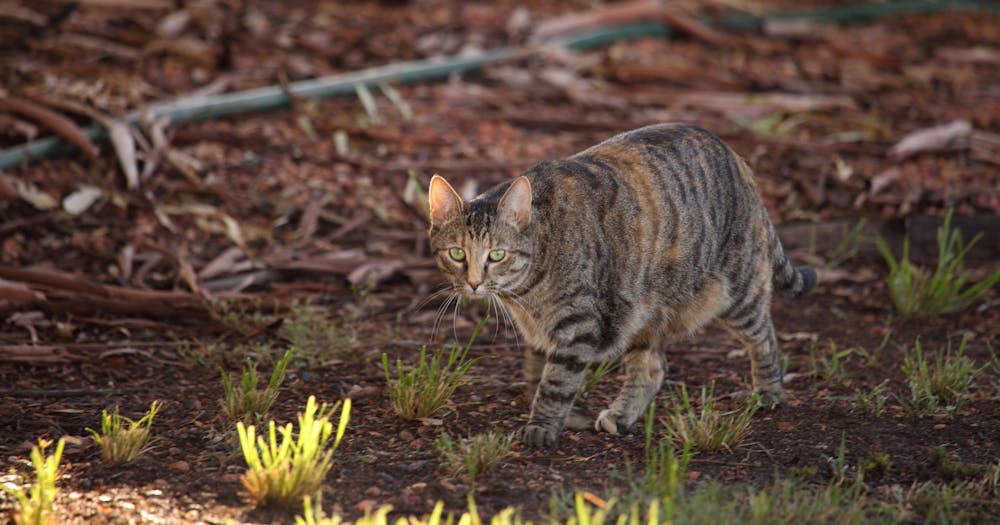 There are twice as many cats per square kilometre on Kangaroo Island than on mainland Australia.
Shutterstock
There are twice as many cats per square kilometre on Kangaroo Island than on mainland Australia.
Shutterstock
A high cat density poses a formidable threat to wildlife survival during the post-fire period, because cats will sometimes travel large distances to hunt within recent fire scars. Research is underway on the island to examine exactly how the fires have changed cat densities and hunting behaviour in and around burnt areas.
How to control feral cats
Controlling feral cats is one of the biggest challenges in Australian conservation. Cats are cryptic and cautious, hard to find, see, trap and remove.
Despite the challenge, a large-scale feral cat eradication is underway on Kangaroo Island. This is the largest island on which cat eradication has ever been attempted, and the project will take years.
Read more: One cat, one year, 110 native animals: lock up your pet, it's a killing machine
In the meantime, feral cats are being controlled around the last refuges for Kangaroo Island dunnarts. There are multiple methods for this including shooting and cage trapping, but in remote areas that are hard to access, poison-baiting is likely to be an effective, long-term strategy.
Most feral cat baits are meat-based, but our research shows possums and bush rats are still likely to consume them.
Therefore, researchers have worked for many years on strategies to minimise the potential impacts of feral cat baits on native wildlife. For example, the poison can be delivered within a hard plastic pellet, inside the meat bait.
Field trials have indicated that while cats swallow portions of this bait whole, ingesting the pellet, most native wildlife will chew around and discard the pellet.
Hope emerges after huge survey effort
Despite the gravity of the risk to Kangaroo Island wildlife, there is hope. A huge, dedicated and effective survey effort by both government and non-government organisations has resulted in the detection of Kangaroo Island dunnarts at more than 22 sites.
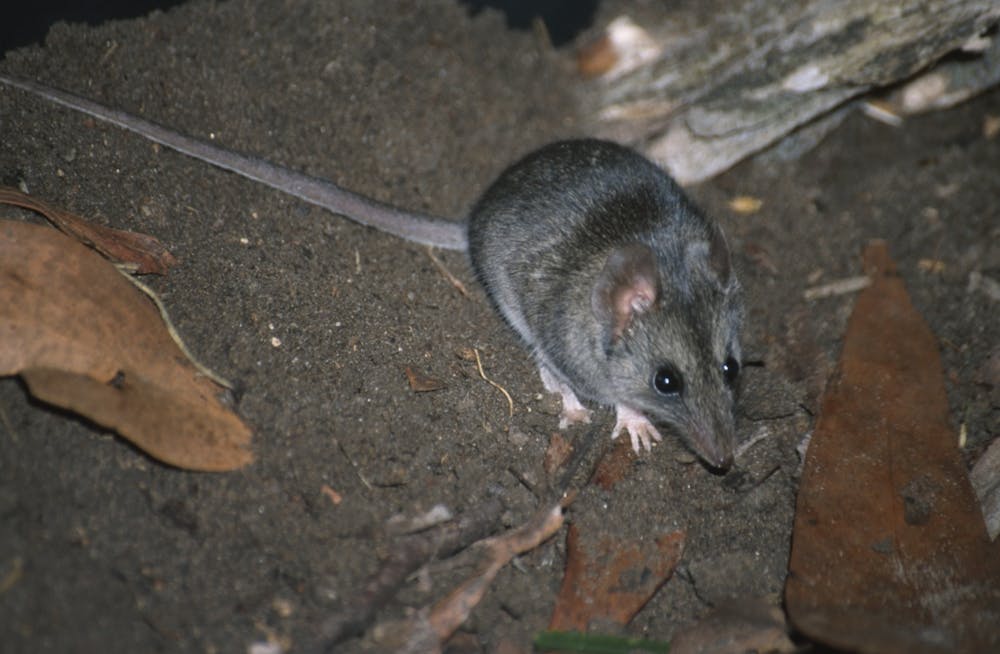 Kangaroo Island dunnarts have been spotted in devastated parts of the landscape.
Jody Gates, Author provided
Kangaroo Island dunnarts have been spotted in devastated parts of the landscape.
Jody Gates, Author provided
These small populations have been found mostly within patches of unburnt vegetation, but also – almost unbelievably – in areas that have been completely burnt.
Read more: 'Jewel of nature': scientists fight to save a glittering green bee after the summer fires
Many of these populations appear to be very small and isolated. And now, more than ever, they’re extremely vulnerable. Targeted cat control and/or protection of vulnerable populations with exclusion fencing may be the only way to prevent their extinction.
By controlling cats, we can help native species like the Kangaroo Island dunnart get through this difficult time, and continue to fulfil their place in that wild landscape for years to come.
The authors would like to acknowledge and thank Paul Jennings, Pat Hodgens, Heidi Groffen, James Smith and Trish Mooney, for their generous contributions to this article.
Authors: Rosemary Hohnen, Adjunct associate, Charles Darwin University


















