

What Spike Lee's Da 5 Bloods gets wrong about veterans returning to Vietnam
- Written by: Mia Martin Hobbs, Researcher, University of Melbourne
Spike Lee’s Da 5 Bloods, out now on Netflix, tells the story of five Black US veterans who return to Vietnam to hunt for gold and recover the remains of their lost squad leader.
Beginning with the reunion of five old “Bloods”, and peppered with flashbacks to their combat days, the film quickly turns into an action-packed recovery mission.
Lee touches on important themes from veterans’ return journeys: reuniting with former girlfriends, reliving “Rest & Relaxation” in Vietnamese bars, engaging in NGO work to atone for the war and the role of war films in reimagining Vietnam as a tourist adventure.
But Lee depicts the Vietnamese as a hostile monolith, frozen in time with resentment toward American soldiers. In reducing the Vietnamese to angry victims, Lee fails to capture the reality of veterans’ return journeys.
Open arms
Since 1981, thousands of US veterans have returned to Vietnam.
In my doctoral research with returning US and Australian veterans, I found from the very first return trip these veterans were warmly welcomed back by the Vietnamese.
Over the decades, returnees’ stories of being welcomed back rippled through the US veteran community, inspiring others to embark on their own journeys to “meet the enemy”.
Read more: The battle over Long Tan's memory – a perspective from Viet Nam
Lee gestures towards this theme of reconciliation with a friendly toast from former enemy veterans in the nightclub Apocalypse Now. But the moment is overshadowed by the broader theme of Vietnamese retribution, with repeated instances of Vietnamese beggars, vendors and gangsters yelling war-related grievances at the US veteran-tourists.
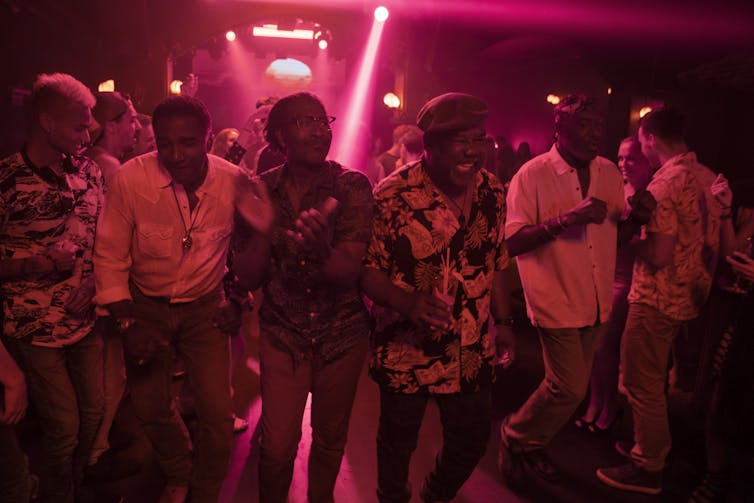 At the nightclub Apocalypse Now, the veterans toast to the Vietnamese.
Netflix
At the nightclub Apocalypse Now, the veterans toast to the Vietnamese.
Netflix
While Americans dwell on the national trauma of Vietnam, the American War — as it is called in Vietnam — was only one of many fought for Vietnamese independence in the 20th century. And with a median age of 31, most of Vietnam’s population were born well after this war ended.
The Vietnamese tend to view returning veterans as remorseful (and useful) allies. Many early returning veterans were radical anti-war activists, searching for answers and wanting to make amends.
The Vietnamese government has consistently emphasised friendship with returning veterans, American tourists and the United States for economic and geopolitical reasons.
Veterans told me both official representatives and ordinary Vietnamese welcomed them back, explaining “war is over” and “Vietnam is a country, not a war”.
Ongoing traumas
Early anti-war returnees reported experiencing Vietnam at peace was profoundly healing. By the 1990s, veterans were returning on “healing journeys” aimed at relieving PTSD symptoms through redemption and reconciliation, often with months of therapeutic preparation in advance.
But even the most well-prepared veterans told me their first moments back “in country” were fraught with anxiety. Over time, veterans gradually relaxed as they came to terms with a peaceful Vietnam and realised they were no longer under threat. Yet Lee shows the Bloods immediately at ease in Ho Chi Minh City, with no indications of latent stress.
Read more: From shell shock to PTSD: proof of war's traumatic history
Where Lee does address veteran trauma, he makes angry Vietnamese the trigger: a resentful adolescent beggar throws firecrackers at the Bloods and mocks them when they duck for cover; a vendor attempts to force a live chicken on one of the Bloods before screaming “you killed my mother and father”, setting off a panic attack.
In my interviews, veterans described how seemingly minor experiences could spark a flashback: a backfiring truck, a glimpse of familiar landscape, the monsoon rains, the humid air as they left the aeroplane. Lee could have instead shown children playing with firecrackers or a vendor offering war-memorabilia to passersby — each utterly unaware of their effect on visiting veteran-tourists.
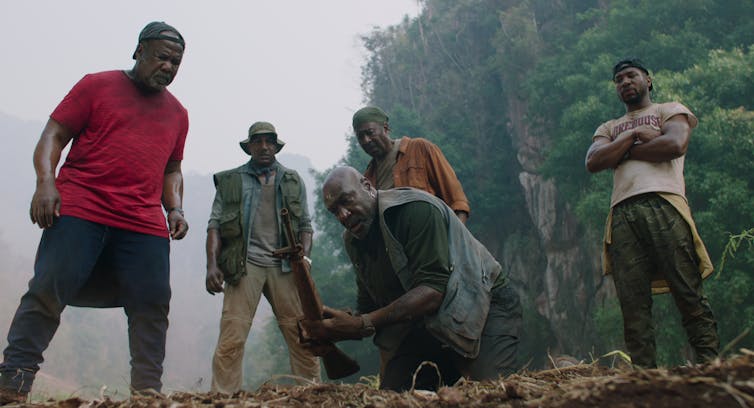 The return to Vietnam is often anxious and fraught.
Netflix
The return to Vietnam is often anxious and fraught.
Netflix
Lee’s reductive treatment of the Vietnamese limits his portrayal of war legacies.
The Bloods’ two-day mission to recover their missing leader is remarkably short, considering the decades-long struggle to recover bodies of former soldiers on all sides.
The film also makes no mention of the more than 300,000 revolutionary Vietnamese soldiers still missing, let alone the unknown thousands of missing South Vietnamese, who the Vietnamese government do not count among their dead.
Da 5 Bloods never acknowledges the sheer magnitude of Vietnamese loss and grief.
Black resistance
The movie is at its best in its exploration of anti-Black racism and Black resistance in American war and society.
Through the Bloods’ debate on reparations, Lee draws together civil rights activism of the Vietnam-era with today’s #BlackLivesMatter movement.
But by positioning Black veterans and Vietnamese in opposition, Lee overlooks the potential for solidarity between the two.
One Black US veteran I interviewed reflected on the shared experience of being oppressed by, and fighting against, American white supremacy.
Upon return to Vietnam, he met with former enemy veterans in Hanoi:
I told them that when I went home and I talked to my father I said ‘Daddy, if I was a Vietnamese, I’d be a VC [Viet Cong]’. When I said that, the VC, they got the biggest smiles on their faces. … It’s a blessing. All these years I’ve been wanting to get back, and I’ve come back, and look at this. Look at the way they’re treating me.
Authors: Mia Martin Hobbs, Researcher, University of Melbourne


















