

Ultraviolet radiation is a strong disinfectant. It may be what our schools, hospitals and airports need
- Written by: Lotti Tajouri, Associate Professor, Biomedical Sciences, Bond University
You may remember when US President Donald Trump suggested exposing coronavirus patients to UV (ultraviolet) light – or “just very powerful light” – to help treat them.
The use of UV light is not, in any way, a viable treatment for people infected with SARS-CoV-2. However, due to its powerful sterilisation abilities, this technology does have great potential for managing the COVID-19 pandemic in other ways.
What is UV light?
The visible light we see every day belongs in a unique region of the whole electromagnetic spectrum. The full spectrum is composed of radio waves, microwaves, infrared, visible light, ultraviolet, X-rays and gamma rays – all emitting and carrying energy.
Of these, ultraviolet (UV), X-ray and gamma rays are high-frequency waves. These can have serious consequences for our health.
The Sun emits three types of UV radiation: UVA, UVB and UVC. Prolonged UV exposure is associated with skin cancer. Thankfully, our planet’s atmosphere shields us from the majority of the Sun’s UVB emissions and all UVC emissions.
Affordable and accessible
UVC has the ability to kill germs and is an alternative to chemical disinfection. UVC can be used to sterilise objects, water, surfaces and materials – whether it’s to clean your phone, a hospital floor, or an entire bus in China.
Read more: Mobile phones are covered in germs. Disinfecting them daily could help stop diseases spreading
The technology needed to generate UVC is not new and there is no reason to suggest this technology could not be implemented cost-effectively. Several companies have developed an array of lamps, machines and even robots capable of sterilising a range of surfaces.
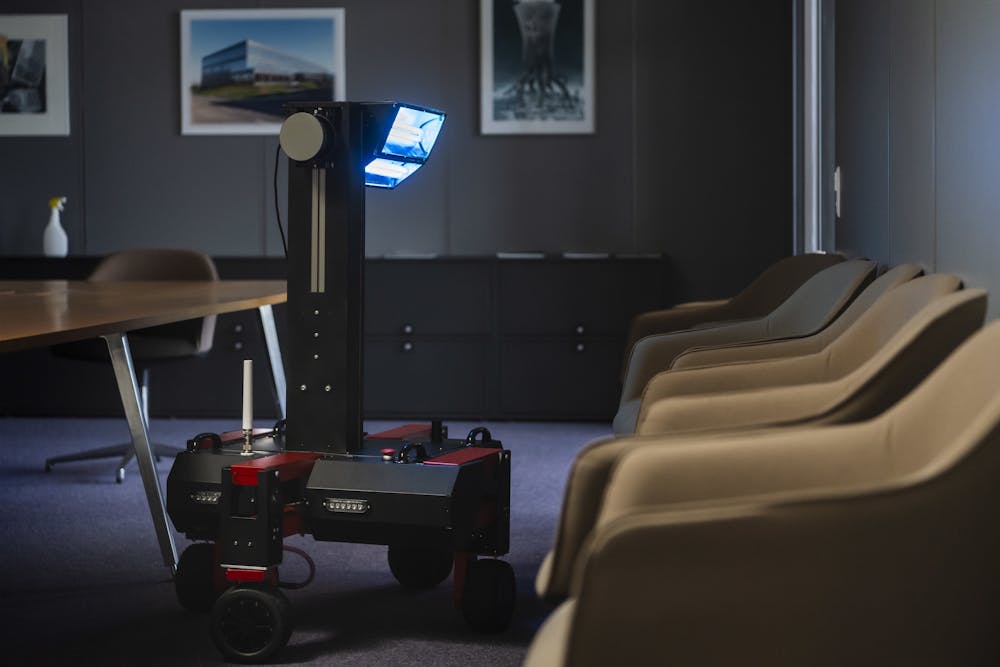 UVC-emitting robots can be deployed inside buildings overnight to help disinfect surfaces.
Jean-Christophe Bott/EPA
UVC-emitting robots can be deployed inside buildings overnight to help disinfect surfaces.
Jean-Christophe Bott/EPA
Isn’t is dangerous?
It’s well established UV radiation is carcinogenic (causes cancer) for humans.
Devices that emit UVC should be calibrated to ensure optimal microbial killing power and are more effective when placed close to the surface or object being treated. When turned off, UVC emission is halted, too.
As per the World Health Organisation’s advice, direct UVC exposure should not be used to disinfect any areas of the skin. Studies are under way to identify particular UVCs that are safe for human cells and still worthwhile as germicides.
Far-UVC (wavelengths between 207-222 nanometres) is promising as it can’t cross physiological barriers, such as the dead outer layer of our skin, or the eye’s outer (tear film) layer.
Nonetheless, UVC still poses risks to our health since our skin and eyes can have cuts and micro-lesions. This would expose susceptible cells in our body to the damaging radiation.
Can it kill COVID-19?
Our knowledge of what constitutes “suitable” UVC emission is growing. This includes knowledge of the proper germicidal UVC wavelength that can be applied to surfaces, the amount of light that reaches the surface, and the exposure time needed to completely sterilise the viral particles.
Research from 2002 confirmed UVC inactivated SARS (severe acute respiratory syndrome) after six minutes of exposure.
A more recent study (while not peer-reviewed) has shown UVC-based disinfection is helpful for stopping the SARS-CoV-2 virus from replicating. However, this depended on how much of the virus was present and how much UVC exposure it received.
The study centred on the efficiency of UVC to inactivate and inhibit the virus at low, medium and high concentrations. It found the highest viral concentrations required quite high UVC dosage.
Another study looking at a different type of coronavirus (SARS-CoV-1) provided further evidence of the utility of UVC disinfection. The authors of this work suggest UV technology may be the solution to filling gaps in the supply of personal protective equipment such as masks.
Read more: What is a virus? How do they spread? How do they make us sick?
Overcoming major hurdles
Apart from being carcinogenic, another limitation on using UVC is its poor penetration. It only allows surface-level sterilisation of microbes (such as viruses, bacteria and fungi) by impacting their genetic material.
That said, as the pandemic continues, the deployment of UVC sanitising technology across sectors could greatly contribute to our awareness of the risks presented by microbial pathogens.
The safe implementation of UVC-based measures could undoubtedly enhance public health and even biosecurity. Beyond the novel coronavirus, this arsenal has great potential to prevent costly impacts of future pandemics, too.
But, while enthusiasm is high, there are obvious risks of direct exposure to humans, with consequences ranging from serious burns to cancer. These will need to be carefully managed.
Authors: Lotti Tajouri, Associate Professor, Biomedical Sciences, Bond University


















