

How New Zealand could keep eliminating coronavirus at its border for months to come, even as the global pandemic worsens
- Written by: Michael Plank, Professor in Mathematics, University of Canterbury
Stringent border controls and mandatory quarantine give New Zealand a good chance to remain free of COVID-19 for months to come, according to our latest modelling.
It’s been 76 days since New Zealand’s last reported case of community transmission, and our model shows the risk of an infectious person slipping through the border undetected remains very low. Provided the rules are followed, we would expect this to happen only once over the next 18 months — and even then, this person may not infect anyone else.
New Zealand’s borders remain closed to everyone except residents, citizens and a small number of foreigners with special exemptions.
Currently about 400 people fly into New Zealand each day. Since June 16, 46 people have tested positive for COVID-19 and of those, 27 remain active cases (at the time of writing). All of them are in quarantine facilities.
Each week, about 12 people have arrived carrying the virus. Provided people are well separated at quarantine facilities and have regular symptom checks, our modelling suggests the risk of an infectious person being released into the community is around 0.1% — which means for every 1000 infected people who arrive at the border, one person will be released from quarantine while still infectious.
Read more: Lockdown, relax, repeat: how cities across the globe are going back to coronavirus restrictions
Keeping COVID-19 out
New Zealand has had a total of 1,548 cases of COVID-19 and 22 people have died.
 PM Jacinda Ardern.
Daniel Hicks/AP
PM Jacinda Ardern.
Daniel Hicks/AP
Prime Minister Jacinda Ardern yesterday announced plans for local or regional lockdowns should the virus reemerge in the community. She referred to the Australian state of Victoria, where the current outbreak appears to be linked to cases at a managed isolation facility, as a cautionary tale for New Zealand.
COVID-19 is exploding outside our borders and every country that we have sought to either replicate or draw experiences from in the fight against COVID-19 has now experienced further community outbreaks. We need only look to the experience of Victoria, Hong Kong, Singapore or Korea to see examples of other places that, like us, had the virus under control at a point in time only to see it emerge again.
Since New Zealand closed its borders on March 19, the rate of COVID-19 infections globally has increased 50-fold, to more than 13 million confirmed cases worldwide.
All new arrivals to New Zealand have to spend 14 days in quarantine at government-managed hotels. Each person has to have a COVID-19 swab test on the third and 12th day of their quarantine period and cannot leave without a negative test result.
A shorter quarantine period would significantly increase the risk of an infectious person being released. The swab tests for COVID-19 have quite high rates of false negative results, so even with multiple tests, a shorter quarantine period could miss too many cases.
Allowing mingling of people within quarantine, or contact between staff and recent arrivals, is also very risky. And our model doesn’t take into account people deliberately absconding from quarantine, which has happened four times. It is incumbent on everyone to do the right thing and follow the rules.
Managing international travel
How many arrivals could New Zealand cope with? Pre-COVID-19, there were around 20,000 international arrivals on a typical day — 50 times the current number of arrivals. There’s obviously no way we could quarantine this number of people. On current trends, this would mean up to 600 infected people passing through at the border per week.
Reopening borders to return to business as usual is just not an option for the foreseeable future. Any plans to ease border restrictions need to be based on a careful risk assessment. For example, countries such as Taiwan, Vietnam and the Pacific Islands have very low levels of COVID-19. A travel bubble with countries that have eliminated community transmission would present a low risk.
Other groups such as international students or migrant workers who contribute to key parts of our economy should be considered. Anyone coming from countries where COVID-19 is widespread would need to be quarantined on arrival, but quarantine facilities are already stretched to the limit with returning New Zealanders. Implementing any plan to allow other groups into New Zealand safely will take time.
New Zealand is in a rare position of having eliminated community transmission of COVID-19. This means we currently enjoy more freedoms than people in most other countries.
But this elimination status poses its own challenges in returning to life as usual when the rest of the world is in an accelerating pandemic. Other countries that have followed a mitigation strategy are facing equally big social and economic challenges of their own. And this is on top of the devastating health impacts that New Zealand has so far managed to largely avoid.
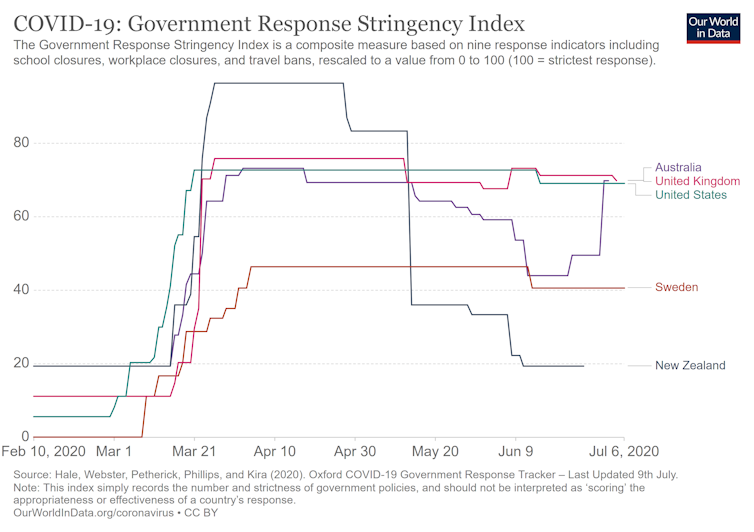 Oxford COVID-19 Government Response Tracker
Freedom within closed borders
The dilemma New Zealand now faces is whether to continue to enjoy Level 1 freedoms within closed borders or to open borders with more restrictions on what we can do. We could, for instance, allow quarantine-free travel from certain countries. But this might require us to implement Level 2 restrictions (including limits on the size of gatherings) to reduce the risk of superspreading events.
Read more:
A few superspreaders transmit the majority of coronavirus cases
These are difficult choices, but they are choices and not foregone conclusions. We disagree with the recent claim by former chief science advisor Sir Peter Gluckman, former prime minister Helen Clark and ex-Air New Zealand chief executive Rob Fyfe that new cases of community transmission are “logically inevitable” and New Zealand should therefore reopen borders more quickly.
The recent surge in cases in Melbourne – where 5 million people are now in a six-week lockdown – shows that managing a community outbreak is almost impossible without resorting to strict lockdowns. They have also shown that the most socio-economically disadvantaged people often bear the brunt of lockdown measures, as well as suffering disproportionately from the health impacts of the virus.
These events should serve to remind us just how lucky we are in New Zealand. Let’s not let our guard down now.
Oxford COVID-19 Government Response Tracker
Freedom within closed borders
The dilemma New Zealand now faces is whether to continue to enjoy Level 1 freedoms within closed borders or to open borders with more restrictions on what we can do. We could, for instance, allow quarantine-free travel from certain countries. But this might require us to implement Level 2 restrictions (including limits on the size of gatherings) to reduce the risk of superspreading events.
Read more:
A few superspreaders transmit the majority of coronavirus cases
These are difficult choices, but they are choices and not foregone conclusions. We disagree with the recent claim by former chief science advisor Sir Peter Gluckman, former prime minister Helen Clark and ex-Air New Zealand chief executive Rob Fyfe that new cases of community transmission are “logically inevitable” and New Zealand should therefore reopen borders more quickly.
The recent surge in cases in Melbourne – where 5 million people are now in a six-week lockdown – shows that managing a community outbreak is almost impossible without resorting to strict lockdowns. They have also shown that the most socio-economically disadvantaged people often bear the brunt of lockdown measures, as well as suffering disproportionately from the health impacts of the virus.
These events should serve to remind us just how lucky we are in New Zealand. Let’s not let our guard down now.
Authors: Michael Plank, Professor in Mathematics, University of Canterbury


















