

A $200 fine for not wearing a mask is fair, as long as free masks go to those in need
- Written by: Francesco Paolucci, Professor of Health Economics, University of Bologna, University of Newcastle
As we reach the two-week mark since the reinstated restrictions for Melbourne, and are yet to see a decline in new daily cases, it is not surprising the Victorian government has now made face masks mandatory.
From midnight tonight, residents in metropolitan Melbourne and Mitchell Shire must wear a face covering whenever outside the home, or face a A$200 fine. The state government has also ordered 1.37 million reusable masks for public distribution, and says schools will be among the first to receive them.
With some people arguing the measures will unfairly penalise poorer Victorians, Health Minister Jenny Mikakos has pledged to provide more information about which groups will also be receiving free masks.
Will mandatory masks help stop the virus?
There are certainly many benefits to wearing masks or similar face coverings in reducing the spread of coronavirus, especially in closed or confined environments. With rising case numbers and a growing recognition that the coronavirus can be transmitted even without symptoms, numerous health advisory bodies – including the US Centers for Disease Control and Prevention and the World Health Organisation – now recommend masks for the general public.
When it comes to mandatory enforcement of mask wearing, the benefits have to be weighed against other questions, such as whether everyone will be able to obtain masks, and whether the fines unfairly discriminate against people with less money.
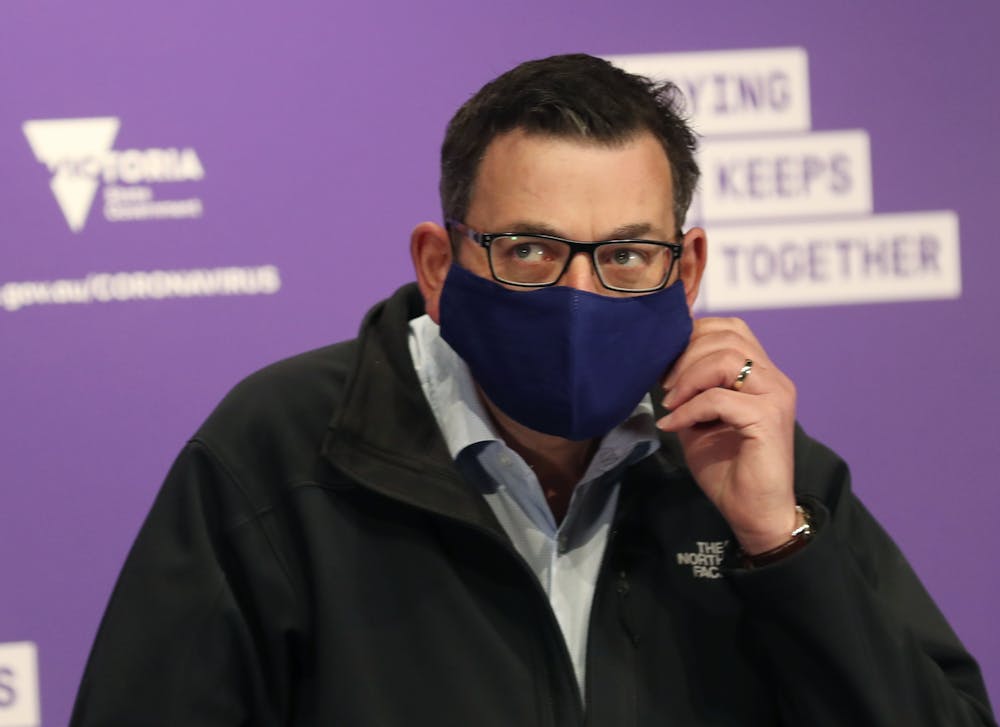 All in this together: but some have accused Victorian Premier Daniel Andrews of setting the fines too high.
David Crosling/AAP Image
All in this together: but some have accused Victorian Premier Daniel Andrews of setting the fines too high.
David Crosling/AAP Image
Given that even low rates of mask-wearing can deliver significant benefits, it would be tempting to conclude there is no need for mandatory enforcement. Not all members of the public are likely to embrace the use of face masks equally, so it might make sense simply to rely on those who are more willing.
However, the fact that face masks are cheap (or can be given out for free) and highly effective means the corresponding public health benefits are huge. According to one US estimate, each additional cloth mask worn by a member of the public would lower the death risk enough to save US$3,000-6,000 in reduced health costs.
Put simply, the more people wear masks, the faster we can potentially resume normal activity. It thus becomes easier to justify stringent measures to deliver universal mask-wearing. The low cost and high effectiveness of masks means even a harsh fine of A$200 becomes justifiable, given the crucial need to suppress COVID-19.
How much do masks cost?
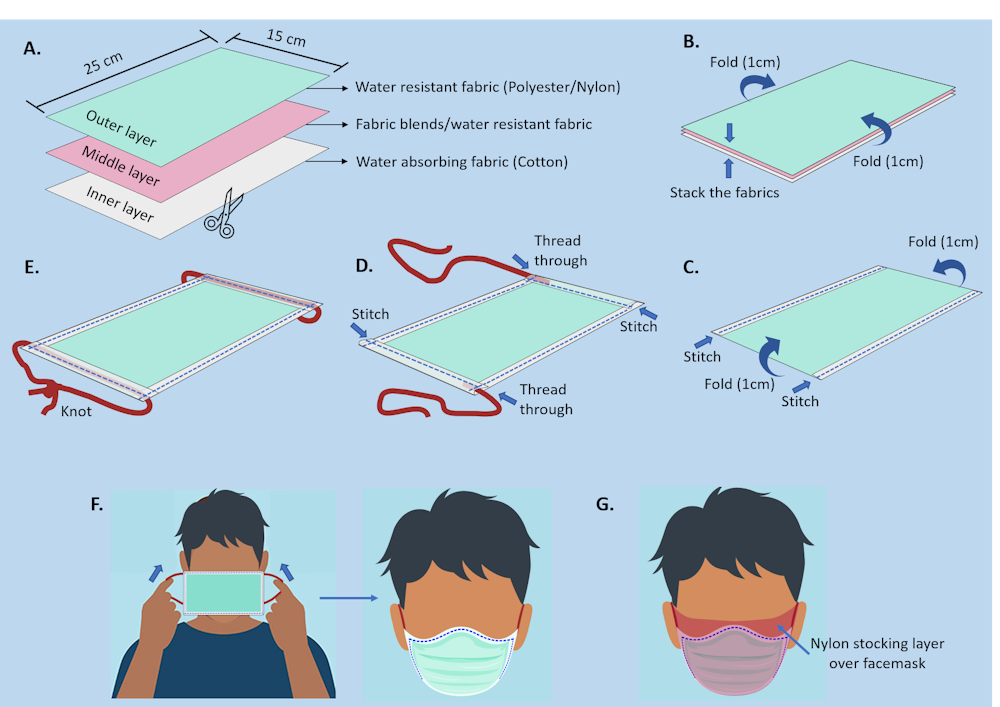
The Victorian government has mandated that any type of face-covering material is suitable, meaning residents could potentially minimise their expenses by making their own masks at home.
 Shovon Bhattacharjee/The Kirby Institute/UNSW
One sensible option would be to give free masks to people living in hotspots or who have less financial means – Melbourne’s public housing towers would tick both of these boxes. Free masks could also be given to people who are more likely to use public transport, or who work in jobs that necessitate close contact with the public.
For those buying their own, disposable masks retail for about A$1 each, meaning someone who works five days a week would need to spend about A$30 on masks during the six-week lockdown.
Another prudent move would be to prevent stockpiling or profiteering by capping the price (as South Korea did) or the number of masks that can be purchased at one time (as in Taiwan, which limited purchases to ten masks per person every two weeks) instead of relying on retailers to apply restrictions.
So why the outrage?
Some Australians have reacted with anger to the mask mandate, despite widespread community support for other, arguably more disruptive, measures such as social distancing, travel bans and quarantines.
As is clearly evident in the United States, it seems there is something unique about face masks that has many people up in arms. As one Australian Twitter user wrote:
Like a good citizen, I’ve stayed home. I’m more than willing to wear a mask publicly indoors but I take my kids for a walk/bike to the park once a day for “FRESH AIR” to relieve some anxiety and stress at government shambles, now he takes the air we breathe?
After weeks of social distancing and hand sanitising, are face masks simply the straw that broke the camel’s back for some people? One theory, called the strength model of self-regulation, suggests the more behavioural changes an individual is required to make (such as quitting smoking or refraining from touching their face) the less success they will have at each.
There are many possible explanations for mask refusal: physical discomfort, inconvenience, denial of the benefits, mixed messaging, lack of role modelling, fear of judgement or stigma, or a desire to rebel against authority. But there is little published research on why people might be more willing to accept one disease prevention tactic over another.
Read more:
Coronavirus spike: why getting people to follow restrictions is harder the second time around
Public health measures work best when they balance the needs of individuals with those of the public at large. Providing free masks to those who can’t afford them, and trying to understand the points of friction that might make some people less likely to wear them, will both increase the overall levels of mask-wearing.
Mandates and punishments, although justified by public health objectives, can only work for so long. In all likelihood, we will be living with COVID-19 until a vaccine is developed. This means we need sensible and pragmatic strategies to help everyone fight this and future pandemics together.
Shovon Bhattacharjee/The Kirby Institute/UNSW
One sensible option would be to give free masks to people living in hotspots or who have less financial means – Melbourne’s public housing towers would tick both of these boxes. Free masks could also be given to people who are more likely to use public transport, or who work in jobs that necessitate close contact with the public.
For those buying their own, disposable masks retail for about A$1 each, meaning someone who works five days a week would need to spend about A$30 on masks during the six-week lockdown.
Another prudent move would be to prevent stockpiling or profiteering by capping the price (as South Korea did) or the number of masks that can be purchased at one time (as in Taiwan, which limited purchases to ten masks per person every two weeks) instead of relying on retailers to apply restrictions.
So why the outrage?
Some Australians have reacted with anger to the mask mandate, despite widespread community support for other, arguably more disruptive, measures such as social distancing, travel bans and quarantines.
As is clearly evident in the United States, it seems there is something unique about face masks that has many people up in arms. As one Australian Twitter user wrote:
Like a good citizen, I’ve stayed home. I’m more than willing to wear a mask publicly indoors but I take my kids for a walk/bike to the park once a day for “FRESH AIR” to relieve some anxiety and stress at government shambles, now he takes the air we breathe?
After weeks of social distancing and hand sanitising, are face masks simply the straw that broke the camel’s back for some people? One theory, called the strength model of self-regulation, suggests the more behavioural changes an individual is required to make (such as quitting smoking or refraining from touching their face) the less success they will have at each.
There are many possible explanations for mask refusal: physical discomfort, inconvenience, denial of the benefits, mixed messaging, lack of role modelling, fear of judgement or stigma, or a desire to rebel against authority. But there is little published research on why people might be more willing to accept one disease prevention tactic over another.
Read more:
Coronavirus spike: why getting people to follow restrictions is harder the second time around
Public health measures work best when they balance the needs of individuals with those of the public at large. Providing free masks to those who can’t afford them, and trying to understand the points of friction that might make some people less likely to wear them, will both increase the overall levels of mask-wearing.
Mandates and punishments, although justified by public health objectives, can only work for so long. In all likelihood, we will be living with COVID-19 until a vaccine is developed. This means we need sensible and pragmatic strategies to help everyone fight this and future pandemics together.
Authors: Francesco Paolucci, Professor of Health Economics, University of Bologna, University of Newcastle


















