

13 insider tips on how to wear a mask without your glasses fogging up, getting short of breath or your ears hurting
- Written by Craig Lockwood, Associate Professor Implementation Science, University of Adelaide
After midnight tonight, wearing face masks will be mandatory for people in Melbourne and Mitchell Shire when they leave home. It’s also recommended in New South Wales when physical distancing isn’t possible.
This means many Australians will be wearing a face mask for the first time.
Yes, wearing a mask can be uncomfortable or frustrating, especially if you’re not used to it. People who wear glasses, those anxious about being able to breathe properly, or who wear masks for extended periods of time face particular challenges.
But health workers, who have long used face masks as part of their everyday work, have developed a number of useful workarounds we’d like to share.
Read more: Victorians, and anyone else at risk, should now be wearing face masks. Here's how to make one
How do I stop my glasses fogging up?
For people with glasses, wearing a mask can lead to their lenses fogging, reducing their vision. As you breathe out, your warm breath shoots upwards out the top of the mask. When it hits the colder lens, it cools down, forming condensation, or fogging.
Having to keep on taking off your glasses to wipe them clear, and putting them back on again, is an infection risk. So preventing or minimising fogging is the key. Here are some tips:
1. Soap and water — wash your glasses with soap and water (such as regular washing up liquid), then dry them with a microfibre cloth. This type of cloth typically comes free with each pair of glasses. You can also buy cheap microfibre cloths from most optometrists. Facial tissues may leave lint, which attracts moisture to the lenses. Soap reduces surface tension, preventing fog from sticking to the lenses.
A surgeon shows us how to keep our glasses fog-free while wearing a mask.2. Shaving foam — apply a thin layer of shaving cream to the inside of your glasses, then gently wipe it off. The residual shaving cream will protect the lenses from misting up.
3. De-misting spray — you can use a commercial de-misting spray that dries clear. But make sure this is compatible with your lens type or existing coatings on your lens. You can buy demisting spray online or from your optometrist.
4. Close the gap on surgical masks — mould the nose bridge at the top of your surgical mask to your face to reduce the gap that allows warm moist air up to the glasses.
5. Twist ties and pipe cleaners — if you make your own cloth mask, add a twist tie (for instance, from a loaf of bread) or pipe cleaner to the top seam of your homemade mask and mould that to your nose for the same effect.
6. Tape — some health professionals apply a strip of tape that’s specially designed for use on skin to the top edge of the mask to close the gap. You can buy a roll online or at the pharmacy.
7. Damp tissue — slightly moistening a tissue, folding it and placing it under the top edge of the mask also does the trick.
8. Nylon stocking — Victoria’s health department says you can also get a snug fit across the cheeks and bridge of the nose by wearing a layer of nylon stocking over a face mask.
Sadly, there is no magic trick, such as putting the mask or glasses on first that will stop fogging. Improving the fit around the curve of the nose and cheeks is the best approach.
I feel anxious about wearing a mask. What can I do?
Putting on a mask may make you feel anxious or you may find it hard to breathe normally, especially if you’re new to wearing a mask.
Fortunately, the World Health Organisation and others say there is no evidence a face mask will cause either a drop in blood oxygen or an increase in blood carbon dioxide levels for normal everyday activities.
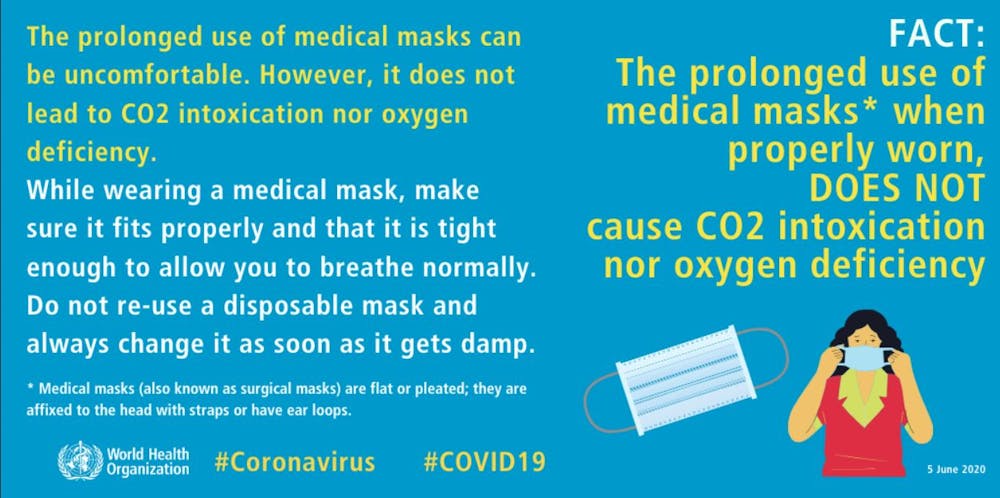 The World Health Organisation busts a common myth.
WHO
The World Health Organisation busts a common myth.
WHO
If you do feel anxious about wearing a mask, here are some tips:
9. Practise at home — take a few minutes before leaving the house to get used to the feel of wearing a mask. Slow your breathing, breathe gently, with a slower, longer inhale and exhale while focusing on the fact that air is getting to your lungs, and safely out again.
10. Try another mask — if you still feel breathing is difficult, try a different mask, use a commercially available design, or use different materials in your next home mask project.
Read more: Which face mask should I wear?
What can I do to stop my ears hurting?
Once you have been wearing a face mask for several hours, you may notice discomfort around the ears as the ear loops can chafe the skin. Here’s what you can do:
11. Wear a headband with buttons… — one solution is to wear a headband with two buttons sewn onto it. Sew the buttons so they sit behind the ears. Rather than looping the mask around your ears, loop it around the buttons instead. This takes the pressure off the skin, increases comfort and helps you keep the mask on longer.
12. …or a paper clip — unfold two paper clips and wrap them around a headband, again positioning them behind the ears. Leave enough paperclip exposed to hook your earloops over, then press down to clamp down the loops in place.
13. 3D printing — freely available 3D printer templates allow you to print your own ear shields.
It’s worth getting this right
It may take a few attempts to get used to wearing a mask. But with a bit of trial and error, your glasses should remain fog-free, your ears comfortable and any anxiety about wearing a mask should reduce.
Wearing a mask in public is another thing we can do to help keep ourselves and the community safe, alongside social distancing and hand hygiene.
Read more: 'Kissing can be dangerous': how old advice for TB seems strangely familiar today
Authors: Craig Lockwood, Associate Professor Implementation Science, University of Adelaide

















