

Cycling and walking can help drive Australia's recovery – but not with less than 2% of transport budgets
- Written by: Matthew Mclaughlin, PhD Candidate, School of Medicine and Public Health, University of Newcastle
What do bike paths and walk-friendly streets have to do with economic recovery from a pandemic-induced recession? How could removing a car parking space benefit a local business? Instead of considering such questions, building roads for cars is often seen as the obvious answer to “kick-start” the economy.
In this article, we explain how cycling and walking infrastructure is a better investment for recovery. Every kilometre walked or cycled has an economic benefit by reducing traffic congestion and vehicle operating costs, improving health and the environment, and saving on infrastructure spending. It’s estimated every dollar invested in cycling infrastructure may reap up to five dollars’ worth of benefits.
In Australia, however, walking and cycling only receive between 0.1% and 2% of transport budgets.
Read more: Cycling and walking are short-changed when it comes to transport funding in Australia
A sustained lack of investment is one reason only 5% of trips to work in Australia are by foot or bicycle. Yet the majority of city journeys are short enough to walk or cycle for most people.
With people now shunning public transport, our roads are becoming even more congested. In a win-win scenario, walk-friendly and bike-friendly design can improve driving conditions, because fewer vehicles clog the roads. So instead of just building roads, is now not the time also to invest in proper walking and cycling infrastructure?
Read more: Cars rule as coronavirus shakes up travel trends in our cities
Road building versus path building
Road building is typically depoliticised and so is widely seen as a legitimate way to stimulate economic growth. But simply building more roads may not reduce traffic or speed up journey times in the long term.
Road building leads to more traffic through induced car use and car dependence. If the default option for short journeys is driving, congestion ultimately gets worse as the population grows.
Australians make three-quarters of all trips to work by car. Most have no passengers.
Yet more than half of car journeys in cities are shorter than 5km. These trips would be well suited to walking and cycling. Safe and enticing walkable streets and cycling paths are key to inducing this swap.
Australia has already committed billions of dollars to road-building projects as well as community infrastructure to “grow out of the COVID-19 recession”. Ultimately, though, if we want less traffic, we need to invest more of this money in walkable streetscapes and safe separated bike paths.
This investment will increase walking and cycling, leading to the many benefits that flow from these behaviours. And enticing people out of their comfy cars for short journeys will result in fewer trips by car.
Read more: Do the sums: bicycle-friendly changes are good business
What transport budgets tell us
Comparing Australian budgets to other countries’ investment in active transport modes, we’re not doing well. Budgets would have to increase at least tenfold to achieve the United Nations recommendation that 20% of the transport budget be invested in “non-motorised transport”.
And many countries have moved rapidly to commit major investments to cycling and walking since COVID-19. For example, Ireland recently committed billions of euros to walking and cycling infrastructure, equivalent to 20% of its transport budget.
Considering our lack of investment, it’s easy to see why Australia is car-dependent. This is despite Australia having both great weather and wide roads to accommodate increased space for cycling and walking.
An equity issue
Many Australians, for reasons of disadvantage, disability or age, may not have access to a car. The typical cost of owning a car is A$300 per week. Increasing spending on walking and cycling infrastructure will therefore improve equity by helping low-income earners and others who need inexpensive mobility.
Poor active transport infrastructure disproportionately disadvantages women. They cycle less than men and report a need for the safety of separated cycleways among other infrastructure.
Read more: Own a bike you never ride? We need to learn how to fail better at active transport
Poor infrastructure also limits children, older adults and people living with a disability from accessing the services they need. Many older Australians depend on public transport and on the quality of the walking environment around their homes and their most common destinations.
On average, three people a day die on Australian roads. Fewer car trips would help reduce the road toll. Similarly, increased investments in separated spaces for cycling and walking, as well as lower speeds on local streets, will reduce collisions between cars and bikes, as well as pedestrian-motorist conflicts.
COVID-19 provides a unique opportunity
COVID-19 has led to a boom in bicycle sales, reduced speed limits, wider footpaths, pop-up bicycle lanes, increased walking and new cyclists. Some of this has come about following calls for “Space For Health”.
Read more: We can't let coronavirus kill our cities. Here's how we can save urban life
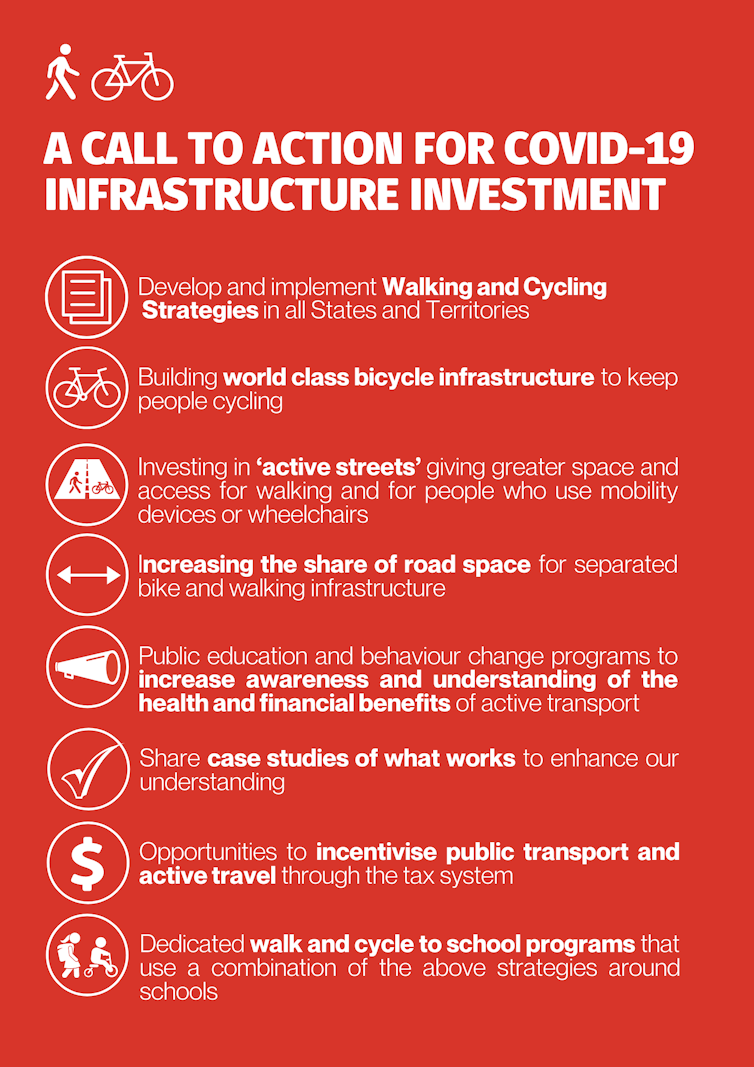
We should “grow out of the COVID-19 recession” by building back better through investment to sustain this increase in walking and cycling. Our call to action is therefore:
 Matthew Mclaughlin
While Australia’s cities have invested in walking and cycling during the COVID-19 pandemic, it’s less than some other countries have invested. For example, Paris has accelerated the installation of 650km of cycleways by removing 72% of its on-street parking. Scotland is proposing to “Walk Back Better” from COVID-19.
It is good to see investment in Australian cities increasing. But now is the time to help kick-start our COVID-19 recovery by investing more in walking and cycling, and to reap the many benefits for the Australian community.
Matthew Mclaughlin
While Australia’s cities have invested in walking and cycling during the COVID-19 pandemic, it’s less than some other countries have invested. For example, Paris has accelerated the installation of 650km of cycleways by removing 72% of its on-street parking. Scotland is proposing to “Walk Back Better” from COVID-19.
It is good to see investment in Australian cities increasing. But now is the time to help kick-start our COVID-19 recovery by investing more in walking and cycling, and to reap the many benefits for the Australian community.
Authors: Matthew Mclaughlin, PhD Candidate, School of Medicine and Public Health, University of Newcastle


















