

4 steps to avert a full-blown coronavirus disaster in Victoria's aged care homes
- Written by: Joseph Ibrahim, Professor, Health Law and Ageing Research Unit, Department of Forensic Medicine, Monash University
As of July 22, the total number of COVID-19 infections nationally was 12,896, with 128 deaths. This figure includes 43 aged-care residents.
In Victoria, at least 45 aged-care facilities have now reported outbreaks, with about 383 positive cases in the sector overall (including among staff).
St Basil’s Home for the Aged in Fawkner and Estia Health in Ardeer have the largest number of cases: 73 and 67 respectively.
Although these outbreaks don’t compare to what we’ve seen internationally, the rising case numbers within Victorian aged-care homes are of grave national concern.
We’ll need a concerted community effort to arrest this looming disaster.
Read more: Why are older people more at risk of coronavirus?
Aged care was in crisis even before COVID-19
The interim report of the Royal Commission into Aged Care Quality and Safety laid bare the system failures in the provision of aged care in Australia.
These deficits include workforce and skill shortages. A report on the sector’s performance between October and December 2019 found around 20% of facilities audited did not meet standards in “safe and effective personal and clinical care”, while 13% fell short on the measure of a “safe, clean and well-maintained service environment”.
This makes aged-care homes highly vulnerable to any external disaster.
Several other factors set the scene for infection transmission in aged care, including its design. Residential aged care is intended to provide a home-like physical environment. While this serves an important purpose, it means aged-care homes may be missing some clinical features needed for optimal infection control, such as prominent placement of multiple hand basins.
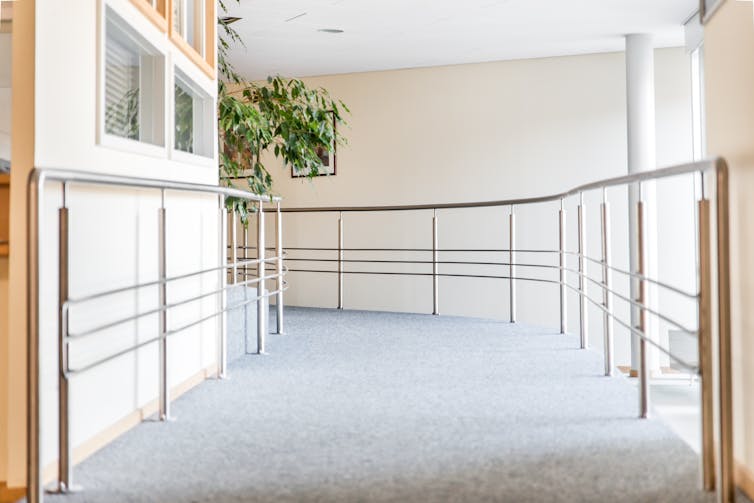 Aged-care homes are designed differently to clinical settings like hospitals.
Shutterstock
Aged-care homes are designed differently to clinical settings like hospitals.
Shutterstock
Communal spaces and a high volume of foot traffic (residents, staff, external contractors and visitors) also increase the risk of infection, while some residents have shared rooms and bathrooms.
And residents have a range of cognitive and physical disabilities that can make it difficult to adhere to the fundamental infection control measures of social distancing and handwashing.
COVID-19 and the elderly
We had early warning of the catastrophic effects of COVID-19 in aged-care homes in March and April from countries like Spain and Italy, which saw widespread outbreaks and deaths in nursing homes.
While roughly one-third of COVID-19 deaths in Australia so far have been aged-care residents, a review taking in 26 countries found this group has accounted for almost half of coronavirus deaths.
Severe illness and death from COVID-19 is more likely in older people because they tend to have lower immunity, less biological reserve and higher rates of chronic conditions such as type-2 diabetes, high blood pressure, heart failure and renal disease.
One study found the case-fatality rate — the proportion of people who get COVID-19 who will die — is 33.7% for aged-care residents.
Avoiding disaster
We need a coordinated, standardised, compassionate, supportive response to prevent premature deaths, and to minimise psychological harm to residents, families and staff.
Different aged-care homes will need different strategies to suit their varying circumstances. For example, facilities located in areas without community transmission, such as South Australia, will be different to those where there’s community spread, like in NSW and Victoria. And the needs of those homes with an active outbreak, such as St Basil’s or Estia Health, will be different again.
But broadly speaking, I believe these four key pillars are applicable to all aged-care homes.
1. Stop COVID-19 entering
In areas where there’s community transmission, all aged-care homes should be put into lockdown, with tight controls at entry and exit points. This should be done as humanely as possible, for example by creating teams to keep residents connected to family and community, and with exceptions for essential visitors.
Staff should be tested routinely and counselled about limiting contact with other people outside the workplace. Staff should also only work in one facility, and be allocated the same group of residents (to minimise the number of contacts in the event of a confirmed or suspected infection).
Finally, the development and provision of specific guidance, training and support around the use of personal protective equipment (PPE) is essential. Individual homes should be supported to engage experienced infection control nurses to train staff if possible on site.
 We’ve known since early in the pandemic that older people are more susceptible to COVID-19.
Shutterstock
We’ve known since early in the pandemic that older people are more susceptible to COVID-19.
Shutterstock
2. Be prepared in case it does
Every aged-care home in Australia should have a “risk and readiness” rating to determine the likelihood of a COVID-19 outbreak and the facility’s ability to prevent and manage an initial infection.
This would include factors such as the experience and size of the aged-care provider, location of the facility, the size and structure of the building, ventilation, access to open spaces, the residents’ profile, staff numbers and skills, and past performance in accreditation audits.
And each home should have designated vacant rooms to be ready for isolation of any suspected cases.
Finally, the government should establish a national rapid response and advisory team dedicated to the management of aged-care homes during COVID-19. This would strengthen existing public health response units and should include clinicians with expertise in aged care.
Read more: Our ailing aged care system shows you can't skimp on nursing care
3. Respond quickly and decisively when an outbreak occurs
Aged-care homes along with public health units should have protocols for coordination of their on-site response, with clear lines of accountability for action and escalation.
They should rapidly separate residents when an outbreak occurs, rather than relying on a continued usual model of care with the addition of PPE.
Aged-care homes require productive partnerships with hospitals to ensure residents can get the specialised care they need. Wherever possible, all confirmed cases should be sent to a clinical setting such as an acute or sub-acute hospital.
And importantly, all homes should have dedicated communication channels to keep family members informed.
4. Learn from past experience
The two major aged-care outbreaks in NSW, particularly the one in Newmarch House, attracted national attention. But we’re still awaiting a public statement from government about the lessons learned.
There are also ongoing inquiries into COVID-19 in aged care by a senate committee and the Royal Commission. But neither are due to report for some time.
The government should release interim reports into the investigations of recent outbreaks which might give us valuable information about reducing transmission.
Eliminating COVID-19 outbreaks from aged-care homes reduces community transmission, the need for hospital care and reduces premature death. This benefits the whole nation.
Read more: Why prisons in Victoria are locked up and locked down
Authors: Joseph Ibrahim, Professor, Health Law and Ageing Research Unit, Department of Forensic Medicine, Monash University


















