

Our lives matter – Melbourne public housing residents talk about why COVID-19 hits them hard
- Written by: Sandra Carrasco, Teaching Assistant and Research Fellow, Melbourne School of Design, University of Melbourne
The toughest lockdown imposed on residents of public housing in Australia has been lifted, but their COVID-19 ordeal isn’t over – and recovering from their traumatic experience will take time. Recent events have highlighted the inequalities that make residents of the locked-down Melbourne housing towers highly vulnerable in the COVID-19 emergency. Nearly 350 residents have been infected to date.
Read more: Melbourne tower lockdowns unfairly target already vulnerable public housing residents
This article draws on our interviews with residents and community and religious leaders after the buildings were locked down. The interviews followed a two-year study of the housing conditions of migrants from the Horn of Africa living in inner Melbourne estates.
These are places of social and economic disadvantage. The current crisis has laid bare the conditions that endanger this community. These include large extended families (up to nine people), low incomes, high unemployment, limited access to education, challenges of communicating in English and poor internet access.
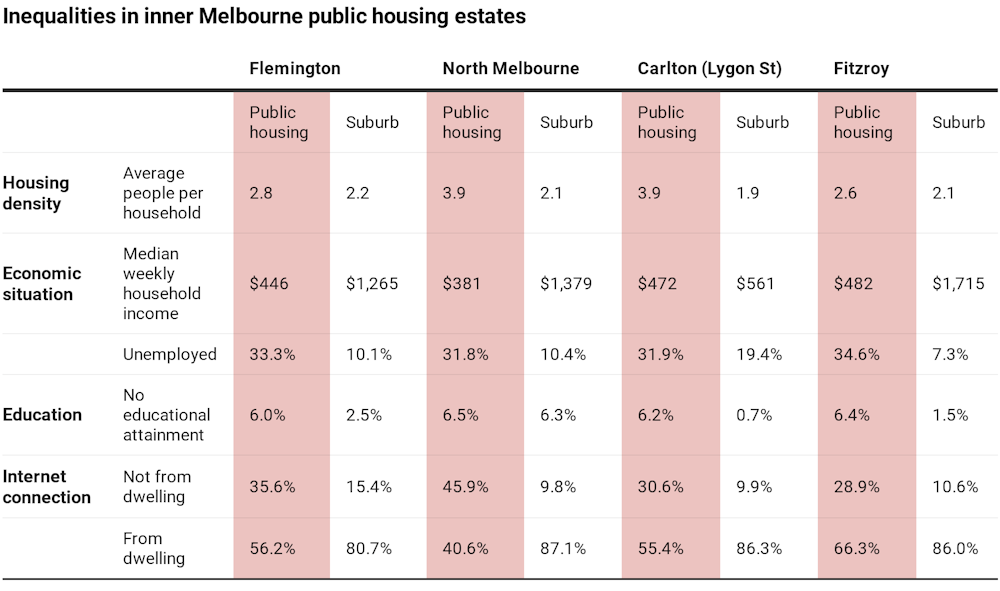 Click on table to enlarge.
Data: ABS 2016, Author provided
Click on table to enlarge.
Data: ABS 2016, Author provided
COVID-19 doesn’t discriminate, but its impacts do in ways felt far beyond the health sector. Studies of disasters and emergencies have shown events like these hit the poor hardest. Recent studies in the US confirm the COVID-19 pandemic is exposing existing inequalities and vulnerabilities of lower-income groups and ethnic minorities.
Voices from the towers
African residents of the Melbourne public housing estates raised their voices during the lockdown, despite their fears and sense of exclusion.
Residents locked down inside Melbourne’s public housing towers speak out.Anisa, a Somali-Australian resident of a North Melbourne tower, told us:
The enforced lockdown is a direct reflection of the systematic inequalities [people face] in public housing.
The lockdown brought back wartime memories of dispossession and the sense of persecution they still feel. Iman, a Somali resident of one of the affected towers, said:
This community is made up of many people who have fled war, who have complicated mental health issues, whose families have been racially profiled and targeted by police.
Anisa told us:
We need a health response, not a police response, at the end of the day.
Lack of communication between residents and authorities is the result of a pre-existing disconnection and lack of mutual trust.
Read more: Voices of residents missing in a time of crisis for public housing
This explains residents’ claims that initial government support was incompatible with their values. Awatif, a Sudanese resident of the Flemington towers, said:
Many people [here] are Muslims. They [the government] brought non-halal food, they do not understand what we eat.
The precarious living conditions of public housing have also been exposed. Issues such as poor ventilation already affected people’s health. Muhubo, a Somali resident of Carlton’s public housing estates, said:
I have asthma and I need to take fresh air because inside the houses sometimes it is stuffy. Ventilation inside is not good enough.
Overcrowding makes isolation of ill residents impossible, and there other, related challenges. As Muhubo said:
In many families only the mother lives with the children. If she gets sick it will be difficult for the children, especially if they are small.
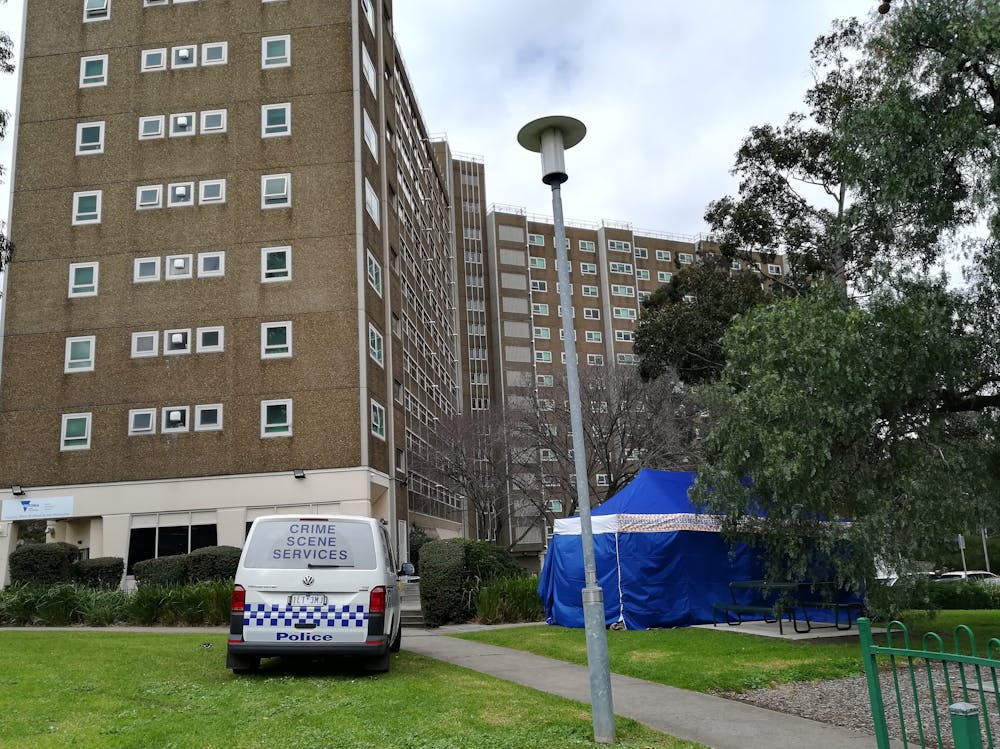 Police attend North Melbourne public housing under lockdown.
Sandra Carrasco, Author provided
Police attend North Melbourne public housing under lockdown.
Sandra Carrasco, Author provided
Adding to residents’ problems
The lockdown made existing problems worse. Tewelde Kidane, who chairs the Melbourne Eritrean United Community, spoke of family tensions increasing in confined spaces, which combined with lack of privacy results in increases in domestic violence. Sultan Abdiwali, the imam of the North Melbourne mosque at the heart of the Australian Muslim Social Services Agency (AMSSA), also referred to increased family violence and drug use, as did Awatif:
Some young people get sometimes drunk, scream at night, [and use] drugs.
However, the lockdown also showed the community’s capacity to support their fellows in need. “We have been receiving support and help from our local community even before this extreme lockdown,” the resident Iman said.
Asked how the African communities were supporting their members, the imam said:
[A] Somali community group collected donations and provided help to public housing residents. Other groups found it hard to manage such activities.
Most residents do not question the lockdown, but object to the lack of information. Anisa said:
I do know that if we, the residents, were treated with some decency and respect and received enough information on the lockdown, our concerns would be a lot more at ease than they are now.
Carlton estate residents volunteered to assist health professionals with door-to-door COVID-19 testing. The volunteers helped overcome language and cultural barriers. Muhubo explained:
People are scared about being ill so they are happy to get tested. People know that they need to get tested and they help with that.
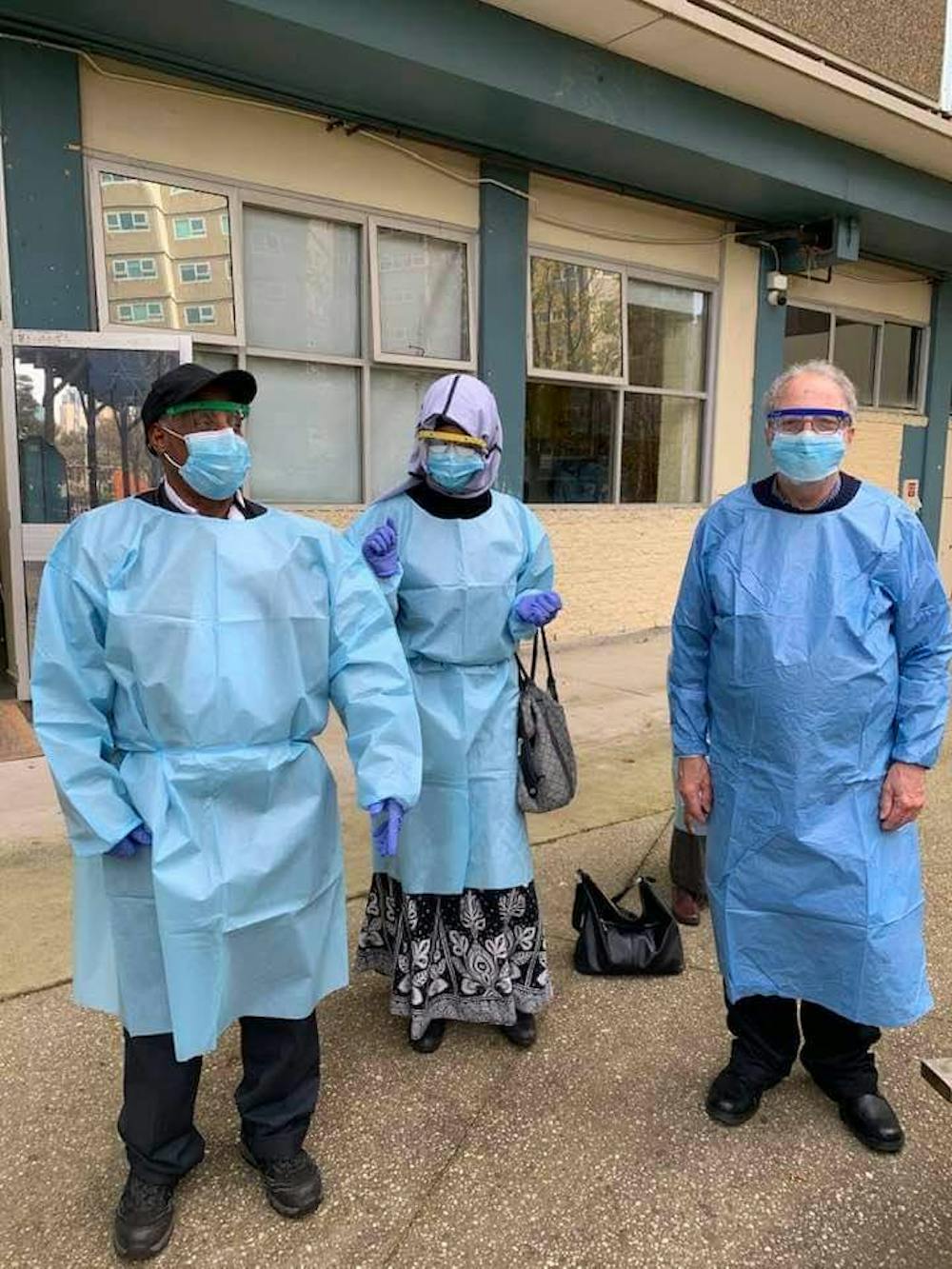 Carlton public housing volunteers help with door-to-door COVID-19 testing.
Tewelde Kidane, Author provided
Carlton public housing volunteers help with door-to-door COVID-19 testing.
Tewelde Kidane, Author provided
Read more: We could have more coronavirus outbreaks in tower blocks. Here's how lockdown should work
Residents use social media, WhatsApp and Zoom to maintain communication within the community. However, many lack internet access. Muhubo said:
[…] for the families that do not have the internet at home and have kids it is difficult. The school gave some kids a small modem with some internet access, but it is slow and the data is limited.
Good communication between authorities and residents is crucial to understand and manage the risks, but this requires proper risk governance. As Tewelde explained:
Many people just live here and rely on the community and don’t know what happens in the rest of the city. We sometimes feel disconnected from the rest.
Language barriers and low literacy in our community members is a big issue. Some people might even have troubles calling emergency numbers like 000.
Building trust will take time
Mutual trust must be built. Yet, surprisingly, government agencies often do not communicate directly with residents.
These days the Carlton public housing residents receive regular communication from Carlton Neighbourhood Learning Centre (CLNC). The centre has gained their trust by working with vulnerable communities for many years. Muhubo said:
Even now we do not get more information from the housing commission. These days we get messages and updates from the school [CNLC], although most of the messages are in English.
Community members’ social networks are part of what has been called an “economy of affection”, a collective support structure characteristic of African communities.
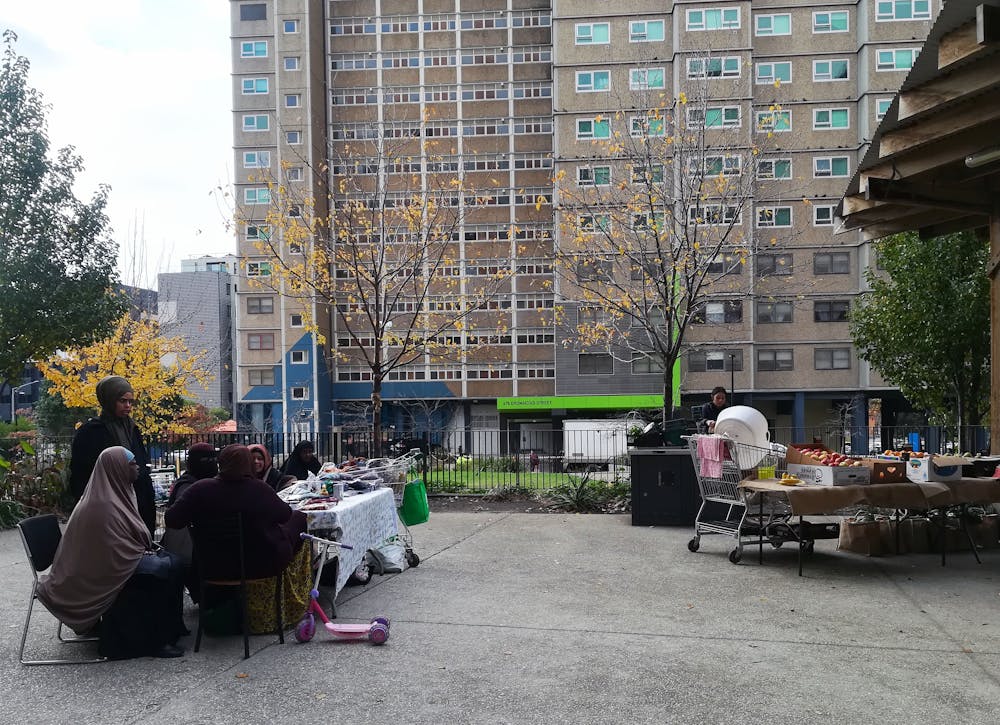 A community meeting during a weekly farmers’ market at a public housing estate in Carlton before the COVID-19 outbreak.
Sandra Carrasco
A community meeting during a weekly farmers’ market at a public housing estate in Carlton before the COVID-19 outbreak.
Sandra Carrasco
Government agencies need to start building communication channels that acknowledge existing community leaders and networks. Awatif said:
They [the government] need to link the leader and community workers to work with them, teach people how to use sanitisers, make them aware of social distancing, bring professional cleaners.
Understanding these communities and the risks they face will lead to better and more inclusive prevention, response and recovery from COVID-19.
Authors: Sandra Carrasco, Teaching Assistant and Research Fellow, Melbourne School of Design, University of Melbourne


















