

vegetarianism, animal welfare and the power of children’s advocacy
- Written by: Clive Phillips, Professor of Animal Welfare, Centre for Animal Welfare and Ethics, The University of Queensland
This month marks 60 years since Dame Jane Goodall first ventured into the wilds of Gombe, Tanzania, at the tender age of 26 to study the behaviour of chimpanzees. She has devoted her life to species conservation and campaigned tirelessly for a healthier environment.
Jane is an icon of our era. Among her groundbreaking discoveries are that chimpanzees have personalities, use tools, have wars and can eat meat — all of which made us question our own behaviour as closely related great apes.
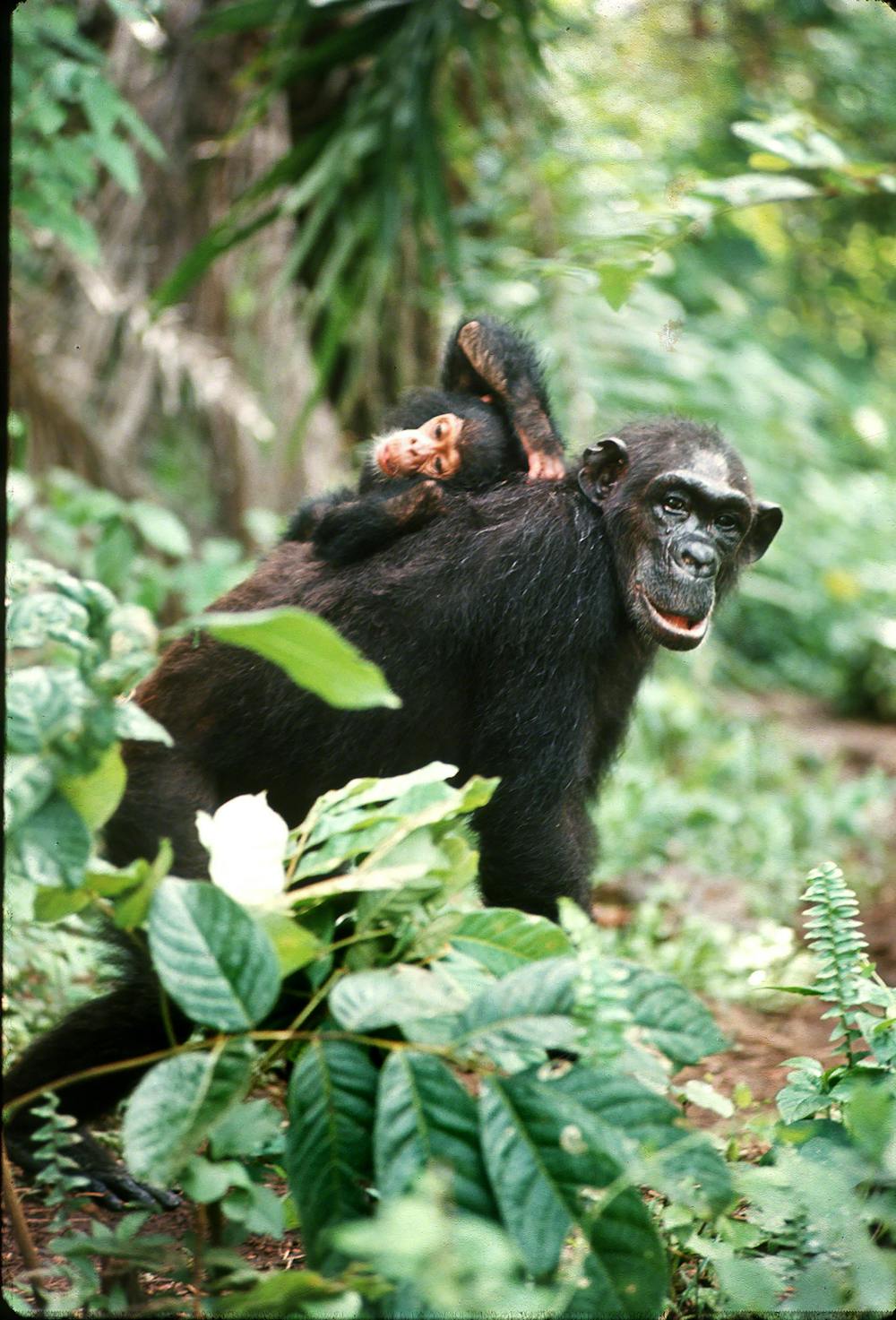 Flo with infant Flint riding on her back. Jane Goodall’s groundbreaking research made us question what it means to be human.
Hugo van Lawick/the Jane Goodall Institute
Flo with infant Flint riding on her back. Jane Goodall’s groundbreaking research made us question what it means to be human.
Hugo van Lawick/the Jane Goodall Institute
She established the Jane Goodall Institute, and her Roots and Shoots program now operates in more than 100 countries to encourage young people to be compassionate, helping people, animals and the environment.
When I first read about Jane’s work, I was amazed anyone could get so close to animals — in her case chimpanzees — to understand their minds, society and lives. For several decades, my research attempted to do the same for intensively farmed animals.
Jane and I ended up in the same philosophical place: committed to exposing the horrors of factory farming, and proudly vegetarian because of the damage eating meat does to animals, the environment and to people eating the end products.
With this in mind I relished the prospect of meeting Jane. She gave us all unique insights into the inner lives of one of our closest relatives, chimpanzees, as well as pioneering a compassionate approach to animals, a cause very close to my heart.
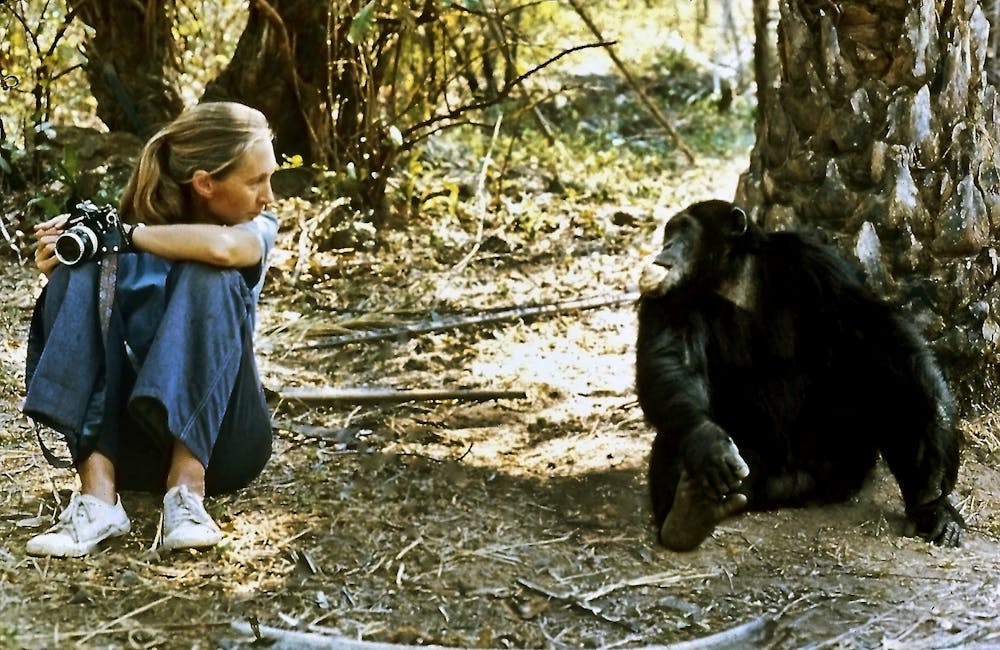 At 26 years old, Jane Goodall travelled to what’s now Tanzania to study the behaviour of wild chimpanzees.
Hugo van Lawick/the Jane Goodall Institute
At 26 years old, Jane Goodall travelled to what’s now Tanzania to study the behaviour of wild chimpanzees.
Hugo van Lawick/the Jane Goodall Institute
Clive Phillips: Jane, you famously dispelled the myth that humans are the only tool-users. Do humans have any unique characteristics to distinguish them from other animals?
Jane Goodall: Well, I believe the most important thing distinguishing us is the explosive development of the human intellect. We have developed communication using words, which means we can learn from our elders, we can plan for the future and we can teach our children about things that are not pleasant.
Above all, we can bring people together from different backgrounds to discuss a problem and try and find the solutions.
Read more: Studying chimpanzee calls for clues about the origins of human language
Phillips: Do you think this “human uniqueness” implies a responsibility towards animals?
Jane Goodall famously discovered that chimpanzees use tools.Goodall: I would say it’s a humanistic responsibility. I mean, once you are prepared to admit that we humans are not the only beings on the planet with personalities, minds and, above all, emotions, and once you are prepared to admit that animals are sentient and can not only know emotions like happiness, sadness, fear, but especially they can feel pain — then, as humans with advanced reasoning powers, we have a responsibility to treat them in more humane ways than we so often do.
Phillips: You mentioned the importance of pain in animals and sentience. Does that give us a moral duty towards them? Or, do you think we have a right to manage them?
Goodall: Well, I don’t know about having a right to to manage them. But the problem is that because of the way our societies have developed, the harm we inflict on the environment, and the devastation we’ve caused so many species, we now have an obligation to try and change things so animals can have a better future.
We now know it’s not only the great apes, elephants and whales that are amazingly intelligent. We now know some birds like crows and the octopus can be, in some situations, more intelligent than small human children. Even some insects have been trained to do simple tests. This was unthinkable a while back.
We also know, for example, that trees can communicate to the micro fungi on their roots, under the soil. And this is amazing. It’s very exciting for any young person wanting to go into this field — these really are exciting times.
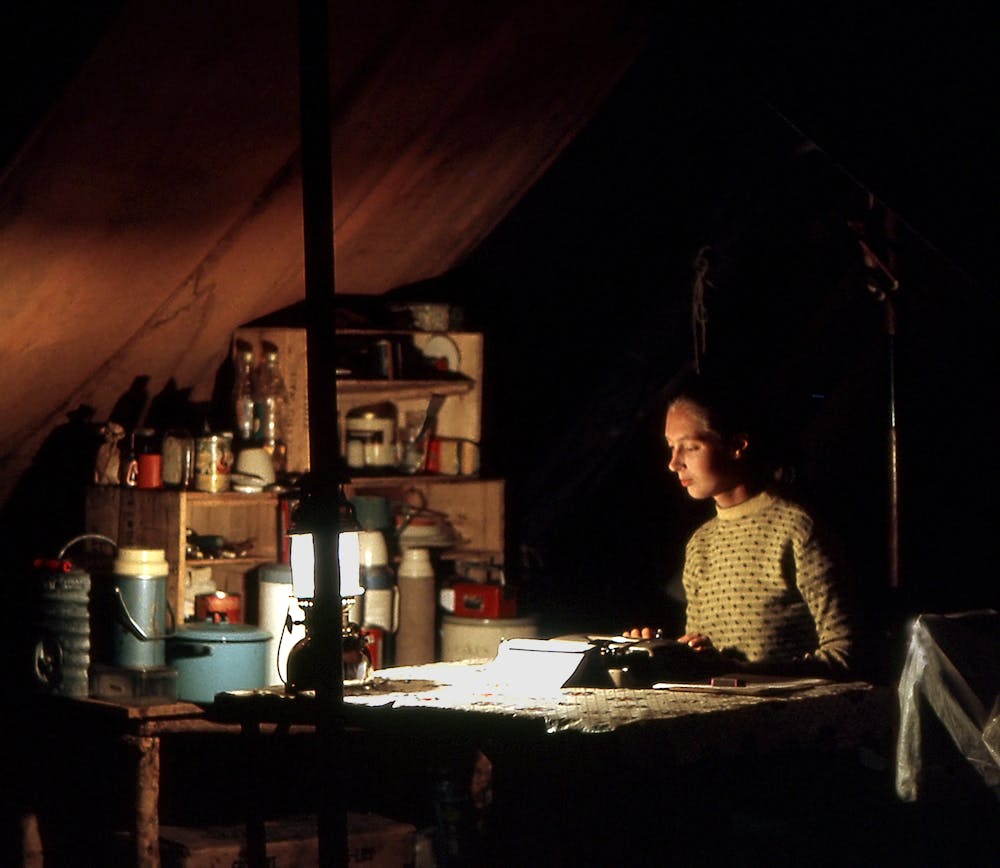 Jane Goodall wrote up her field notes each evening in her tent at Gombe.
Hugo van Lawick/the Jane Goodall Institute
Jane Goodall wrote up her field notes each evening in her tent at Gombe.
Hugo van Lawick/the Jane Goodall Institute
Phillips: Do you believe climate change will alter the relationship we have with other animals, and our ability to manage and use them in the way we do at the moment?
Goodall: We shouldn’t be managing and using them. We should be giving them the opportunity to live their own lives in their own way. And we should stop interfering.
We should protect habitat so that they can continue to flourish in their natural habitat. Those animals that we have subjugated to domestication should be treated as animals: sentient sapiens with feelings, knowing fear and depression and pain.
And we should really start thinking about what we’re doing in our factory farms, in our labs and with hunting. To me, that’s the most important thing.
Phillips: And that will, in itself, address some of the climate change issues, I imagine.
Goodall: Yes. Eating meat involves billions of animals in factory farms that have to be fed. Areas of environment are cleared to grow the grain, fossil fuels are used get the grain to the animals, the animals to the abattoir and the meat to the tables.
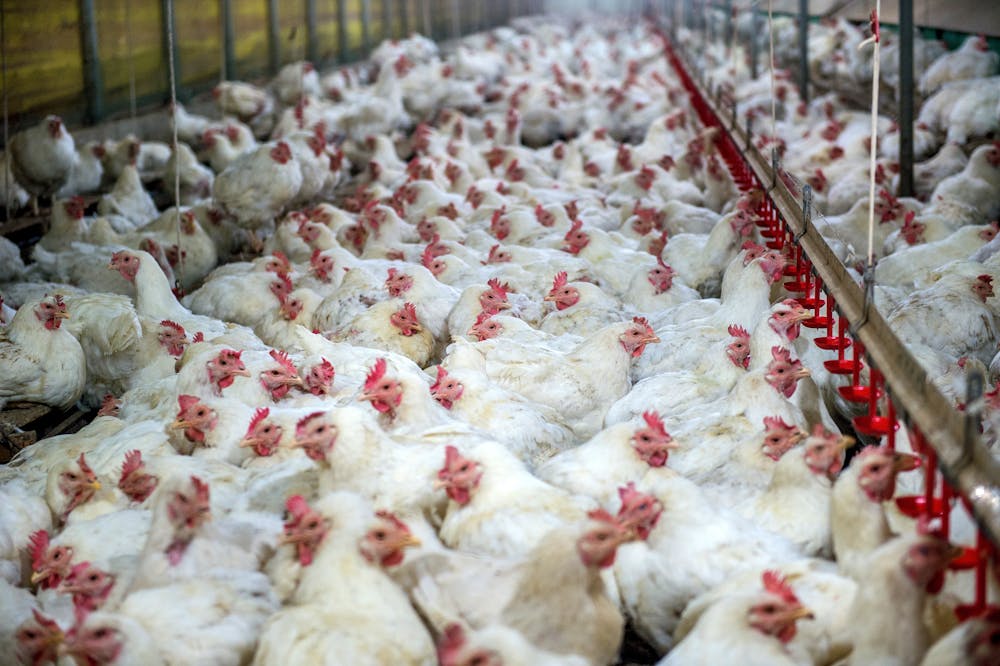 Global meat consumption comes with a range of animal welfare and environmental issues.
Shutterstock
Global meat consumption comes with a range of animal welfare and environmental issues.
Shutterstock
Water is wasted changing vegetable to animal protein, and methane the animals produce in their digestion is one of the most intense greenhouse gases. All of this means we have to do something about continuing to eat more and more meat.
Read more: No animal required, but would people eat artificial meat?
Phillips: And yet the world is eating more and more meat.
Goodall: Well, we have to change attitudes. Yes, we’re eating more meat, but at the same time the number of people who are becoming vegetarian and vegan is increasing.
Phillips: It reminds me of one of your early discoveries of chimpanzees eating meat. Do you think that had an implication or any bearing on the human diet?
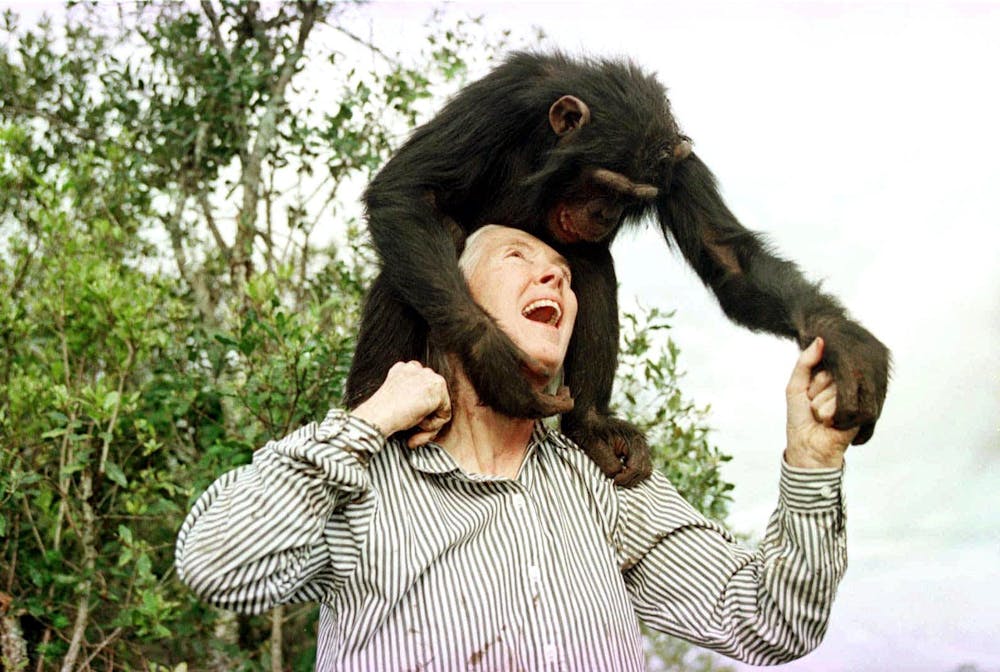 ‘We should be giving them the opportunity to live their own lives in their own way. And we should stop interfering’.
AP Photo/Jean-Marc Bouju
‘We should be giving them the opportunity to live their own lives in their own way. And we should stop interfering’.
AP Photo/Jean-Marc Bouju
Goodall: Humans are not carnivorous, we are omnivorous. And there is a big difference. Our gut is not like a carnivore’s guts, which is short to get rid of the meat before it goes bad and inside your gut. We have a vegetarian gut, an omnivore’s diet. This means our gut is much longer to get all the goodness out of leaves and all the other things we eat.
So when you think of chimps — yes, they hunt, and they seem to love hunting. But it’s been estimated that meat occupies only about 2% of their diets. That’s just for some individuals. Others hardly ever eat meat at all.
Read more: Young people won't accept inaction on climate change, and they'll be voting in droves
Phillips: How can we best get the message across that a vegetarian diet is the most sustainable for the planet, and good for animal welfare?
Goodall: We’re working with young people from kindergarten through university, now in more than 50 countries, growing all the time. It involves young people of all ages choosing projects to make the world better for people, animals and the environment.
They are changing the way their parents think, and the vegetarian ethic is very strong in many of them. So I say you’ve got to change the mindset and children help to change the behaviour of their parents.
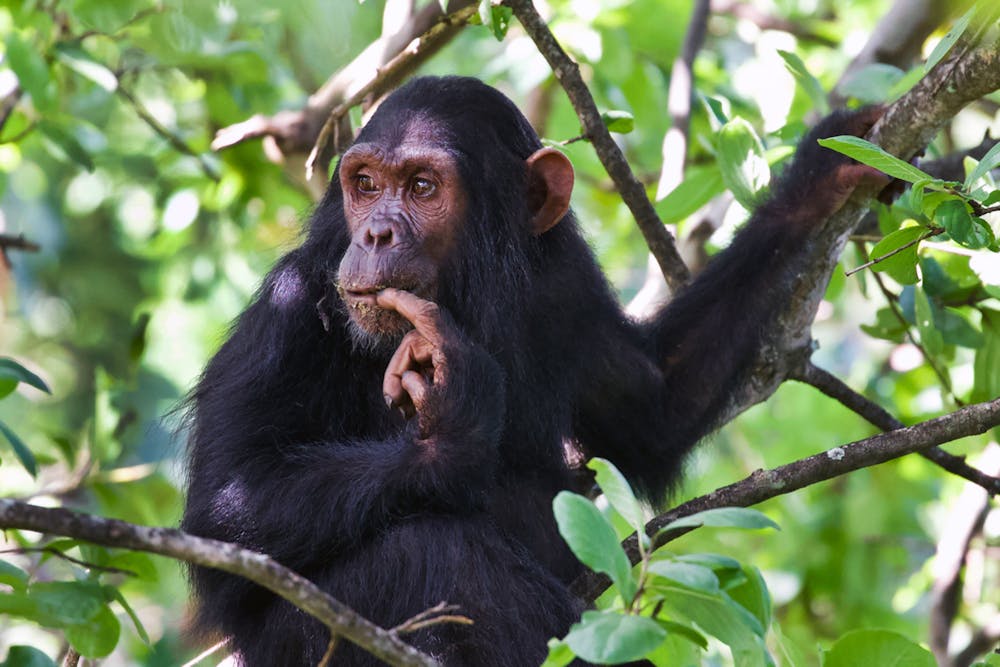 Chimpanzee Fifty, son of Fanni in Gombe National Park.
Carlos Drews/the Jane Goodall Institute
Chimpanzee Fifty, son of Fanni in Gombe National Park.
Carlos Drews/the Jane Goodall Institute
Phillips: That’s a tremendous piece of advocacy, given the huge concerns there are about animals’ contribution to climate change and other dangers they pose to our water supplies and the quality of our land.
Do you think there should be any legal control of the use of animals for intensive animal production?
Goodall: Yes, I do. I think it should be banned. A) for the tremendous suffering caused to the animals; B) for the harm to the environment; and C) for the harm to human health. There should be legislation that limits or bans these intensive farms.
This is an edited version of the original interview.
Authors: Clive Phillips, Professor of Animal Welfare, Centre for Animal Welfare and Ethics, The University of Queensland


















