

Dine in or walk away? How to tell if a venue is COVID safe in NSW
- Written by: Lisa Bricknell, Senior Lecturer in Environmental Health, CQUniversity Australia
New South Wales premier Gladys Berejiklian has called for more businesses to register as COVID Safe, as the state recorded 19 new cases of coronavirus in the 24 hours to 8pm Tuesday night. Berejiklian said:
If I walk into a venue and I’m not comfortable with how COVID safe that venue is, I’d leave. I expect patrons to do the same.
Good advice — and timely, too. As NSW Health’s Jeremy McAnulty said on Wednesday, NSW is “at a knife’s edge, a critical point”.
Here’s what to look for when you walk into a bar, cafe or restaurant to know if it’s COVID safe — and how to know when to walk out the door.
Read more: How to stay safe in restaurants and cafes
What to look for
Familiarise yourself with the rules business must follow to register as a COVID Safe business in NSW. The rules are here.
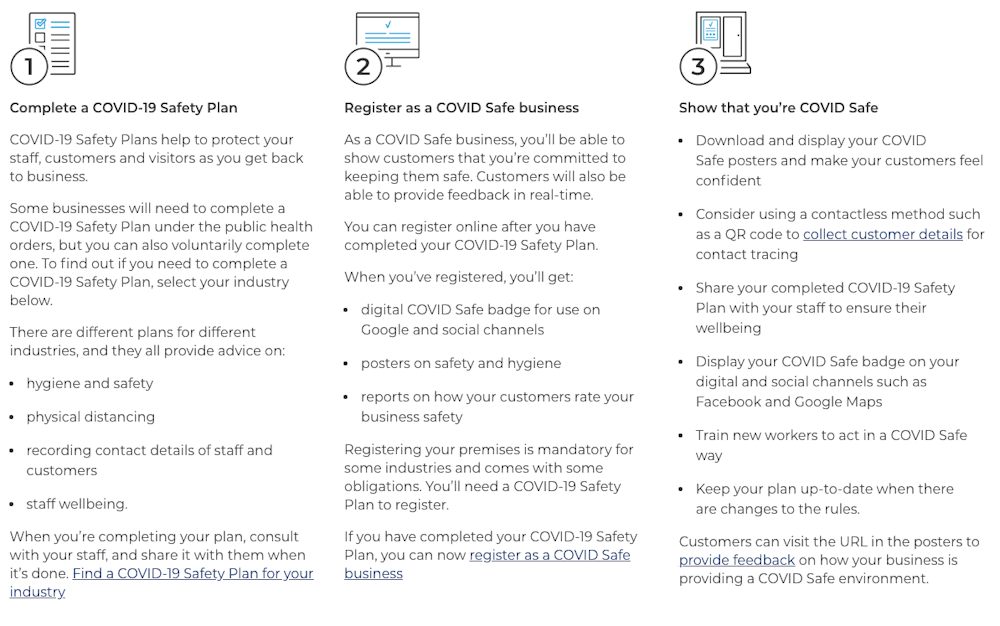 Steps to become a COVID Safe business, according to NSW Health.
NSW Health
Steps to become a COVID Safe business, according to NSW Health.
NSW Health
Check to see the venue’s COVID Safe certificate is clearly displayed and that they are taking every patron’s contact details. If a patron is dining in, the venue must be recording their contact details or checking they are registered with the COVIDSafe app.
If they’re not recording people’s details in some way, leave. If a COVID-19 positive case visits that venue, contact tracers are unable to do their job unless all patrons’ details are recorded.
Check if tables are appropriately spaced and that cutlery, napkins, glasses, plates, bowls or straws aren’t left lying on tables — even if they are disposable. Nothing should be on the table for people to pick up (or in a tub for patrons to collect themselves). Cutlery and other utensils should be brought out by staff when your order is ready. The idea is to reduce the risk of a COVID-19 positive person handling your utensils.
Your table should be 1.5m away from other tables but I’d even be trying to keep 1.5m from friends at my own table. Personally, I’d also want to see my friends wearing masks (it’s different if you’re dining with people with whom you live). Even if you or your friend had a COVID-19 test yesterday and it came back negative, that doesn’t mean you’re negative today. You could have been infected in the past 12 hours.
Read more: Heading back to the office? Here's how to protect yourself and your colleagues from coronavirus
Watch what happens when a patron leaves. Are staff appropriately sanitising tables and chairs with spray and, ideally, disposable paper towel? They should be.
Look around to see if the venue provides hand sanitiser for patrons — and keep an eye on the staff to make sure they are using it too.
Staff, ideally, should be wearing masks, in my view. I know that’s not yet compulsory in many places, but masks provide a barrier if a staff member is unknowingly positive. It’s hard to make patrons wear masks, because they have to eat, but I’d be looking for the staff to be wearing them (all staff, not just a couple).
Check if the venue is enforcing contactless transactions to reduce the handling of money, cards and pin pads. I know the evidence about the role of surfaces in spreading this coronavirus is still emerging but we should stick to universal precautions — if something can be avoided, it should be.
Staff should be limiting the number of patrons at the venue, and the number of patrons allowed in the venue at any one time should be clearly displayed. If people are lining up outside, make sure they are being spaced out too.
In general, aim for an open-air setting if you can, such as a beer garden or an open-air cafe. The more fresh air flow you have around you, the more transmission risk is reduced. Any sort of indoor socialising, where air flow is limited, is inherently risky at the moment in NSW.
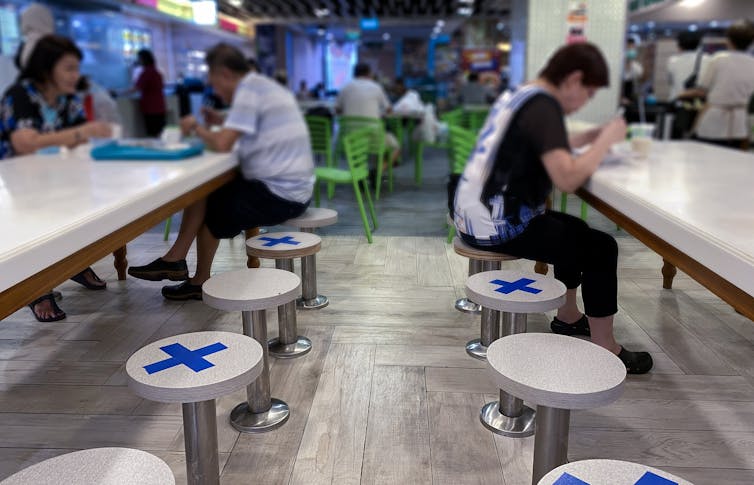 Eating out? Check to see if staff are sanitising surfaces, wearing masks, using contactless payment, and spacing out customers.
Shutterstock
Eating out? Check to see if staff are sanitising surfaces, wearing masks, using contactless payment, and spacing out customers.
Shutterstock
When to leave
Breaches of any of the above would be enough to make me want to leave. But here are some more triggers that would make me think, “I’m getting out of here.”
If you see staff or patrons with symptoms — they have a cough, or cold, or seem unwell — leave.
If they are not wiping surfaces or tables, or allowing patrons to come in and seat themselves, leave. Patrons should be shown to tables that have been sanitised.
If the place is starting to fill up and you sense physical distancing is not being observed — leave.
A critical point
NSW is at an especially critical point. I’d be very, very careful right now. If I was in a Sydney hotspot, I wouldn’t be going out to dinner at all.
NSW is doing a good job of putting out spot fires but any one of those spot fires can flare up if people aren’t taking precautions.
If you thinking of going out, and you are wondering if it is risky, then you are better off not doing it. If you feel you have to go, then mitigate your risk by moving the event outside or making sure everyone is distancing and wearing masks.
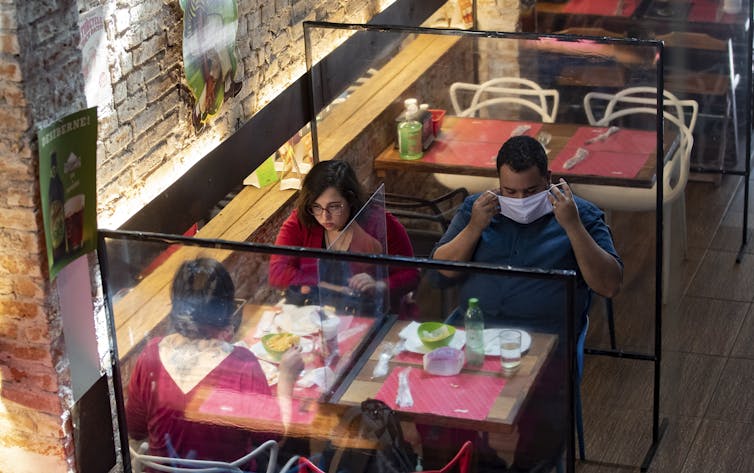 Restaurants might look quite different for some time.
Andre Penner/AP/AAP
Restaurants might look quite different for some time.
Andre Penner/AP/AAP
COVID-19 is a really serious disease that affects young and old. You can get sick or even die, even if you are young and healthy — and the evidence on long term effects is worrying. And of course, healthy people can pass it on to someone who is in a high risk category. It’s so important that everyone continues to observe the appropriate protocols — today. This week. This weekend.
Until COVID-19 either burns out globally or we get a vaccine — and neither of those are right on the horizon and may not happen at all — then this may become the new normal, sadly. Infection control measures remain our best chance of keeping the pandemic in check.
Authors: Lisa Bricknell, Senior Lecturer in Environmental Health, CQUniversity Australia
Read more https://theconversation.com/dine-in-or-walk-away-how-to-tell-if-a-venue-is-covid-safe-in-nsw-143603


















