

New 'Closing the Gap' targets will cover attachment to land and culture
- Written by Michelle Grattan, Professorial Fellow, University of Canberra
The government will unveil 16 targets for Indigenous advancement, including ensuring the maintenance of strong relationships with land and culture, when Scott Morrison announces on Thursday a new national agreement on “Closing the Gap”.
Negotiated with Indigenous representatives as a partnership, the agreement sets out four priority reforms aimed at changing how governments work with Aboriginal and Torres Strait Islander people.
The reforms would:
build and strengthen structures to empower Indigenous people to share decision-making with governments
build Indigenous community-controlled sectors to deliver services to support closing the gap
transform mainstream government organisations to improve accountability and better respond to Aboriginal and Torres Strait Islander people’s needs
improve and share access to data and information to enable Indigenous communities to make informed decisions.
The agreement has been signed by all states and territories and the Indigenous Coalition of Peaks. The Morrison government believes it will lead to more success in closing the gap because of the shared drafting and the commitment by Indigenous representatives.
The 16 targets cover improving health, education, housing, employment and economic participation, lowering incarceration rates, ensuring the safety of families and households, and promoting social and emotional wellbeing.
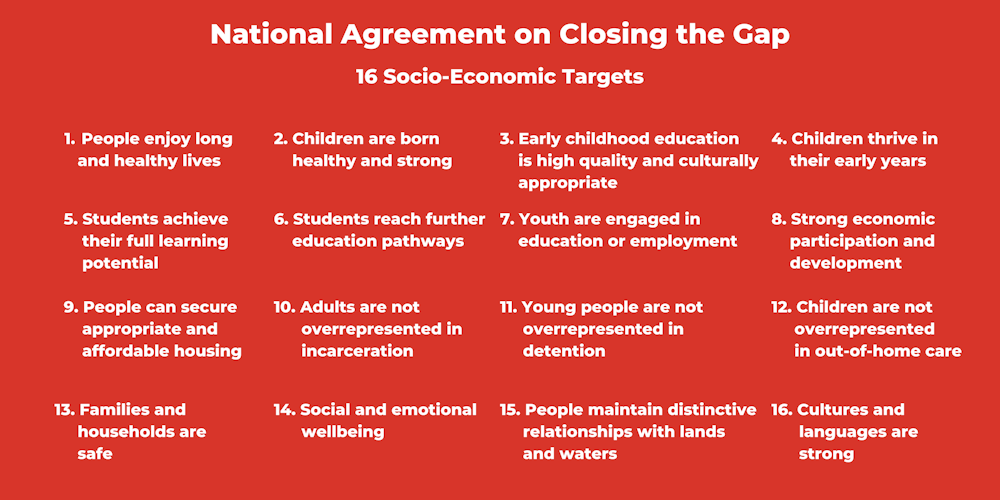 They also include ensuring Indigenous people “maintain distinctive relationships with lands and waters” and that cultures and languages are strong.
The specifics of the targets will be spelt out on Thursday.
Four other targets – on family violence, access to information, community infrastructure and inland waters – are to be developed over the next year.
The old “Closing the Gap” plan, initiated by the Rudd government, had only mixed results, with progress on many of its targets falling short.
Morrison said the agreement was “a new chapter” in efforts to close the gap - “one built on mutual trust, shared responsibility, dignity and respect.
"The gaps we are now seeking to close are the gaps that have now been defined by the representatives of Aboriginal and Torres Strait Islander peoples. This is as it should be. This creates a shared commitment and a shared responsibility,” Morrison said.
“This is the first time a national agreement designed to improve the lives of Aboriginal and Torres Strait Islander people has been negotiated directly with Aboriginal and Torres Strait Islander representatives.
"By focusing our efforts on these more specific, practical and shared objectives we can expect to make much greater progress,” he said.
The Minister for Indigenous Australians, Ken Wyatt, said the best outcomes were achieved when Aboriginal and Torres Strait Islander Australians were equal partners with governments.
Pat Turner, lead negotiator for the Coalition of Peaks said: “For the first time, First Nations people will share decision-making with governments on Closing the Gap.
"Our country has unforgivable gaps in the life outcomes of Aboriginal and Torres Strait Islander people and other Australians in all aspects of life including mortality, chronic disease, disability rates, housing security, education, employment and wealth.
"The National Agreement represents a turning point in our country’s efforts to close these gaps.
"The Coalition of Peaks have always said that targets alone do not drive change. We have seen this from the past 10 years. It is the full implementation of the Priority Reforms by governments and a commitment to additional resources our communities need that will make the difference,” Turner said.
The agreement promises an increase in the level of reporting to improve transparency and accountability. The Productivity Commission will do an assessment of progress every three years and there will be an Indigenous-led review of change on the ground. There will also be annual reports tabled in federal, state and territory parliaments.
They also include ensuring Indigenous people “maintain distinctive relationships with lands and waters” and that cultures and languages are strong.
The specifics of the targets will be spelt out on Thursday.
Four other targets – on family violence, access to information, community infrastructure and inland waters – are to be developed over the next year.
The old “Closing the Gap” plan, initiated by the Rudd government, had only mixed results, with progress on many of its targets falling short.
Morrison said the agreement was “a new chapter” in efforts to close the gap - “one built on mutual trust, shared responsibility, dignity and respect.
"The gaps we are now seeking to close are the gaps that have now been defined by the representatives of Aboriginal and Torres Strait Islander peoples. This is as it should be. This creates a shared commitment and a shared responsibility,” Morrison said.
“This is the first time a national agreement designed to improve the lives of Aboriginal and Torres Strait Islander people has been negotiated directly with Aboriginal and Torres Strait Islander representatives.
"By focusing our efforts on these more specific, practical and shared objectives we can expect to make much greater progress,” he said.
The Minister for Indigenous Australians, Ken Wyatt, said the best outcomes were achieved when Aboriginal and Torres Strait Islander Australians were equal partners with governments.
Pat Turner, lead negotiator for the Coalition of Peaks said: “For the first time, First Nations people will share decision-making with governments on Closing the Gap.
"Our country has unforgivable gaps in the life outcomes of Aboriginal and Torres Strait Islander people and other Australians in all aspects of life including mortality, chronic disease, disability rates, housing security, education, employment and wealth.
"The National Agreement represents a turning point in our country’s efforts to close these gaps.
"The Coalition of Peaks have always said that targets alone do not drive change. We have seen this from the past 10 years. It is the full implementation of the Priority Reforms by governments and a commitment to additional resources our communities need that will make the difference,” Turner said.
The agreement promises an increase in the level of reporting to improve transparency and accountability. The Productivity Commission will do an assessment of progress every three years and there will be an Indigenous-led review of change on the ground. There will also be annual reports tabled in federal, state and territory parliaments.
Authors: Michelle Grattan, Professorial Fellow, University of Canberra

















