

Tree ferns are older than dinosaurs. And that's not even the most interesting thing about them
- Written by Gregory Moore, Doctor of Botany, University of Melbourne
With massive fronds creating a luxuriously green canopy in the understory of Australian forests, tree ferns are a familiar sight on many long drives or bushwalks. But how much do you really know about them?
First of all, tree ferns are ferns, but they are not really trees. To be a tree, a plant must be woody (undergo secondary plant growth, which thickens stems and roots) and grow to a height of at least three metres when mature. While tree ferns can have single, thick trunk-like stems and can grow to a height of more than 15 metres, they are never woody.
They’re also incredibly hardy — tree ferns are often the first plants to show signs of recovery in the early weeks after bushfires. The unfurling of an almost iridescent green tree fern fiddlehead amid the sombre black of the bushfire ash is almost symbolic of the potential for bushfire recovery.
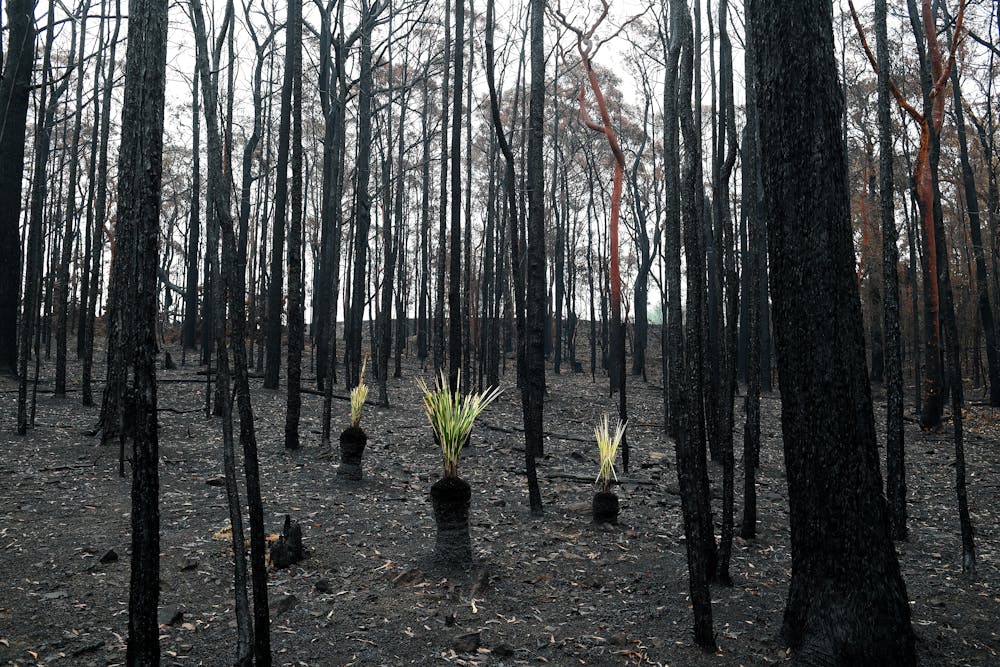 Ferns are often the first plants to grow back in a bushfire ravaged forest.
AAP Image/Dan Himbrechts
Ferns are often the first plants to grow back in a bushfire ravaged forest.
AAP Image/Dan Himbrechts
Ancient family ties
Tree ferns are generally slow growing, at rates of just 25-50 millimetres height increase per year. This means the tall individuals you might spot in a mature forest may be several centuries old.
However, in the right environment they can grow faster, so guessing their real age can be tricky, especially if they’re growing outside their usual forest environment.
Read more: The coastal banksia has its roots in ancient Gondwana
As a plant group, tree ferns are ancient, dating back hundreds of millions of years and pre-dating dinosaurs.
They existed on earth long before the flowering or cone-bearing plants evolved, and were a significant element of the earth’s flora during the Carboniferous period 300-360 million years ago, when conditions for plant growth were near ideal. This explains why ferns don’t reproduce by flowers, fruits or cones, but by more primitive spores.
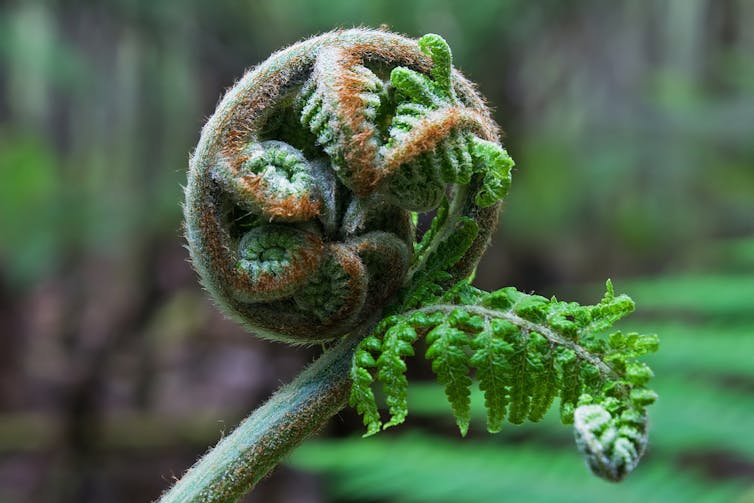 A shoot of the Dicksonia antarctica, ready to unfurl.
JJ Harrison/Wikimedia, CC BY-SA
A shoot of the Dicksonia antarctica, ready to unfurl.
JJ Harrison/Wikimedia, CC BY-SA
In fact, fossilised tree ferns and their relatives called the fern allies laid down during the carboniferous then have provided much of the earth’s fossil fuels dating from that period. And tree ferns were a great food source, with Indigenous people once eating the pulp that occurs in the centre of the tree fern stem either raw or roasted as a starch.
Until recent times, ferns were quiet achievers among plant groups with an expanding number of species and greater numbers. Today, human activities are limiting their success by the clearing of forests and agricultural practices. Climate change is also a more recent threat to many fern species.
Species you’ve probably seen
Two of the more common tree fern species of south eastern Australia are Cyathea australis and Dicksonia antarctica. Both species have a wide distribution, extending from Queensland down the Australian coast and into Tasmania.
They’re often found growing near each other along rivers and creeks. They look superficially alike and many people would be unaware that they are entirely different species at first glance. That is, until you look closely at the detail of their fronds and run your fingers down the stalks.
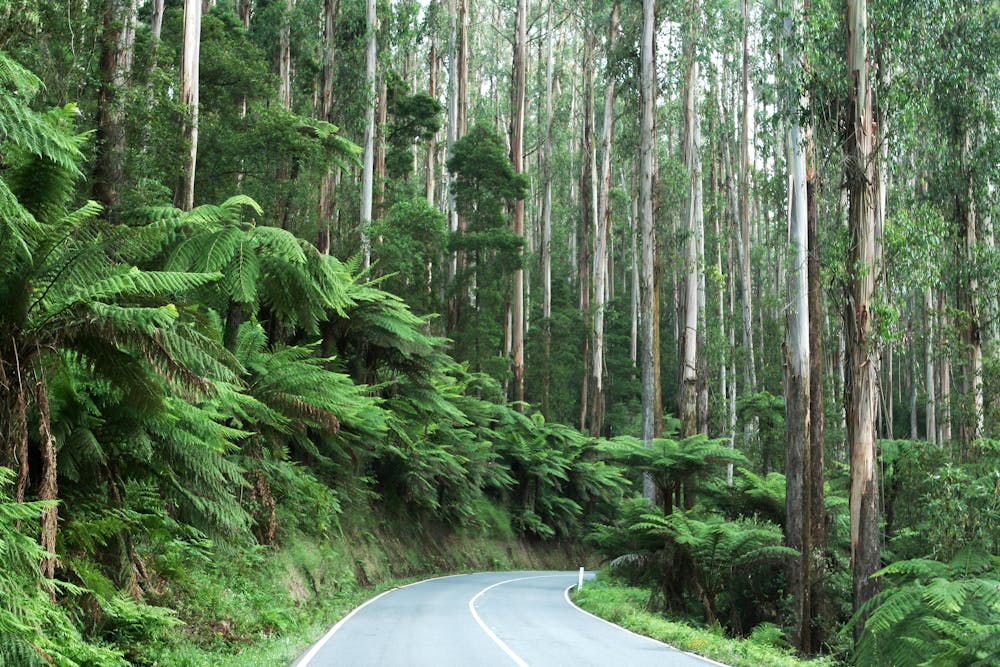 Tree ferns are a familiar sight on road trips through forests and bushwalks.
Shutterstock
Tree ferns are a familiar sight on road trips through forests and bushwalks.
Shutterstock
C. australis has a rough almost prickly frond, hence its common name of rough tree fern, and can grow to be 25 metres tall. While D. antarctica, as the soft tree fern, has a smooth and sometimes furry frond and rarely grows above 15 metres.
Both contribute to the lush green appearance of the understory of wet forests dominated by eucalypts, such as mountain ash (Eucalyptus regnans).
Stems that host a tiny ecosystem
The way tree ferns grow is quite complex. That’s because growth, even of the roots, originates from part of the apex of the stem. If this crown is damaged, then the fern can die.
At the right time of the year, the new fronds unfurl in the crown from a coil called a fiddlehead. The stem of the tree fern is made up of all of the retained leaf bases of the fronds from previous years.
The stems are very fibrous and quite strong, which means they tend to retain moisture. And this is one of the reasons why the stems of tree ferns don’t easily burn in bushfires — even when they’re dry or dead.
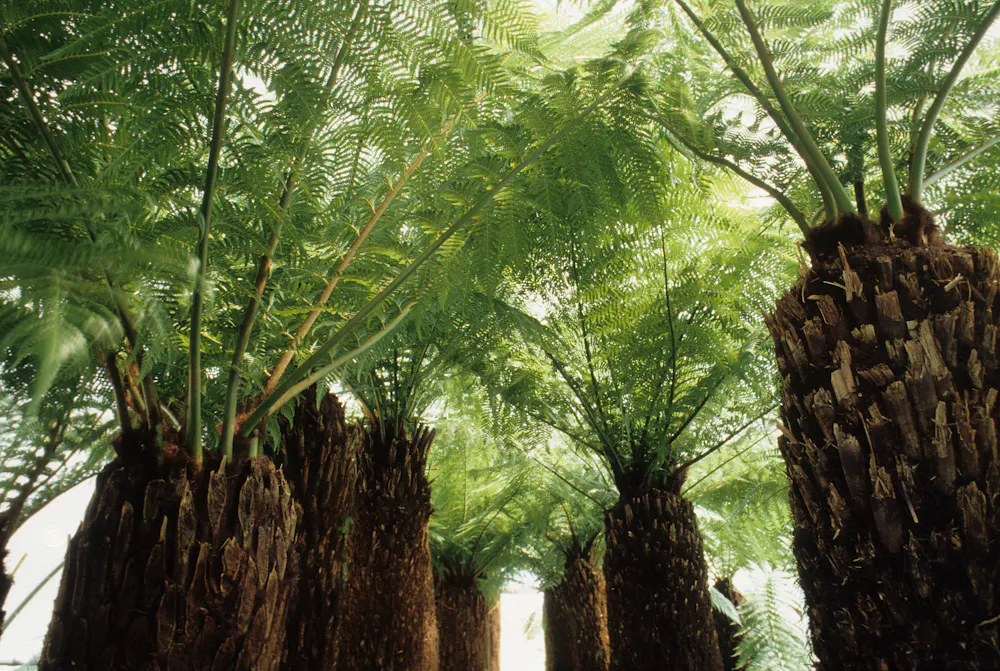 Dicksonia antarctica is one of the more common species in Australian forests.
Shutterstock
Dicksonia antarctica is one of the more common species in Australian forests.
Shutterstock
In some dense wet forest communities, the stems of tree ferns are a miniature ecosystem, with epiphytic plants — such as mosses, translucent filmy ferns, perhaps lichens and the seedlings of other plant species — growing on them.
These epiphytes are not bad for the tree ferns, they’re just looking for a place to live, and the fibrous, nutrient-rich, moist tree fern stems prove brilliantly suitable.
Engulfed by trees
Similarly, the spreading canopies of tree ferns, such as D. antarctica, provide an excellent place for trees and other species to germinate.
That’s because many plants need good light for their seedlings to establish and this may not be available on the forest floor. Seeds, such as those of the native (or myrtle) beech, Nothofagus cunninghamii, may germinate in the crowns of tree ferns, and its roots can grow down the tree fern trunks and into the soil.
Read more: People are 'blind' to plants, and that's bad news for conservation
As time passes, the tree species may completely grow over the tree fern, engulfing the tree fern stem into its trunk. Decades, or even centuries later, it’s sometimes still possible to see the old tree fern stem embedded inside.
Still, tree ferns are wonderfully resilient and give a sense of permanence to our ever-changing fire-affected landscapes.
Authors: Gregory Moore, Doctor of Botany, University of Melbourne

















