

Research shows coronavirus thrives in dry air (and August is coastal Australia's least humid month)
- Written by: Michael Ward, Chair of Veterinary Public Health and Food Safety, University of Sydney
We know some influenzas are seasonal, and the common cold is more common in winter. But what about COVID-19? Many people have been wondering whether the weather plays a role in its spread.
At this stage we don’t really know if or how temperature affects COVID-19 transmission. But it looks like one aspect of the weather — humidity — does play a role.
In a new study published today, we found the number of locally acquired COVID-19 cases in the Sydney area increased as the air became drier.
This adds to a growing body of evidence that identifies a link between humidity and COVID-19.
What we did
We accessed the daily numbers of reported COVID-19 cases from NSW Health. Cases are reported by postcode, with information on the likely source of each case. These data allowed us to compile the daily numbers reported between February and May, and to match them to the nearest weather recording stations.
We downloaded the relevant meteorological data and then used a method called time-series analysis to predict cases based on weather recorded up to 14 days prior.
We found we needed only relative humidity to predict COVID-19 cases. Humidity is a measure of water vapour in the air. Lower relative humidity at a given temperature means the air is drier. For every 1% decrease in relative humidity, there was a corresponding 7-8% increase in cases.
 We examined the COVID-19 cases in greater Sydney alongside weather data.
Shutterstock
We examined the COVID-19 cases in greater Sydney alongside weather data.
Shutterstock
This relationship was consistent: we found it in both the exponential stage of the epidemic (when the numbers of cases were growing rapidly, in February and March) and when the epidemic was declining (in April and May). And the relationship was evident across different areas of greater Sydney.
We didn’t find a relationship between COVID-19 cases and temperature, rainfall or wind speed.
Read more: Why we can't tell if warmer weather slows down the spread of coronavirus
This study adds to our earlier research
Our research originally began with a study in China, very early in the COVID-19 pandemic (December to February). In that study we found both drier air and lower temperatures were linked to more reported cases of COVID-19.
We then conducted a study in Sydney, published in May, also focusing on the early phase of the pandemic. In this study we didn’t analyse the findings by area like we have in our most recent study (we just looked at the dataset for Sydney as a whole).
The fact we were able to identify relative humidity as an important factor in both the Chinese winter and Australian summer, using the same research methods, gave us confidence this is a real phenomenon. Our latest study strengthens this hypothesis even further.
Of course, laboratory research on SARS-CoV-2, the coronavirus that causes COVID-19, is still in its infancy. But there has been research on closely related coronaviruses, including those that cause sudden acute respiratory syndrome (SARS) and Middle East respiratory syndrome (MERS).
In two studies on SARS in Hong Kong and China, and two on MERS in Saudi Arabia, researchers found the same inverse relationship between relative humidity and cases.
Why would there be a link between low humidity and COVID-19?
Coronaviruses can survive for a period of time on surfaces, and in the air. When an infected person coughs, sneezes or even talks, they can produce infectious droplets and aerosols.
By virtue of their larger size (and therefore weight), droplets land on surfaces relatively quickly.
However, aerosols are much smaller, so they persist in the air and they hang around for longer in drier air. So it follows transmission of COVID-19 is more likely when humidity is lower.
Read more: Is the airborne route a major source of coronavirus transmission?
In one of the first studies on SARS-CoV-2, scientists detected infectious aerosolised virus for up to 16 hours. In another study, aerosolised virus remained viable for at least three hours.
Although we need much more research on this topic, airborne spread of COVID-19 is plausible. It might even be the primary way this disease spreads.
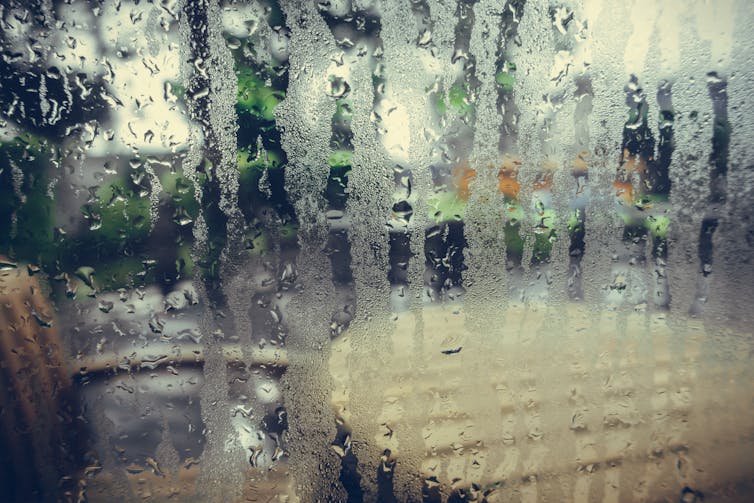 Humid conditions seem to be less conducive to the spread of COVID-19.
Shutterstock
Humid conditions seem to be less conducive to the spread of COVID-19.
Shutterstock
COVID-19 and the weather
US President Donald Trump famously suggested warmer weather would see COVID-19 “miraculously” go away. But we don’t have much information yet on the relationship between the weather and COVID-19.
Some studies have found lower temperature to be a factor in coronavirus diseases, while other studies have found the reverse.
We will need to examine at least a year of COVID-19 data to really know. But a growing number of studies, including our new paper, are pointing to humidity as a consistent a factor.
In Sydney, humidity is lowest in winter, particularly in August, and highest in summer. The same is true for most coastal areas in Australia — meaning people in these parts may now be in a period of heightened COVID-19 risk.
In inland areas we tend to see the opposite. So for example, in Canberra, the relative humidity is lowest in December and January.
Read more: Here's what we know so far about the long-term symptoms of COVID-19
Of course, we can’t change the weather.
But knowing what conditions can promote virus transmission allows us to better target the interventions we already have available — such as social distancing and wearing a mask — via public health messaging.
It also allows us to focus more on surveillance during anticipated periods of increased transmission risk.
Authors: Michael Ward, Chair of Veterinary Public Health and Food Safety, University of Sydney
?highlight=WyJwYW5kZW1pYyJd&media=https://www.modernaustralian.com/https://images.theconversation.com/files/353083/original/file-20200817-16-k6hm26.jpg?ixlib=rb-1.1.0&q=45&auto=format&w=754&fit=clip&description=Research%20shows%20coronavirus%20thrives%20in%20dry%20air%20(and%20August%20is%20coastal%20Australia's%20least%20humid%20month) "Pin It")

















