

A new quantum paradox throws the foundations of observed reality into question
- Written by Eric Cavalcanti, Associate Professor (ARC Future Fellow), Griffith University
If a tree falls in a forest and no one is there to hear it, does it make a sound? Perhaps not, some say.
And if someone is there to hear it? If you think that means it obviously did make a sound, you might need to revise that opinion.
We have found a new paradox in quantum mechanics – one of our two most fundamental scientific theories, together with Einstein’s theory of relativity – that throws doubt on some common-sense ideas about physical reality.
Quantum mechanics vs common sense
Take a look at these three statements:
When someone observes an event happening, it really happened.
It is possible to make free choices, or at least, statistically random choices.
A choice made in one place can’t instantly affect a distant event. (Physicists call this “locality”.)
These are all intuitive ideas, and widely believed even by physicists. But our research, published in Nature Physics, shows they cannot all be true – or quantum mechanics itself must break down at some level.
This is the strongest result yet in a long series of discoveries in quantum mechanics that have upended our ideas about reality. To understand why it’s so important, let’s look at this history.
The battle for reality
Quantum mechanics works extremely well to describe the behaviour of tiny objects, such as atoms or particles of light (photons). But that behaviour is … very odd.
In many cases, quantum theory doesn’t give definite answers to questions such as “where is this particle right now?” Instead, it only provides probabilities for where the particle might be found when it is observed.
For Niels Bohr, one of the founders of the theory a century ago, that’s not because we lack information, but because physical properties like “position” don’t actually exist until they are measured.
And what’s more, because some properties of a particle can’t be perfectly observed simultaneously – such as position and velocity – they can’t be real simultaneously.
No less a figure than Albert Einstein found this idea untenable. In a 1935 article with fellow theorists Boris Podolsky and Nathan Rosen, he argued there must be more to reality than what quantum mechanics could describe.
Read more: Einstein vs quantum mechanics ... and why he'd be a convert today
The article considered a pair of distant particles in a special state now known as an “entangled” state. When the same property (say, position or velocity) is measured on both entangled particles, the result will be random – but there will be a correlation between the results from each particle.
For example, an observer measuring the position of the first particle could perfectly predict the result of measuring the position of the distant one, without even touching it. Or the observer could choose to predict the velocity instead. This had a natural explanation, they argued, if both properties existed before being measured, contrary to Bohr’s interpretation.
However, in 1964 Northern Irish physicist John Bell found Einstein’s argument broke down if you carried out a more complicated combination of different measurements on the two particles.
Bell showed that if the two observers randomly and independently choose between measuring one or another property of their particles, like position or velocity, the average results cannot be explained in any theory where both position and velocity were pre-existing local properties.
That sounds incredible, but experiments have now conclusively demonstrated Bell’s correlations do occur. For many physicists, this is evidence that Bohr was right: physical properties don’t exist until they are measured.
But that raises the crucial question: what is so special about a “measurement”?
The observer, observed
In 1961, the Hungarian-American theoretical physicist Eugene Wigner devised a thought experiment to show what’s so tricky about the idea of measurement.
He considered a situation in which his friend goes into a tightly sealed lab and performs a measurement on a quantum particle – its position, say.
However, Wigner noticed that if he applied the equations of quantum mechanics to describe this situation from the outside, the result was quite different. Instead of the friend’s measurement making the particle’s position real, from Wigner’s perspective the friend becomes entangled with the particle and infected with the uncertainty that surrounds it.
This is similar to Schrödinger’s famous cat, a thought experiment in which the fate of a cat in a box becomes entangled with a random quantum event.
Read more: Schrödinger's cat gets a reality check
For Wigner, this was an absurd conclusion. Instead, he believed that once the consciousness of an observer becomes involved, the entanglement would “collapse” to make the friend’s observation definite.
But what if Wigner was wrong?
Our experiment
In our research, we built on an extended version of the Wigner’s friend paradox, first proposed by Časlav Brukner of the University of Vienna. In this scenario, there are two physicists – call them Alice and Bob – each with their own friends (Charlie and Debbie) in two distant labs.
There’s another twist: Charlie and Debbie are now measuring a pair of entangled particles, like in the Bell experiments.
As in Wigner’s argument, the equations of quantum mechanics tell us Charlie and Debbie should become entangled with their observed particles. But because those particles were already entangled with each other, Charlie and Debbie themselves should become entangled – in theory.
But what does that imply experimentally?
Read more: Quantum physics: our study suggests objective reality doesn't exist
Our experiment goes like this: the friends enter their labs and measure their particles. Some time later, Alice and Bob each flip a coin. If it’s heads, they open the door and ask their friend what they saw. If it’s tails, they perform a different measurement.
This different measurement always gives a positive outcome for Alice if Charlie is entangled with his observed particle in the way calculated by Wigner. Likewise for Bob and Debbie.
In any realisation of this measurement, however, any record of their friend’s observation inside the lab is blocked from reaching the external world. Charlie or Debbie will not remember having seen anything inside the lab, as if waking up from total anaesthesia.
But did it really happen, even if they don’t remember it?
If the three intuitive ideas at the beginning of this article are correct, each friend saw a real and unique outcome for their measurement inside the lab, independent of whether or not Alice or Bob later decided to open their door. Also, what Alice and Charlie see should not depend on how Bob’s distant coin lands, and vice versa.
We showed that if this were the case, there would be limits to the correlations Alice and Bob could expect to see between their results. We also showed that quantum mechanics predicts Alice and Bob will see correlations that go beyond those limits.
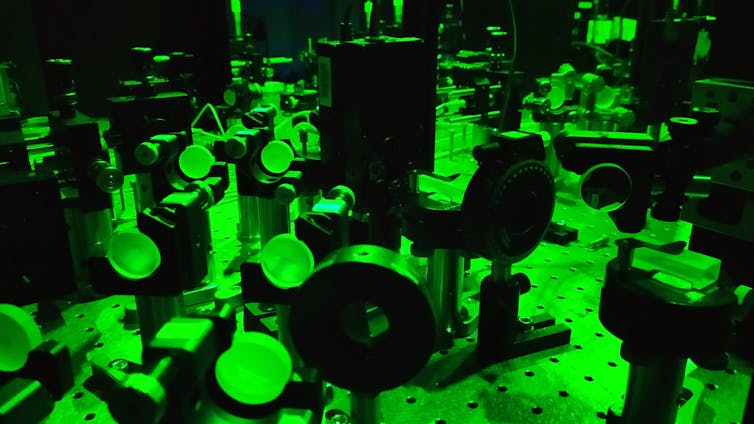 Experimental apparatus for our test of the paradox with particles of light.
Photograph by Kok-Wei Bong
Experimental apparatus for our test of the paradox with particles of light.
Photograph by Kok-Wei Bong
Next, we did an experiment to confirm the quantum mechanical predictions using pairs of entangled photons. The role of each friend’s measurement was played by one of two paths each photon may take in the setup, depending on a property of the photon called “polarisation”. That is, the path “measures” the polarisation.
Our experiment is only really a proof of principle, since the “friends” are very small and simple. But it opens the question whether the same results would hold with more complex observers.
We may never be able to do this experiment with real humans. But we argue that it may one day be possible to create a conclusive demonstration if the “friend” is a human-level artificial intelligence running in a massive quantum computer.
What does it all mean?
Although a conclusive test may be decades away, if the quantum mechanical predictions continue to hold, this has strong implications for our understanding of reality – even more so than the Bell correlations. For one, the correlations we discovered cannot be explained just by saying that physical properties don’t exist until they are measured.
Now the absolute reality of measurement outcomes themselves is called into question.
Our results force physicists to deal with the measurement problem head on: either our experiment doesn’t scale up, and quantum mechanics gives way to a so-called “objective collapse theory”, or one of our three common-sense assumptions must be rejected.
Read more: The universe really is weird: a landmark quantum experiment has finally proved it so
There are theories, like de Broglie-Bohm, that postulate “action at a distance”, in which actions can have instantaneous effects elsewhere in the universe. However, this is in direct conflict with Einstein’s theory of relativity.
Some search for a theory that rejects freedom of choice, but they either require backwards causality, or a seemingly conspiratorial form of fatalism called “superdeterminism”.
Another way to resolve the conflict could be to make Einstein’s theory even more relative. For Einstein, different observers could disagree about when or where something happens – but what happens was an absolute fact.
However, in some interpretations, such as relational quantum mechanics, QBism, or the many-worlds interpretation, events themselves may occur only relative to one or more observers. A fallen tree observed by one may not be a fact for everyone else.
All of this does not imply that you can choose your own reality. Firstly, you can choose what questions you ask, but the answers are given by the world. And even in a relational world, when two observers communicate, their realities are entangled. In this way a shared reality can emerge.
Which means that if we both witness the same tree falling and you say you can’t hear it, you might just need a hearing aid.
Authors: Eric Cavalcanti, Associate Professor (ARC Future Fellow), Griffith University

















