

Populism from the Brexit and Trump playbooks enters the New Zealand election campaign – but it's a risky strategy
- Written by Robert G. Patman, Professor of International Relations, University of Otago
COVID-19 might have been challenging for populist governments, but that hasn’t stopped populist strains emerging in the run-up to New Zealand’s general election in October.
Populism, as commonly defined, embraces an ideology that divides society between “the pure people” and “the corrupt elite”. It contends the “will of the people” requires leadership promoting mono-culturalism, traditionalism and opposition to “globalist” plans within the “deep state”.
We have already seen some of these themes playing out in the current contest to govern New Zealand.
Having hired prominent Leave.EU campaigners Arron Banks and Andy Wigmore (the self-styled “bad boys of Brexit”), New Zealand First’s social media strategy has begun to reflect their brash strategic advice.
Party leader and Deputy Prime Minister Winston Peters has claimed New Zealand First’s “common sense” is a safeguard against the “woke pixie dust” of the Labour and Green parties. He has cast himself as the the defender of “socially conservative values like the right to believe in God”.
A risky strategy
Meanwhile, the National Party appeared to adopt a more partisan strategy after the renewed outbreak of COVID-19 in Auckland.
Leader Judith Collins said the return of the virus would “come as a shock to all New Zealanders who believed what we had been told”. She complained Health Minister Chris Hipkins had been reluctant to brief her own health spokesperson, Shane Reti.
Read more: When great powers fail, New Zealand and other small states must organise to protect their interests
Her deputy, Gerry Brownlee, took it further, implying Jacinda Ardern’s government had known more about the resurgence of the virus than it was publicly acknowledging. He said New Zealanders had been left “in a position of wondering what do the health authorities know that they are not fully explaining”.
Where National was taking advice is unclear, but it has in the past had direct and indirect links with conservative research and polling organisation Crosby Textor and Topham Guerin, the social media agency that helped Boris Johnson win the 2019 UK election.
To be fair to Peters, he joined other political leaders in criticising National’s position as “undermining democracy”.
However, he also joined National’s questioning of his own coalition government’s decision to grant refugee status to Kurdish-Iranian journalist Behrouz Boochani, asking why he had “jumped the queue”. Peters was accused of “race-baiting” in return.
Lessons from the US and UK
Populist lines of attack may be born out of electoral weakness and political expediency, but they are risky at a time when Ardern’s handling of the worst global pandemic since 1918 has boosted her national and international standing.
Moreover, the performance of populist governments in dealing with COVID-19 has been woeful, which hardly boosts the credibility of populist posturing over the pandemic in New Zealand.
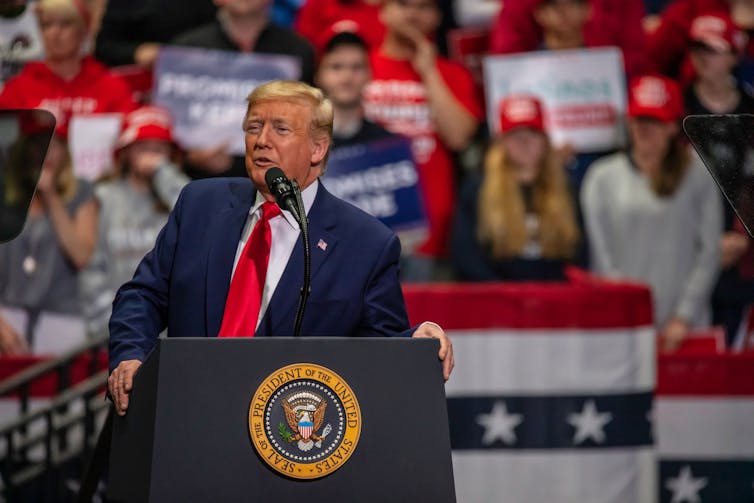 US President Donald Trump addresses a rally in March this year: the virus plays by different rules.
Shutterstock
US President Donald Trump addresses a rally in March this year: the virus plays by different rules.
Shutterstock
Take Boris Johnson’s original argument in favour of a “herd immunity” strategy to avoid disrupting the economy: “You could take it on the chin […] and allow the disease, as it were, to move through the population.”
By mid-March the World Health Organisation (WHO) was publicly questioning the absence of any clinical evidence to support this response, and the Johnson government was ordering a strict national lockdown to suppress the virus.
Now, senior cabinet ministers, including the prime minister, are facing possible prosecution for alleged misconduct in public office, which some say has led to over 60,000 avoidable deaths.
In the US, President Donald Trump responded to warnings about a potential pandemic from the WHO, intelligence agencies and senior officials between late 2019 and March 2020 by reassuring Americans they had nothing to worry about.
Only on March 17 did Trump publicly concede there was a highly contagious “invisible enemy”. But by prioritising the opening of America’s businesses and schools over a lockdown strategy, Trump undermined efforts to overcome dire shortages of PPE and ventilators in a pandemic that has now taken more than 170,000 American lives.
Populism versus pandemic
The inability of the Johnson and Trump governments to deal effectively with a real-world problem like COVID-19 is no coincidence.
Both seemed indifferent to WHO warnings on January 30 that the coronavirus was a “public health emergency of international concern”. They appeared impervious to the concerns of many health-care experts, emphasised a sense of national exceptionalism, and were painfully slow to react as the threat grew.
In contrast, the response by Ardern’s government placed New Zealand in the company of states like South Korea, Taiwan, Singapore, Germany and Vietnam that have managed to keep virus-related deaths to relatively low levels.
Read more: After Trump and Brexit: The coming of the progressive wave
What they have in common is a willingness to heed WHO advice, consult with scientific and health experts, and learn from each other.
To be sure, the Ardern government must be held accountable for its handling of the pandemic. But opposition for opposition’s sake is not the answer in a major health crisis.
Politicians taking advice from those peddling misinformation and populist conspiracy theories run the risk of undermining public health messages and weakening the capacity of the country to suppress a deadly threat.
Furthermore, such tactics have already proved useless against a virus that plays only by the rules of science and objective reality.
To date, there are few signs that many New Zealand voters will be tempted by a politics-first, science-second approach during the COVID-19 crisis. Politicians who take this approach run the risk of a backlash.
Authors: Robert G. Patman, Professor of International Relations, University of Otago

















