

Federal Court finds border closures safest way to protect public health in Clive Palmer case
- Written by: Anne Twomey, Professor of Constitutional Law, University of Sydney
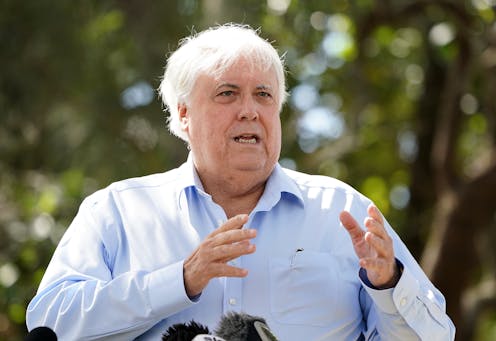
Clive Palmer’s legal challenge to the Western Australian border closures seems less likely to succeed after findings made by the Federal Court.
Palmer started his case in the High Court, arguing the Western Australian border closure breached section 92 of the Australian Constitution, which says trade and commerce among the states and the movement of people across state borders shall be “absolutely free”.
But it’s not as simple as that.
The High Court has previously recognised that laws that are reasonably necessary to achieve another legitimate end, such as protecting public health, may impede the movement of people or goods across state borders. Most people will be familiar, for example, with having to dispose of fruit at state borders to stop the spread of fruit flies.
Stopping the spread of COVID-19 is certainly a legitimate end, so the question is whether a border closure is reasonably necessary to achieve this purpose.
Because the parties in Palmer’s case could not agree on the relevant factual matters, the Federal Court was given the task of hearing the scientific and governmental evidence and making findings on the facts. The matter will then return to the High Court, possibly in October, so it can decide the constitutional issue.
Read more: States are shutting their borders to stop coronavirus. Is that actually allowed?
Justice Darryl Rangiah in the Federal Court has now handed down his decisions on the facts and on an application to have the matter re-heard. He rejected the argument that the Commonwealth’s withdrawal from the case meant he had to start again. As Palmer had said he would adopt the Commonwealth’s evidence and call the Commonwealth’s witnesses in any new hearing, Justice Rangiah thought this would be pointless. He proceeded on the basis of the evidence as presented by all parties and interveners, including the Commonwealth.
Despite favouring Palmer in rejecting the argument for a re-hearing, Justice Rangiah’s separate judgment on the risks and probabilities of the spread of COVID-19 is a cautious one, which appears to favour the Western Australian position.
He accepted that the state’s border restrictions have been effective in reducing the probability of COVID-19 being imported into Western Australia from interstate. He ranked the risks of persons from different states importing COVID-19 into Western Australia if the border restrictions were partially or completely removed. He considered those risks were high for people from Victoria, moderate for those from New South Wales, low for visitors from South Australia, the ACT and the Northern Territory, very low for Tasmanians and uncertain for people from Queensland, given recent outbreaks. But, overall, he ranked the risk of the spread of COVID-19 in Western Australia as “high” if the state’s border restrictions were completely removed.
Critically, Justice Rangiah concluded that replacing border restrictions with mandatory hotel quarantining was not practical because Western Australia could not safely manage such numbers in hotel quarantine. He also thought other public hygiene measures such as mandatory face masks and testing would be less effective than border restrictions in preventing COVID-19 from being imported into Western Australia.
He was critical of the “hot spot” approach used by Queensland and the Northern Territory, finding it was also less effective than border closures. He concluded that due to the uncertainties involved, including predicting human behaviour, and taking into account the potentially serious consequences, a “precautionary approach” should be taken to decision-making about protecting the community.
Where does this leave matters?
When the High Court considers the constitutional issue, it will take broader matters into account. Justice Rangiah confined himself to risks to public health. He expressly did not take into account broader economic, social or other matters.
The High Court is not so constrained and has previously taken into account economic matters when considering the application of section 92.
Read more: WA border challenge: why states, not courts, need to make the hard calls during health emergencies
Another wild card factor is that the factual situation keeps changing. By the time the High Court hears this case, the situation is likely to have changed again. The risk levels, as assessed by Justice Rangiah, may no longer be applicable.
High Court Chief Justice Susan Kiefel has previously raised a concern that the findings on the facts may be “stale” by the time the court gets to decide the matter.
But the important aspect of the Federal Court’s ruling is the assessment about whether other approaches could equally protect public health while still allowing the movement of people across state borders. Once you remove hotel quarantine and hot spot exclusions as effective alternatives, this really only leaves the “travel bubble” idea of permitting entry of people from those states or territories where the risk of transmission of COVID-19 is low or very low.
The assessment of such risks is a moving feast. Not even Justice Rangiah, who is based in Queensland, could give an assessment of Queensland’s risk status at the moment, labelling it as “uncertain”. This makes it very difficult to apply such a risk assessment as a basis of constitutionality.
Of course, all of this is a matter for the High Court, taking into account a range of additional factors. But the Federal Court’s judgment is very helpful in providing a factual base from which to proceed.
Authors: Anne Twomey, Professor of Constitutional Law, University of Sydney


















