

Job-ready graduates changes loom as last straw for emerging researchers
- Written by: Alexie Papanicolaou, Senior Lecturer in Bioinformatics, Western Sydney University
With the federal government making concessions on the Job-ready Graduates Package, we are closer to it becoming law. It’s meant to take effect in 2021. We prepared a submission on behalf of the Australian Academy of Sciences’ EMCR Forum that warns the package is unlikely to achieve its aims, and could drive an exhausted workforce of early and mid-career researchers (EMCRs) from the industry.
The draft legislation lowers student fees for some courses and increases fees for others. The changes also attempt to right wrongs that disadvantaged regional universities, as the sector has evolved since the Dawkins reforms of the late 1980s. In the process, however, the government is reducing its overall funding contribution across all subjects.
Who does most of the research and teaching?
To understand the long-term consequences for research and development, we need to dissect how research and teaching are intertwined and driven by a voiceless cohort within the R&D sector: early and mid-career researchers. They are typically defined as researchers less than 15 years out of their PhD.
Their research outputs in universities, government and industry are critical for Australia’s economy and research standing globally. Their work has helped make education one of the largest contributors to the economy.
The tertiary education sector is worth A$91 billion a year while costing state and federal governments A$38.4 billion a year. When combined with the A$98 billion added from the “professional, scientific, and technical services” sector (which tertiary education trains for), we are talking about a large slice of our economy.
Read more: Early and mid-career scientists face a bleak future in the wake of the pandemic
How will the proposed changes affect scientific research in practice? Research is a painstaking endeavour achieved via often deliberate, always methodical, experimentation, data collection and interpretation. This work can take many years to complete.
On the ground, research is not mainly the work of an individual professor, as often portrayed in popular fiction, but represents the collective work of younger researchers. The countless hours put in by research assistants and emerging research leaders underpins Australia’s scientific output.
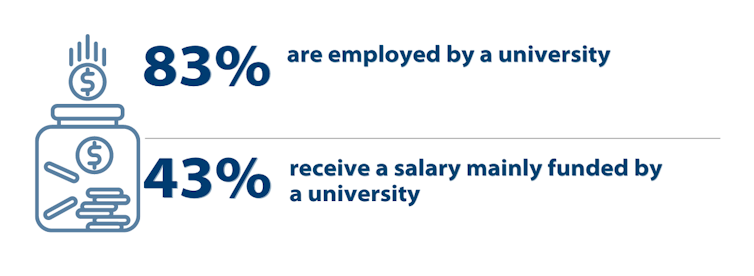 The majority of early to mid-career researchers surveyed by the EMCR Forum are employed by universities.
Over the past few decades, however, individuals with fixed-term contracts do much of the research work (“research only” or “post-docs”) while casual contracts drive much of the teaching and tutoring. They are rarely provided with ongoing, permanent contracts.
Universities often employ early to mid-career researchers on a casual or short-term basis. This leaves them at the mercy of an administrator’s spreadsheet. They are particularly vulnerable as universities look to cut costs due to the impact of the COVID-19 pandemic on revenues.
In the past month alone, the University of Technology Sydney, University of Wollongong, Macquarie University, La Trobe University and Victoria University have announced thousands of expected redundancies into 2021. And these numbers do not include casual or fixed-term positions that have not been renewed, nor redundancies in future years.
Read more: Universities are cutting hundreds of jobs – they, and the government, can do better
While the sector will eventually recover from COVID-19, the EMCR Forum’s work shows even a small disruption to an emerging researcher’s career is likely to lead to their exit from the research and teaching workforce. Their skills and knowledge will be lost with them. One respondent to our survey summed up their plight:
Sessional teaching contracts are cancelled and will not be back. Lots of EMCRs, including me, are facing financial difficulties and uncertainties on top of their increased workload and caring duties. I need to bring [externally funded] projects to uni to employ myself otherwise I can’t pay my mortgage.
These researchers have committed themselves to a sector that in many cases has overworked and underpaid them. They have done so in the hope of building a career, on top of trying to start or support a family after training that usually lasts ten years or more.
Also lost when these researchers leave is the taxpayer investment in their training. We estimated this at A$168,032 to $A332,344 per new researcher for an undergraduate degree, PhD direct costs and PhD stipend. Post-PhD training can add another A$300,000 over three years including salary and associated costs.
Federal funding cuts will be the final straw
The government based its proposed changes on a Deloitte report that failed to substantiate what form higher education reform ought to take.
Our submission challenged the report’s reliance on questionable statistics. It also avoided drilling down into the causes of variation in university costs. For example, the University of Sydney and James Cook University were treated as equals, including their mission and the people they serve.
That the government allowed less than a week for public consultation on the draft legislation only worries us more.
If a projected increase in student numbers, and hence fee revenue, overcomes the shortfall in university budgets, then vice chancellors are more likely to be satisfied. That may look good when viewed in a spreadsheet, but not if viewed through the lens of the 5,000-plus members of the EMCR Forum.
Early and mid-career researchers – as the “junior” (and therefore cheaper) teaching staff – know COVID-19 has overwhelmed them to the point of exhaustion. These reforms will be the final straw for young researchers as universities declare that further “efficiencies” will be needed to teach within their reduced budgets. The chief executive of the Group of Eight universities, Vicki Thomson, stated:
We are being asked to teach more students with less support at a time when, collectively, the Group of Eight is facing a $2 billion revenue downgrade in 2020 and most likely worse to follow in 2021.
Read more: Coronavirus and university reforms put at risk Australia's research gains of the last 15 years
The Group of Eight is among those seeking a Senate review.
Australia can’t afford to lose these researchers
These policies will have a direct and broad impact on Australian society. A vastly reduced research capacity will cripple our ability to overcome the challenges we face. No generation of scientists has been needed more as bushfires, drought, floods, international tensions, trade protectionism and racism at the highest level of global governance are coming to a head.
As the people who underpin Australia’s research capacity are now preparing for a bleak future, the federal government has chosen once more to sacrifice Australia’s economy and climate change resilience. The consequences could end our reputation as the lucky country.
Authors: Alexie Papanicolaou, Senior Lecturer in Bioinformatics, Western Sydney University


















