

Facebook and Google used to be the future of news. But now media companies need more strings to their bow
- Written by James Meese, Research fellow, RMIT University
Given the recent commentary about the reforms proposed for the news media sector, you would be forgiven for thinking Google and Facebook are the only game in town.
The planned reforms arose from last year’s Digital Platforms Inquiry by the Australian Competition and Consumer Commission (ACCC), which focused squarely on the corporate behaviour of these two tech behemoths.
It is clear Google and Facebook will be the first platforms regulated under the draft mandatory code that will potentially force them to pay for content produced by Australian news media companies. The move is a response to what the ACCC describes as “a significant bargaining power imbalance […] between Australian news media businesses and Google and Facebook”.
This idea that news companies are essentially stuck with Google and Facebook, for better or worse, is a common view. Yet while that might have been true a few years ago, media companies are realising there are other ways to cultivate readers, and there’s no need to be beholden to tech platforms that generate clicks but don’t want to pay for the privilege.
In the mid-2010s, many news companies seemed to follow Facebook’s every move. When Facebook promoted video, the media invested in video. When it down-ranked clickbait headlines, content writers frantically altered their style to maintain their presence in the news feed. Newsrooms have had a similarly dependent (albeit less direct) relationship with Google.
The focus on adapting to Google and Facebooks’s algorithms completely changed newsroom practices over the past decade, as journalists have weighed editorial considerations against audience metrics.
Is this still the case?
This dependency developed at a time when major platforms, particularly Facebook, were engaging substantially with the distribution of news. But in recent years this trend has declined, as governments have begun to regulate platforms in response to concerns over “fake news”.
Facebook performed perhaps the most public pivot, changing its algorithm in January 2018 to promote content from users’ friends and family. As a result, traffic to news sites fell, leaving profit-starved media companies to pursue alternative strategies or simply lay off staff.
Read more: 'Suck it and see’ or face a digital tax, former ACCC boss Allan Fels warns Google and Facebook
In our research, published earlier this year, we spoke to 15 Australian journalists and editors who had collectively worked across 11 media companies after the dust had settled from the 2019 crisis.
We asked them whether their companies still depend on Facebook for traffic, or whether they have moved to other platforms, or are now doing something else entirely to cultivate their readership.
Breaking up with Facebook
Many respondents, particularly those who had worked at newer companies focused on social media, revealed they had followed the demands of the Facebook algorithm at times. They had pivoted to video and had focused on share counts. However, respondents working at older media companies also noted that lots of readers still visited their publication’s home page, which challenges the idea that companies depend totally on Facebook.
Companies were also exploring different ways of generating revenue. These included placing ads inside content (known as native advertising) and holding events.
The standout trend, however, was a renewed focus on subscriptions, ensuring that a certain percentage of readers actually paid money for the news product at some point.
The Conversation (which does not charge for access to its content) was one of the newsrooms that saw a steep drop in traffic as a result of the January 2018 algorithm change. As such, it has pivoted its digital strategy to prioritise the channels over which it has the most control, particularly its daily newsletter.
That’s not to say companies have stopped trying to engage with big platforms. Many are consciously trying to make their news easy to find via Google search (a process called search engine optimisation. Some companies (including The Conversation) have also begun distributing news through Instagram (which is owned by Facebook).
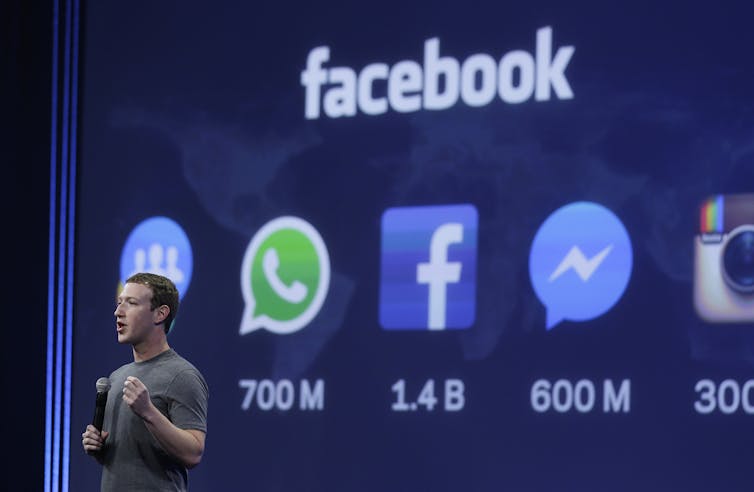 Yes, Facebook has literally billions of users. But it’s not the only way to reach readers.
Eric Risberg/AP
Yes, Facebook has literally billions of users. But it’s not the only way to reach readers.
Eric Risberg/AP
Yet although the big platforms are doubtless here to stay, our research reveals a distinctly changed relationship between news and social media, compared with the past decade. Many companies, particularly newer ones like Buzzfeed and Vice, previously built huge audiences off the back of social media, and grew at a dizzying rate as a result. Now, companies are more interested in securing a stable revenue stream than in harvesting clicks.
The pandemic effect
This has become even more important amid the economic chaos caused by COVID-19. Advertising spending has dried up, leading to another round of media industry layoffs.
This suggests news media are still struggling to secure an alternative income stream to plug the hole in advertising revenue. The big question is whether big tech platforms will step in and help fill the gap by making financial contributions to news providers. Google’s current campaign against the draft mandatory code suggests they are deeply unwilling to do this.
Our research shows the relationship between news media and big tech platforms is far from straightforward. This is supported by a recent survey, which found that while many young people access news through social media, older people still prefer television or news websites. Not every Australian gets their news via social media.
There may come a time when platforms become the central access point for news, but it hasn’t happened yet. This doesn’t mean the ACCC should abandon platform regulation, but it does mean news companies are probably wise to find other ways of reaching their readers while they still can.
Authors: James Meese, Research fellow, RMIT University

















