

How COVID caused chaos for cricket – and may force a rethink of all sport broadcasting deals
- Written by: Jack Anderson, Professor of Sports Law, Melbourne Law School, University of Melbourne
Cricket Australia faces a summer of discontent.
The disruption caused by the COVID-19 pandemic has exposed financial and governance tensions and mistrust involving its players’ and state associations. However, those issues are a distant second to the current dissatisfaction and distrust that one of the sport’s broadcasting partners has with the quality and scheduling of the upcoming domestic playing season.
Channel Seven’s A$450 million concern with the restricted number of Australian international cricketers who might appear in this year’s BBL tournament now threatens to destabilise the sport’s principal source of revenue – the combined Foxtel and Seven six-year broadcasting deal signed in 2018 and worth A$1.18 billion over its six-year term.
COVID causes chaos
In March, it had all looked so different. On International Women’s Day 2020, the MCG hosted the ICC Women’s T20 World Cup Final. Played in front of 86,000 people, Australia’s victory over India was a suitable end to a highly successful tournament. Within a week sport in Melbourne – including the first Formula 1 race of the year – and indeed globally had to shut down due to the pandemic.
Of all the major sports in Australia, cricket seemed the best equipped to survive the coronavirus lockdown. By then, 90% of the season had been completed. The men’s T20 World Cup tournament, to be hosted by Australia, was not scheduled until October, a month that marked the second anniversary of the appointment of the then CEO of Cricket Australia (CA), Kevin Roberts.
And yet the following month 80% of staff at Cricket Australia were stood down. The CEO was indicating that by August cricket would, to the amazement of many within the sport, have severe cashflow problems.
Read more: World Cup 2023 will be a massive boost for women's sport – but does it make financial sense?
By June it was clear the men’s T20 World Cup would have to be postponed and Roberts was gone. He was replaced on an interim basis by Nick Hockley, then the CEO of the T20 World Cup local organising committee who had overseen the successful women’s T20 World Cup earlier in the year.
The previous Cricket Australia CEO, James Sutherland, had been in the job for 17 years. In contrast, 2020 was a precarious year to be a CEO in Australian sport – the CEOs of both Rugby Australia (RA) and the National Rugby League (NRL) also departed their jobs in April.
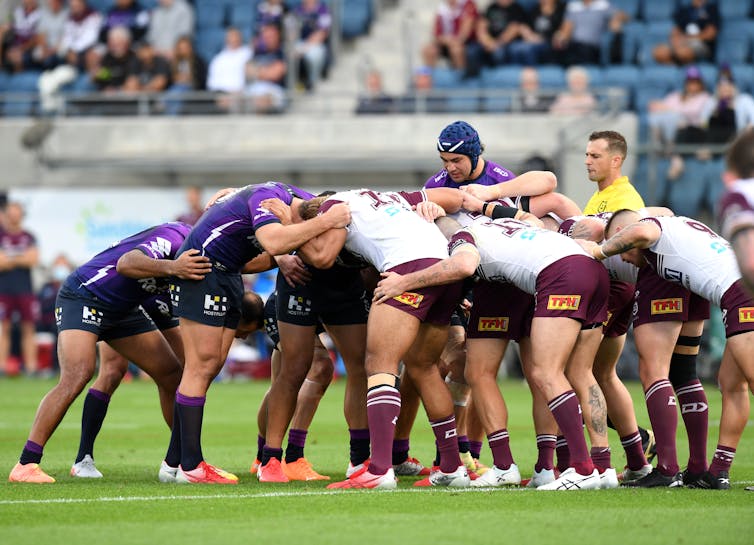 2020 has been a precarious year for many sporting codes, including NRL.
Dan Peled/AAP
2020 has been a precarious year for many sporting codes, including NRL.
Dan Peled/AAP
Reflecting on the year’s instability, Sutherland commented empathetically that when you’re a sports administrator, you can deal with anything but uncertainty.
And for all Australian sports, 2020 has brought nothing but uncertainty to their finances, competition scheduling and administration.
Too much riding on broadcast deals
However, one point that has been constant in the operation of elite professional sport in Australia and elsewhere is how dependent their revenues are on TV broadcasting deals. The AFL’s revenue in 2019 was just shy of A$800 million, half of which related to broadcasting and media. Broadcasting accounted for 61% of the NRL’s total revenue last year.
The lengths to which the AFL and the NRL have gone to ensure their seasons go ahead – from biosecurity hubs and lobbying state and federal governments for border exemptions, to pay cuts for players and staff – must be seen in the context of their dependency on TV money.
In April, the equation for the AFL and NRL, as it was for Rugby Australia and the Football Federation of Australia (FFA) whose schedules were also affected, was simple: in the absence of games, there would be no obligation on broadcasters to honour their TV rights deals. This meant up to two-thirds of the sport’s revenue would disappear overnight.
In terms of contract law, broadcasters hinted at provisions in the agreements with sports such as force majeure clauses (unforeseeable circumstances), acts of God and other principles of contract law, such as the doctrine of frustration.
Broadcasters argued these would allow them to walk away from existing deals given that, for reasons outside both parties’ control, the playing season could not go ahead as scheduled, if at all.
Even as sports bodies desperately gave them assurances a season would go ahead, broadcasters remained adamant that the product they had originally paid for was now of such a different variety that the original broadcasting deal would have to be stood down and terms and conditions renegotiated.
Clearly, it was in the interest of the above sports bodies to enter into such negotiations. They did so with alacrity and some success. It must also be noted that an absence of live TV would likely have had an impact on what has fast become the second-most-important source of review for Australian sport – gambling.
For the broadcasters, as the playing seasons in the AFL, NRL and other codes were about to begin, they were acutely aware that without sport a significant advertising hole would be left in their schedules for the next six months. Moreover, given the pandemic had halted production of other advertising-rich programs such as reality TV, and the postponement of key international events such as the Olympics would exacerbate the scarcity of live sport on the schedules, it was also in the interest of broadcasters not to walk away from such deals.
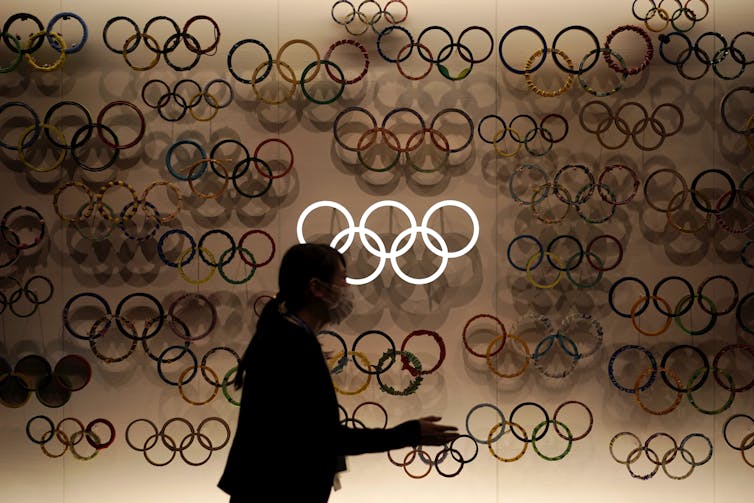 The postponement of the 2020 Tokyo Olympics added further pain for broadcasters.
Eugene Hoshiko/AP/AAP
The postponement of the 2020 Tokyo Olympics added further pain for broadcasters.
Eugene Hoshiko/AP/AAP
Lessons from a difficult year
The lessons from all of this are that, despite its protestations, it seems inevitable Cricket Australia will also have to renegotiate its broadcasting deal with Seven. The reality for modern sports organisations is that, while they rightly lament the absence of spectators, a dearth of subscribers does much greater commercial damage.
Cricket Australia faces a slightly trickier situation than the AFL, NRL and others faced earlier in the year. A key concern for the domestic broadcasters is that CA has been frustratingly slow in confirming its summer schedule.
Moreover, in renegotiating with other sports, there was never an issue that the best players available domestically in those sports would not play. Given the international demands and scheduling in cricket – notably Test matches against India and Afghanistan – it seems CA cannot guarantee the availability of the quality of player in competitions such as the BBL that the broadcasters feel their money deserves.
While matters now seem tense between CA and its broadcasting partners, the current standoff is probably all just part of the preening process. Already, CA has responded by indicating it will be more aggressive in its recruitment of marquee international players for the BBL. It has also raised the salary cap for those on BBL rosters. A “relaunched” BBL in its tenth year and over the summer holiday period would be an attractive proposition.
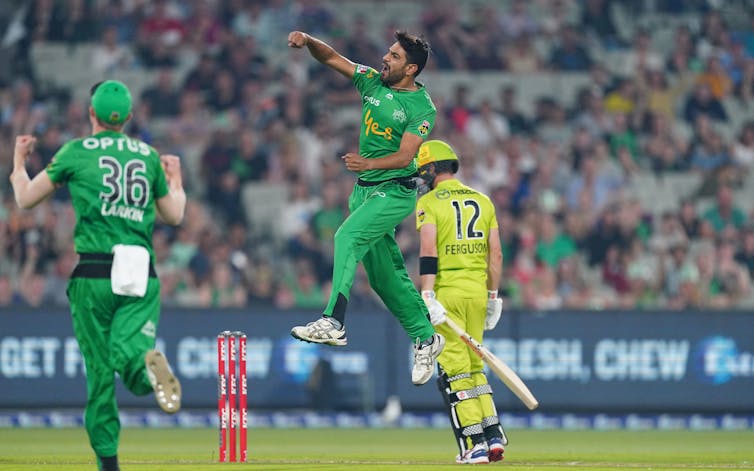 A relaunched Big Bash League (BBL) this coming summer could be an attractive proposition.
Scott Barbour/AAP
A relaunched Big Bash League (BBL) this coming summer could be an attractive proposition.
Scott Barbour/AAP
As the interim chief of CA, who is in an unenviable position, contemplates the inevitable phone call with the broadcaster, it might be advisable for him first to call the CEOs of the other sports organisation that have been recently through this process. The sport’s former, long-time boss Sutherland, recently installed as the CEO of Golf Australia, would also be worth talking to. Their experience could be invaluable for cricket in the weeks ahead.
Read more: Why the fall-out from postponing the Olympics may not be as bad as we think
Finally, an interesting subtext to all of this is the emerging view that sports rights are overvalued and the future of such deals lies elsewhere in streaming services and on other digital, even in-house platforms.
But that is a matter for the future. For now, cricket powerbrokers should heed the advice of one of sport’s most colourful dealmakers, the boxing promoter Don King, who once said that, in sports contracts, you never get what you deserve, you get what you negotiate.
Authors: Jack Anderson, Professor of Sports Law, Melbourne Law School, University of Melbourne


















