

How fake assistance animals and their users are gaming the system and increasing prejudices
- Written by: Paul Harpur, Senior Lecturer, TC Beirne School of Law, The University of Queensland
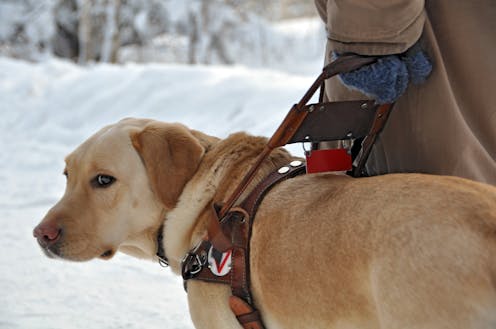
Reports recently emerged of accusations against Uber drivers in the United Kingdom regularly refusing to take a cerebral palsy sufferer as a passenger because of her service dog.
This follows a number of reports pointing to the growth of fake disability assistance animal documentation. Our 2016 workshop found documentation fraud also occurs in Australia.
These issues highlight the confusion around the distinction between pets and disability assistance animals. Our recent research shows that, amid the confusion, faking and gaming also occur regularly, and there is a lack of understanding of when an animal is and is not legally protected.
Confusion and vague legal distinctions are ripe for exploitation
Guide dogs help people who are blind and deaf, while assistance animals help those with physical and mental impairments. Other animals can provide therapeutic and emotional support for people with psychological and emotional conditions. To be recognised in Australia, an assistance animal must have appropriate training in helping people with disabilities manage their conditions.
Read more: Commonwealth Games have better integrated para-sports, but society needs to catch up
While some accreditation systems operate in the state and territory jurisdictions, the Federal Disability Discrimination Act 1992 contains no requirement for accreditation and overrides state and territory laws. A person can thus claim their animal is protected as an assistance animal without any form of accreditation. For instance, a key finding of Mulligan v Virgin Australia Airlines 2015 was that an animal could be trained by an organisation outside of those accredited by the act.
People with valid assistance animals continue to face discrimination, even where the legal status of the animal is clear. Urgent legal and policy attention is therefore required to promote greater awareness in dealing with a person who is accompanied by an animal.
Unscrupulous businesses in the UK are exploiting the current regulatory framework to sell under-trained animals to people with disabilities. Similarly, fake apparel and documentation designed to enable disability fraud are now being cracked down on in many US states. Documentation checks are not as common in Australia, although our 2016 workshop found signature fraud still occurred.
Our study of fake assistance animals identifies:
• Users who do not have a disability and are not entitled to use an assistance animal. Accredited trainers in our study had found their accreditation documents fraudulently provided to airlines. However, other duty holders found it was not commercially viable to challenge documentation and apparel.
• Users who are entitled to an assistance animal, but the animal is inadequately trained, or the person with a disability has decided to use a species where no training standards exist. These species are extended protection in anti-discrimination laws in most states, but do not have the same level of training standards of guide-dogs.
• Instances where both the user and assistance animal are un(der)-qualified.
Assistance animal misuse harms all of us
The issues arising from fake assistance animal use are manifold. First, people may obtain undeserved benefits from transport operators, schools, hospitals, and other public or private service providers.
Second, it consumes resources that should otherwise be available for people with actual disabilities and assistance animals.
Third, it fuels negative public perceptions and feeds prejudicial attitudes about disability animals and their users. The effect on public perceptions and prejudicial attitudes may also disproportionately affect those with “invisible” or less obvious or accepted disabilities.
Finally, fake assistance animals may be poorly trained, posing public health and safety risks. In one reported case, a poorly trained Saint Bernard wearing a service vest attacked a quadriplegic woman’s golden retriever service dog after being “startled” by the woman’s wheelchair.
There are also numerous harms arising from the discrimination of legitimate assistance animals. For example, it may result in people being unable to attend critical medical appointments and generally lead an independent and meaningful life. It also consumes emotional resources for the person with the disability to constantly reassert their rights. And it may discourage users of disability animals from certain modes of transportation and venues, among other things. This may have a greater impact on those with “invisible” disabilities.
Time for a national accreditation system
Ongoing doubts over the scope for the legitimate use of assistance animals causes harm to people with disabilities. It adds to insecurity and uncertainty about whether their assistance animal is afforded legal protection and whether access to public spaces and services will be granted.
Moreover, for those with legal responsibilities to respect the rights of people with disabilities, there exists the prospect of legal proceedings and potential financial liability for wrongfully denying access to an assistance animal. Conversely, there are harms that flow from wrongfully granting access to an animal that is not accredited or properly trained.
Read more: Four Corners: can the NDIS prevent abuse of people with disability?
Ultimately, the lack of government certification creates a difficult situation where duty-holders and people with disabilities need to negotiate access rights against opaque statutory definitions.
We argue that it would be desirable for law-makers to create a national system in which training institutions can become accredited and authorised to assess and accredit disability service animals.
Such measures are becoming increasingly common in the US. In response to widespread disability assistance animal fraud in Indiana, the Senate recently passed a bill entitling landlords to ask for evidence the person is not gaming the system.
Authors: Paul Harpur, Senior Lecturer, TC Beirne School of Law, The University of Queensland


















