

How to win an election? Do the substance as well as the theatre of politics
- Written by: Chris Wallace, Associate Professor, 50/50 By 2030 Foundation, Faculty of Business Government & Law, University of Canberra
This is an edited extract from Chris Wallace’s book, How to Win an Election, NewSouth Books.
Leadership challenges make terrific political theatre – the kind leaders themselves want to avoid. To do so they have to do the substance and theatre of politics well enough to keep their job and win elections.
Not doing the theatre of politics well enough means no one will ever know how well they do the substance, because no one will listen or watch to find out. The public sphere, as sociologist Ari Adut puts it, is “simply a space of appearances” that is sensory, largely visual, involves distance, and of which spectatorship is the essence – in short, it is spectacle.
 Further, theatre is about emotion. The prime error made by contemporary social democratic politicians is to rely on reasoned argument to sway voters. Emotion trumps reason every time. Labor relies overwhelmingly on reason and facts to carry the day, making it easy pickings for right-wingers who understand the primacy of emotion and exploit it to the hilt.
Earnest political players may scoff at the importance of politics’ thespian dimension, but even cursory consideration of a few prominent examples makes the point. As with Ronald Reagan, many of Bill Clinton’s speeches were banal on the page but tremendously effective, and sometimes electrifying, in the delivery. In contrast, Hillary Clinton’s speeches read well on the page but tended to fall flat in the delivery. The two outstanding examples of politicians whose speeches read brilliantly and were delivered brilliantly – Winston Churchill and John F. Kennedy – put tremendous time and effort into getting both the texts of their speeches and the performance of those texts absolutely right.
Who was the last Labor leader to pull off this double?
The Shorten-Morrison contest in 2019, on the Labor side, was bad theatre. Had Bill Shorten won rather than narrowly lost the 2013 election against Malcolm Turnbull, perceptions of him might have undergone the kind of transformation Gough Whitlam’s did on winning office in 1972. As opposition leader, though, Shorten’s presentational problems symbolised his situation and caged him in them.
Ill-fitting suits with overly large coats made him look like a boy in a grown-up’s clothes. He spoke at voters rather than with them. They appeared as passive listeners to a politician rather than feeling a fellow human being was communicating with them, seeking their trust and favour.
Compare and contrast with Bob Hawke, whose enviable ability to be only and obviously himself, in public and in private, flaws and all, made him a national phenomenon and helped Labor win four consecutive elections in 1983, 1984, 1987 and 1990.
Further, theatre is about emotion. The prime error made by contemporary social democratic politicians is to rely on reasoned argument to sway voters. Emotion trumps reason every time. Labor relies overwhelmingly on reason and facts to carry the day, making it easy pickings for right-wingers who understand the primacy of emotion and exploit it to the hilt.
Earnest political players may scoff at the importance of politics’ thespian dimension, but even cursory consideration of a few prominent examples makes the point. As with Ronald Reagan, many of Bill Clinton’s speeches were banal on the page but tremendously effective, and sometimes electrifying, in the delivery. In contrast, Hillary Clinton’s speeches read well on the page but tended to fall flat in the delivery. The two outstanding examples of politicians whose speeches read brilliantly and were delivered brilliantly – Winston Churchill and John F. Kennedy – put tremendous time and effort into getting both the texts of their speeches and the performance of those texts absolutely right.
Who was the last Labor leader to pull off this double?
The Shorten-Morrison contest in 2019, on the Labor side, was bad theatre. Had Bill Shorten won rather than narrowly lost the 2013 election against Malcolm Turnbull, perceptions of him might have undergone the kind of transformation Gough Whitlam’s did on winning office in 1972. As opposition leader, though, Shorten’s presentational problems symbolised his situation and caged him in them.
Ill-fitting suits with overly large coats made him look like a boy in a grown-up’s clothes. He spoke at voters rather than with them. They appeared as passive listeners to a politician rather than feeling a fellow human being was communicating with them, seeking their trust and favour.
Compare and contrast with Bob Hawke, whose enviable ability to be only and obviously himself, in public and in private, flaws and all, made him a national phenomenon and helped Labor win four consecutive elections in 1983, 1984, 1987 and 1990.
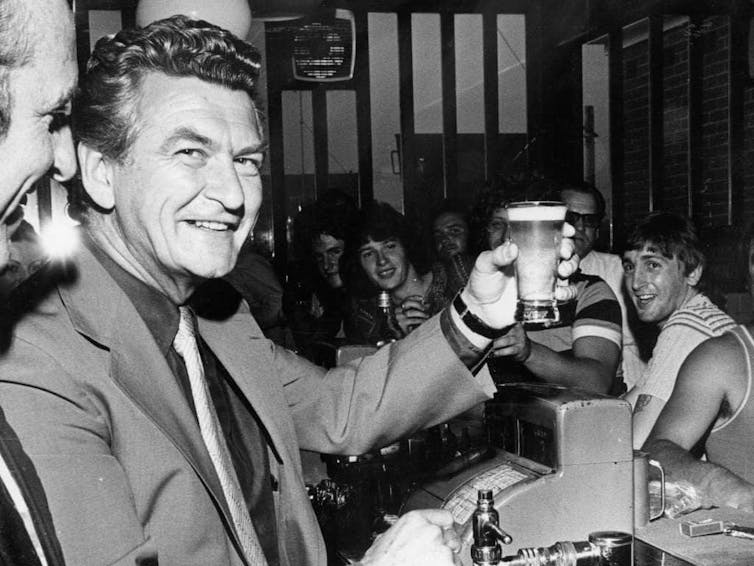 Bob Hawke understood well that good political leadership required theatre and substance.
Women's Agenda
A university visit Shorten made to address a student meeting a few years ago suggested he was able to change gears if he wanted. The vice-chancellor attended. A wooden performance from Shorten ensued until one student asked an especially challenging question. Shorten electrified the meeting with the brilliance and conviction of his response, then reverted to his previous mode.
Afterwards the vice-chancellor raised the dramatic, impressive but temporary change in tenor for that one question and asked why he didn’t speak that way all the time. Shorten said his office forbade it as insufficiently “leader-like”.
So it did not have to be this way. Shorten could have been less wooden and more engaging, making him more credible and likeable – that is, more electable.
Read more:
How might Labor win in 2022? The answers can all be found in the lessons of 2019
Nor was it as though Scott Morrison was strong on the “trust” front himself. He had a documented record of sketchy performances in positions of responsibility, departing from two jobs under a cloud after serious governance failures – firstly, as director of the New Zealand Office of Tourism and Sport (1998-2000) and secondly in Australia under the Howard government as managing director of Tourism Australia (2004-2006).
In 2018, colleagues noted the cynicism and cunning of Morrison and his supporters in their manipulation of Peter Dutton into a leadership tilt against Turnbull, and then of Turnbull out of a prime ministership while ostensibly remaining loyal to Turnbull, with Morrison himself magically emerging from the fray as prime minister. Post-election revelations about the A$100 million “sports rorts” affair, overseen by Morrison’s office in a way that bent the flow of cash to boost the government’s prospects in marginal seats, reinforced concerns about his trickiness.
Nevertheless, Morrison easily bettered Shorten in the theatre of politics for the duration of the 2019 election campaign, when it really counted. Political scientist Glyn Davis, paraphrasing research by American sociologist Frederic Milton Thrasher on Chicago gang leaders in the 1920s, noted the leader “must embody those attributes the gang most values […] must be of the culture”.
So it was that Morrison interacted enthusiastically with every ordinary voter in sight, left no sizzled sausage voraciously uneaten, and radiated palpable energy through the media coverage of those interactions to voters not there. Shorten and his wooden ways looked lower energy and less relatable by comparison. Relative to Shorten – and that is an important qualification – Morrison visibly connected with enough people in enough places, amplified through the media, to boost his chance of winning significantly.
Bob Hawke did the same for Labor, informed by and advancing social democratic rather than conservative values, in his four consecutive election wins from 1983. Voters want to feel, vicariously if they cannot get it directly, energy and connection.
Bob Hawke understood well that good political leadership required theatre and substance.
Women's Agenda
A university visit Shorten made to address a student meeting a few years ago suggested he was able to change gears if he wanted. The vice-chancellor attended. A wooden performance from Shorten ensued until one student asked an especially challenging question. Shorten electrified the meeting with the brilliance and conviction of his response, then reverted to his previous mode.
Afterwards the vice-chancellor raised the dramatic, impressive but temporary change in tenor for that one question and asked why he didn’t speak that way all the time. Shorten said his office forbade it as insufficiently “leader-like”.
So it did not have to be this way. Shorten could have been less wooden and more engaging, making him more credible and likeable – that is, more electable.
Read more:
How might Labor win in 2022? The answers can all be found in the lessons of 2019
Nor was it as though Scott Morrison was strong on the “trust” front himself. He had a documented record of sketchy performances in positions of responsibility, departing from two jobs under a cloud after serious governance failures – firstly, as director of the New Zealand Office of Tourism and Sport (1998-2000) and secondly in Australia under the Howard government as managing director of Tourism Australia (2004-2006).
In 2018, colleagues noted the cynicism and cunning of Morrison and his supporters in their manipulation of Peter Dutton into a leadership tilt against Turnbull, and then of Turnbull out of a prime ministership while ostensibly remaining loyal to Turnbull, with Morrison himself magically emerging from the fray as prime minister. Post-election revelations about the A$100 million “sports rorts” affair, overseen by Morrison’s office in a way that bent the flow of cash to boost the government’s prospects in marginal seats, reinforced concerns about his trickiness.
Nevertheless, Morrison easily bettered Shorten in the theatre of politics for the duration of the 2019 election campaign, when it really counted. Political scientist Glyn Davis, paraphrasing research by American sociologist Frederic Milton Thrasher on Chicago gang leaders in the 1920s, noted the leader “must embody those attributes the gang most values […] must be of the culture”.
So it was that Morrison interacted enthusiastically with every ordinary voter in sight, left no sizzled sausage voraciously uneaten, and radiated palpable energy through the media coverage of those interactions to voters not there. Shorten and his wooden ways looked lower energy and less relatable by comparison. Relative to Shorten – and that is an important qualification – Morrison visibly connected with enough people in enough places, amplified through the media, to boost his chance of winning significantly.
Bob Hawke did the same for Labor, informed by and advancing social democratic rather than conservative values, in his four consecutive election wins from 1983. Voters want to feel, vicariously if they cannot get it directly, energy and connection.
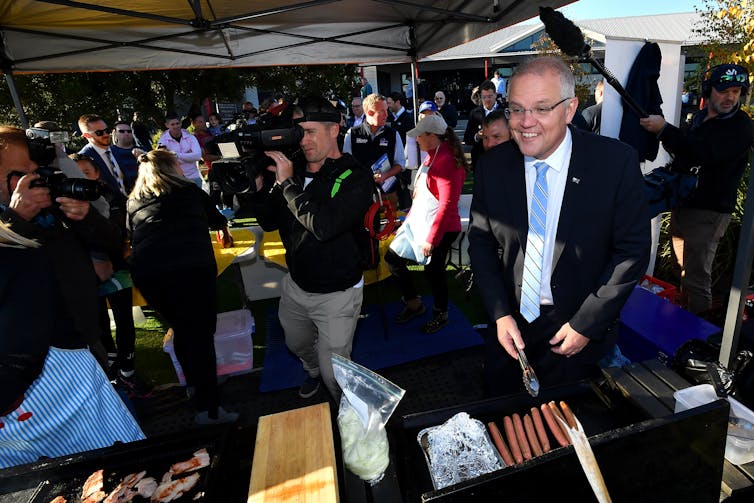 Scott Morrison understands political theatre well and performed it to a tee in the 2019 election.
AAP/Mick Tsikas
“It is often said of democratic politics,” historian David Runciman pointed out astutely, “that the question voters ask of any leader is: ‘Do I like this person?’
But it seems more likely the question at the back of their minds is: ‘Would this person like me?’”
Morrison enthusiastically made encounters with voters appear to be all about them, conveying the impression he really liked the ordinary Australians he met on the election trail. Viewers of news reports carrying pictures of these interactions day in, day out, during the campaign were more likely to think he would like them too.
With Shorten, it too often seemed to be about him as he stayed controlled and within himself, smiling but slightly distant, looking ahead to the next person whose hand had to be shaken almost before he finished shaking the one in front of him.
Morrison’s mishandling of the national crisis over the summer of 2020 – secretly going on holiday to Hawaii while the east coast was ablaze, having his office deny he was there, reluctantly returning when he was found out, failing to show compassion for affected communities and then attempting to exploit the situation for political gain through ads designed to burnish his leadership standing – revealed his true self. But he managed to devise, create and perform the “daggy dad” political persona for the five weeks of the 2019 election campaign sufficiently well to see off Shorten’s prime ministerial prospects for good.
Scott Morrison understands political theatre well and performed it to a tee in the 2019 election.
AAP/Mick Tsikas
“It is often said of democratic politics,” historian David Runciman pointed out astutely, “that the question voters ask of any leader is: ‘Do I like this person?’
But it seems more likely the question at the back of their minds is: ‘Would this person like me?’”
Morrison enthusiastically made encounters with voters appear to be all about them, conveying the impression he really liked the ordinary Australians he met on the election trail. Viewers of news reports carrying pictures of these interactions day in, day out, during the campaign were more likely to think he would like them too.
With Shorten, it too often seemed to be about him as he stayed controlled and within himself, smiling but slightly distant, looking ahead to the next person whose hand had to be shaken almost before he finished shaking the one in front of him.
Morrison’s mishandling of the national crisis over the summer of 2020 – secretly going on holiday to Hawaii while the east coast was ablaze, having his office deny he was there, reluctantly returning when he was found out, failing to show compassion for affected communities and then attempting to exploit the situation for political gain through ads designed to burnish his leadership standing – revealed his true self. But he managed to devise, create and perform the “daggy dad” political persona for the five weeks of the 2019 election campaign sufficiently well to see off Shorten’s prime ministerial prospects for good.
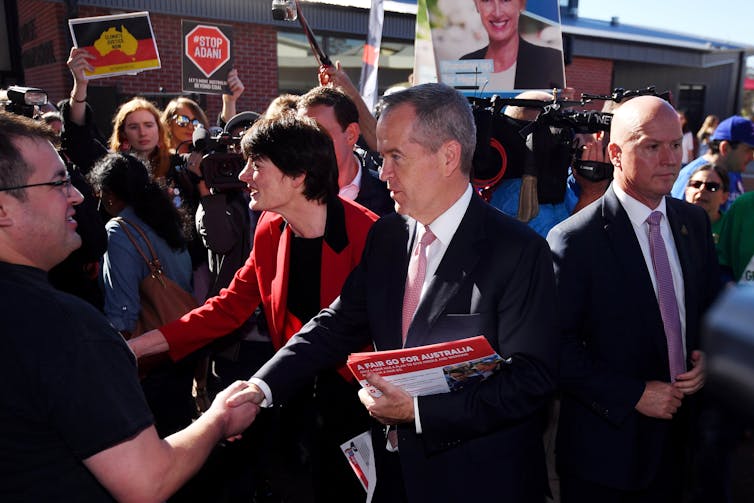 Too often, Shorten seemed stiff when meeting people on the election trail – it was more about him, and not about them.
Lukas Coch/AAP
Winning the theatre of politics does not always come down to good looks, likeability or the ability to scoff sausages like a local, but it does always come down to the better performance. In his successful 1993 election campaign, Paul Keating was respected and awesomely powerful in his public arguments and interventions – so much so that his opponent, John Hewson, cracked under the media pressure orchestrated by Keating’s relentless pursuit of him on policy grounds.
Read more:
She won't be right, mate: how the government shaped a blokey lockdown followed by a blokey recovery
The campaign yielded two of the most memorable images of modern Australian politics: Lorrie Graham’s photograph of Keating cheekily peering over a pair of dark sunglasses on the cover of Rolling Stone magazine, and a perspiring Hewson facing Mike Willesee’s forensic examination on the Nine Network’s A Current Affair of the way his proposed goods and services tax would apply to the purchase of a birthday cake. Keating was cool; Hewson perspired under pressure. Keating won the substance and theatre of the campaign, the theatre powerfully coming, during the campaign, to symbolise the substance.
So successful leaders need to be able to do both, ideally in a way that enables voters to say yes when asking themselves the question: “Do I like this person and, more importantly, would they like me?” A leader who can do the substance and theatre of politics will beat a competitor who can only do the substance or theatre of politics every time.
Too often, Shorten seemed stiff when meeting people on the election trail – it was more about him, and not about them.
Lukas Coch/AAP
Winning the theatre of politics does not always come down to good looks, likeability or the ability to scoff sausages like a local, but it does always come down to the better performance. In his successful 1993 election campaign, Paul Keating was respected and awesomely powerful in his public arguments and interventions – so much so that his opponent, John Hewson, cracked under the media pressure orchestrated by Keating’s relentless pursuit of him on policy grounds.
Read more:
She won't be right, mate: how the government shaped a blokey lockdown followed by a blokey recovery
The campaign yielded two of the most memorable images of modern Australian politics: Lorrie Graham’s photograph of Keating cheekily peering over a pair of dark sunglasses on the cover of Rolling Stone magazine, and a perspiring Hewson facing Mike Willesee’s forensic examination on the Nine Network’s A Current Affair of the way his proposed goods and services tax would apply to the purchase of a birthday cake. Keating was cool; Hewson perspired under pressure. Keating won the substance and theatre of the campaign, the theatre powerfully coming, during the campaign, to symbolise the substance.
So successful leaders need to be able to do both, ideally in a way that enables voters to say yes when asking themselves the question: “Do I like this person and, more importantly, would they like me?” A leader who can do the substance and theatre of politics will beat a competitor who can only do the substance or theatre of politics every time.
Authors: Chris Wallace, Associate Professor, 50/50 By 2030 Foundation, Faculty of Business Government & Law, University of Canberra


















