

Victoria's roadmap out of lockdown is the wrong approach. Here's what good public policy looks like
- Written by: Marc Stears, Professor and Director, Sydney Policy Lab, University of Sydney
In the early months of the pandemic, Australia’s public policy response to COVID-19 was widely celebrated across the world. The missteps and extended lockdowns in Victoria recently, though, shows how at least one state has slipped from being a gold standard.
So, what has gone wrong?
Effective public policy-making in a pandemic is enormously difficult. Very few countries around the world, if any, have had an exemplary record in the past few months. There are nonetheless a set of key principles that should underpin approaches to decision-making.
What good policy-making looks like
Identifying those principles begins with accepting that pandemics are, by definition, international. They sweep across the world. Terrible though this is in many ways, it nonetheless provides policy-makers with the opportunity to learn from the experiences of others.
Early on in the pandemic, other countries learned swiftly from the horrific impact of the virus on Italy and were able to adjust their policy responses accordingly.
Similarly, as the pandemic has worn on, governments have increasingly recognised the potentially devastating consequences of blunt “stay at home” orders on mental health, social connections and the broader economy. As a result, they have sought to switch their emphasis away from sweeping lockdowns in favour of intensive testing, contact tracing and helping people to self-isolate with financial assistance, if required.
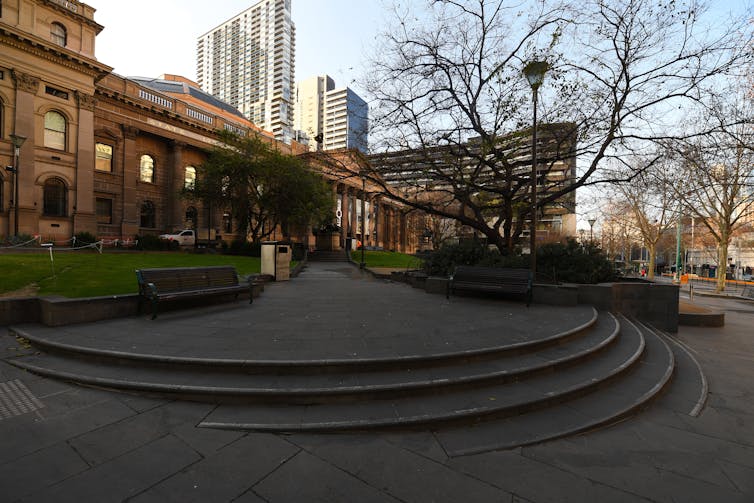 Victoria’s lockdown has been among the most strict in the world.
James Ross/AAP
Victoria’s lockdown has been among the most strict in the world.
James Ross/AAP
In addition to widening the circle of other nations from which they take advice, governments need to have a willingness to engage a broad range of expertise.
In the early days of the pandemic, epidemiologists — especially those gifted in mathematical modelling — understandably held enormous sway.
However, it has become clear the science required for us to emerge stronger from the pandemic must be far wider in scope. A sole focus on predicting and controlling COVID case numbers fails to take into account the other compelling consequences of our public policy.
Good decision-making in these circumstances demands a breadth of perspectives. We need to draw on the predictive powers of psychologists and psychiatrists, sociologists and anthropologists, economists and educators — in addition to the epidemiological modellers.
A further advantage of such breadth is it enables policy-makers to examine their choices against different timelines.
Those whose focus is limiting case numbers, that is, can tell us what is likely to happen in a matter of days or weeks. Other experts can draw attention to the impact of choices in months or years.
For example, Victoria’s stage 4 lockdown may appear successful by pushing case numbers into single digits after a period of exponential increase, but it could also extract an enormous toll, including on the development and mental well-being of children.
Good policy-making takes all of these perspectives into account.
Read more: Can Victorians stick to the stage 4 rules? Our perception of what others are doing might be the key
Victoria’s narrow vision
These three principles — an international perspective, a breadth of expertise and an ability to look to the long-term as well as the short — show us precisely where Australia, and especially Victoria, has gone wrong.
When Premier Daniel Andrews announced his roadmap out of lockdown, none of these conditions were met.
There was no indication the Andrews administration had learned from global best practice or had any interest in doing so. In fact, the only references to other countries made by government officials have been derogatory and dismissive.
No explanation was provided why the Victorian government says, for example, that cases have to fall below an average of five per day over a 14-day period for lockdown to be eased, when recent research in the British Medical Journal suggests a reasonable track-and-trace program, rather than a lockdown, can control the spread as long as there is a seven-day rolling average of fewer than four new cases per 100, 000 people a day.
Nor was an explanation was provided for why the government believed the nighttime curfews were required, when they have been absent in most other democratic nations, including those with otherwise strict lockdowns.
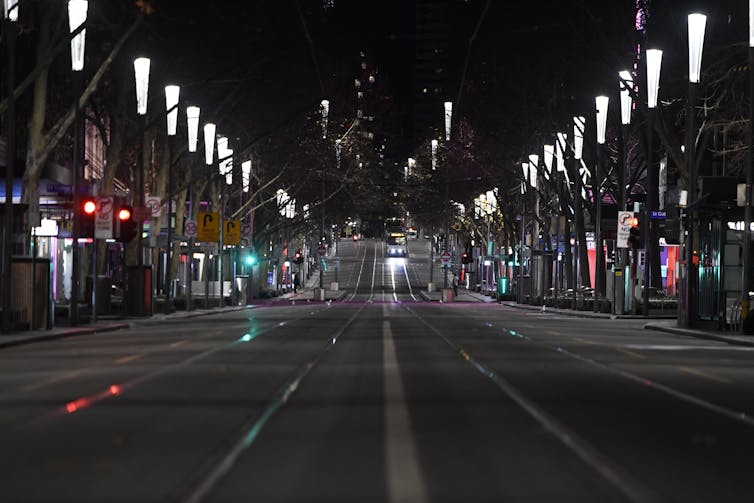 Melbourne’s curfew has been extended under the government’s roadmap.
Erik Anderson/AAP
Melbourne’s curfew has been extended under the government’s roadmap.
Erik Anderson/AAP
Similarly, there is no sense the government has either commissioned work from or listened attentively to experts from beyond the narrow world of epidemiological modelling.
Shitij Kapur, the dean of medicine at the University of Melbourne, recently drew attention to this folly, emphasisng that different experts recognise
there are more than one vulnerable groups to COVID-19. We need to protect them all. Differently.
Most worryingly of all, the Andrews roadmap says nothing about the long-term consequences of lockdown, nor does it paint a picture of alternative futures, including a future where there is no workable vaccine and societies around the world must learn to live with the virus.
Others will have their explanations of precisely why the Victorian government’s decision-making has failed in this regard. It is rooted, perhaps, in the competitive politics that exists between the states, and between states and the Commonwealth government.
That does not matter to the rest of us, though. What we need is for a swift return to policy-making that inspires the world, not leaves it behind.
Read more: The modelling behind Melbourne's extended city-wide lockdown is problematic
Authors: Marc Stears, Professor and Director, Sydney Policy Lab, University of Sydney


















