

Why Australia needs a national ban on conversion therapy
- Written by Larissa Sandy, Senior Lecturer in Criminology & Justice Studies, RMIT University
In recent weeks, Queensland and the ACT became the first Australian jurisdictions to ban conversion therapy.
Both passed laws making the widely discredited practice a criminal offence.
While this is progress, it is not enough to adequately protect LGBTIQ Australians from the devastating impact of conversion therapy. A national approach is needed.
What is conversion therapy?
Conversion therapy involves practices aimed at changing the sexual orientation, gender identity or expression of lesbian, gay, bisexual, trans and gender diverse people.
The goal is achieve an exclusively heterosexual and cisgender identity (in other words, where a person’s gender identity matches that assigned at birth).
In Australia, religious-based conversion therapy is most common, and includes things like counselling for “sexual brokenness”, prayer, scripture reading, fasting, retreats and “spiritual healing” .
Read more: 'Treatments' as torture: gay conversion therapy's deep roots in Australia
According to the International Rehabilitation Council for Torture Victims, so-called “therapeutic” measures can also include forms of abuse like beatings, rape, electrocution, forced medication, confinement, forced nudity, verbal abuse and aversion therapy.
Even more extreme measures throughout history have included castration, lobotomy and clitoridectomy.
Crucially, conversion therapy does not refer to interventions that help affirm a person’s lived gender identity, such as for transgender people.
How widespread is it?
There are no studies of the prevalence of conversion therapy in contemporary Australia, but a 2018 Human Rights Law Centre/La Trobe University report pointed to the United Kingdom as a reasonable comparison.
The UK’s 2018 national LGBT survey saw 2% of respondents report having undergone conversion therapy, with a further 5% reporting they had been offered it. People from multicultural and multi-faith backgrounds were up to three times as likely to report being offered it.
As The Age reported in 2018, conversion therapies are commonly encountered in religious settings.
[They are] hidden in evangelical churches and ministries, taking the form of exorcisms, prayer groups or counselling disguised as pastoral care. They’re also present in some religious schools or practised in the private offices of health professionals.
Why does it need to be banned?
The practice causes real harm to survivors, many of whom live with acute and long-lasting distress, psychological damage, feelings of guilt and isolation as a result. Conversion therapy encourages internalised homophobia, self-hatred, shame and confusion about sexuality and gender identity.
In addition to direct harms, the practice also violates human rights.
It is opposed by many professional medical and human rights bodies, including the Australian Psychological Society, Australian Medical Association and the United Nations.
The Independent Forensic Expert Group recently released a statement, stressing the “lack of medical and scientific validity of conversion therapy”.
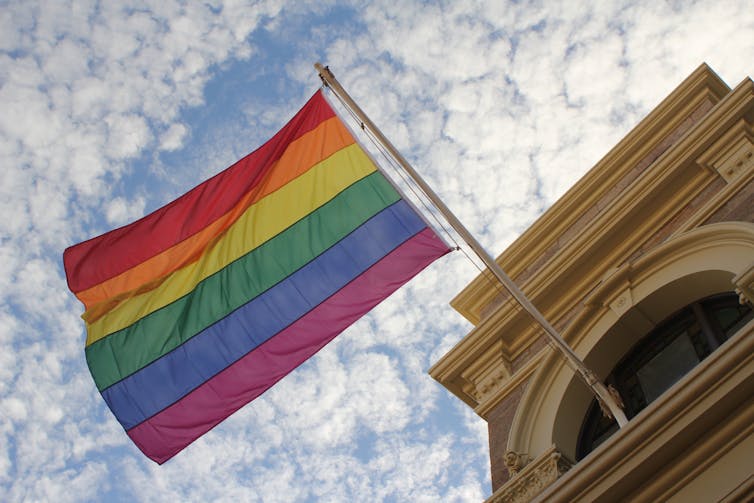 There is a growing push to ban conversion therapy around the world.
Rebecca Gredley/AAP
There is a growing push to ban conversion therapy around the world.
Rebecca Gredley/AAP
Conversion therapy has already been banned in a number of countries including Brazil, Malta, Germany and parts of Spain, and the United States.
Canada is moving towards a national ban, while the European Parliament has condemned the practice. In July, Prime Minister Boris Johnson also pledged a ban in the UK.
Australia’s progress to date
In the lead up to the 2019 federal election, federal Labor promised a nationwide ban.
But Prime Minister Scott Morrison said while he didn’t support conversion therapy, it was “ultimately a matter for the states”.
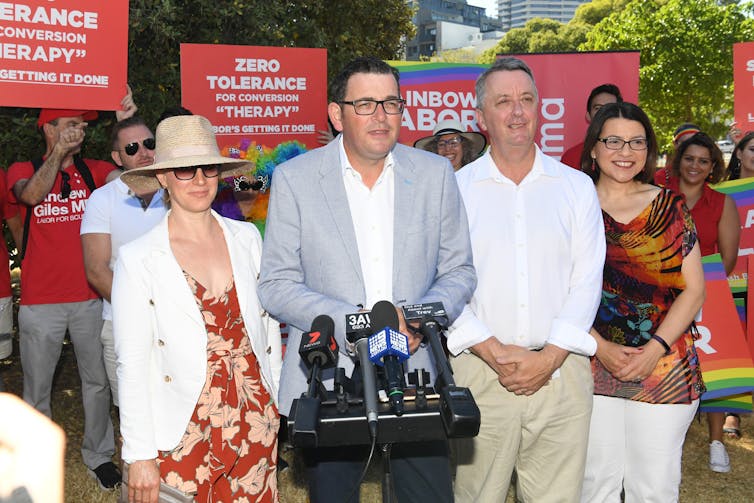 Pre-COVID, the Victorian government announced plans for a ban.
James Ross/AAP
Pre-COVID, the Victorian government announced plans for a ban.
James Ross/AAP
On top of Queensland and the ACT, Victoria also intends to ban the practice, and South Australia’s Labor opposition is calling for a ban.
A national approach is required
While Australia is making welcome progress, a much more comprehensive approach is needed. Conversion practices remain legal in most of Australia, despite their clear harms.
Queensland’s ban has been criticised for not capturing the less-formalised practices in religious settings.
It is important to note the UN’s independent expert on sexual orientation and gender identity recommends banning conversion therapy beyond just healthcare to include religious, education, and community settings.
Read more: Gay conversion therapy: a short history of an ongoing problem
Lawmakers so far have also focused on balancing the rights of LGBTIQ people with religious freedoms. For example, the ACT legislation was amended after Christian schools raised concerns the definition of “conversion” was “vague and imprecise” (the ACT Law Society also criticised the bill as “too broad”).
The Morrison government’s controversial religious discrimination legislation, stalled due to COVID-19, may also raise difficult questions for state lawmakers.
Legal groups, such as the Law Institute of Victoria, have already criticised the proposed legislation for allowing health professionals to put their religious beliefs before the Australian Charter of Healthcare Rights.
State-based bans could also be undermined by federal religious freedom exemptions.
A new system is needed
Australia needs to enact a ban that works in concert with federal human rights and anti-discrimination law, overseen by the Australian Human Rights Commission.
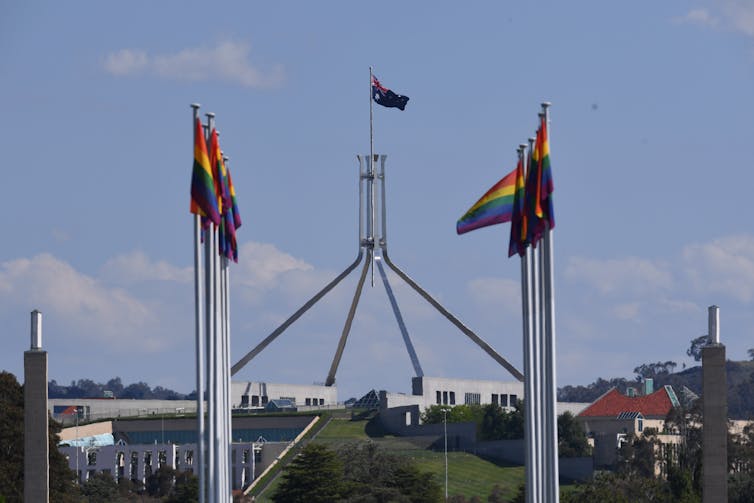 Individual state bans on conversion therapy are not enough.
Lukas Coch/AAP
Individual state bans on conversion therapy are not enough.
Lukas Coch/AAP
This is essential to counter any ramifications of the proposed religious freedom legislation and address recommendations made by the UN.
Ultimately, law reform also needs to go hand in hand with complaint mechanisms and other support for victims. This includes community awareness campaigns to tackle the deep discrimination and prejudice at the heart of conversion practices.
Authors: Larissa Sandy, Senior Lecturer in Criminology & Justice Studies, RMIT University
Read more https://theconversation.com/why-australia-needs-a-national-ban-on-conversion-therapy-145410

















