

Dreading going back to the workplace? You might be feeling separation anxiety from your home
- Written by Raquel Peel, Lecturer, University of Southern Queensland
As some of us return to the workplace, or are planning to do so in the future, we face the challenges of a changed environment of social distancing rules and restrictions. It might be your workplace will set limits on how many people are allowed in the lunchroom at a time, or the only people you talk to in the corridors are the cleaners.
For some people, going back to work is an opportunity to regain independence, especially if they have experienced difficulty working from home and are looking forward to going back.
But for others, it might be anxiety-inducing to think about another abrupt shift of routine, from a controlled environment where they feel safe to a place where rules and regulations are changing dramatically.
Indeed, it’s possible we might face separation anxiety from our home.
Read more: Heading back to the office? Here's how to protect yourself and your colleagues from coronavirus
Are you feeling attached to your home?
Humans are not only emotionally attached to people and pets – we’re also attached to places, especially safe ones. Place attachment is defined as the bond we create with specific places such as our home, a park, or a city. These bonds are formed with meaningful places that provide us with a feeling of safe haven, at the same time as providing us the opportunity to grow and continue to explore our interests.
However, this isn’t static, as we can create attachment to different places as our habits or feelings change. College students are an example of how identity can be tied to a place. Researchers have found relocating from home to college will impact how college students see and understand themselves by engaging in different activities, taking on more responsibility, and becoming independent.
Just as a new university student might feel the campus rapidly becomes a cherished part of their identity, people in lockdown might also see their home as emblematic of staying safe during the pandemic.
 Humans don’t only create attachments with people, but places too.
Shutterstock
Humans don’t only create attachments with people, but places too.
Shutterstock
How might we experience separation anxiety from our homes?
As defined in the Diagnostic and Statistical Manual of Mental Disorders, one of the criteria for a clinical diagnosis of separation anxiety is “recurrent excessive distress when anticipating or experiencing separation from home or from major attachment figures”.
A diagnosis of separation anxiety can also explain:
unusual distress or heightened fear about being separated from a loved one
excessive worry this separation could end in harm
physical symptoms such as stomach ache, nausea, headache and sore throat when thinking about separation or when the separation is imminent. This is most often found in children, but can also be found in adults.
Read more: Separation anxiety disorder: not just for kids
Leading up to my first day back at work, I experienced a sense of dread and uncertainty. These feelings didn’t make sense at first. But they became clear when I realised I was worried about working away from home — a place that has been my safe haven throughout the coronavirus crisis. I had become more attached to my home office, routine, and fur assistants.
Although concerning, it’s unlikely I met the criteria for a clinical case of separation anxiety, of “recurrent excessive distress”. Nonetheless, the fear of separation I felt can be understood as John Bowlby (a pioneer of attachment theory) originally intended: a non-clinical concept to explain the phenomena of fear of separation from close attachments such as places, people and pets.
Even if you feel fear around separation but don’t meet the clinical criteria, you can still develop strategies to cope and minimise disruptions to daily functioning.
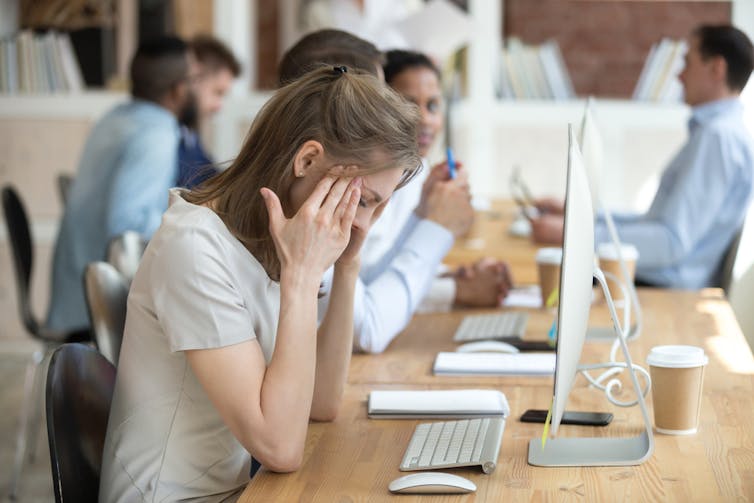 Many of us have spent a lot of time at home during the pandemic, so it might be anxiety-inducing to re-enter the workplace.
Shutterstock
Many of us have spent a lot of time at home during the pandemic, so it might be anxiety-inducing to re-enter the workplace.
Shutterstock
How managers and employees could minimise potential separation anxiety
COVID-19 has changed our workplaces a lot. Thus, strengthening support in the workplace should be considered. Managers need to be flexible and understanding to help staff go back to work. Managers could:
have an individual conversation with each employee to find out what they need, specially if there are signs they are struggling
consider how the transition will impact them in terms of commute times, costs, and hours away from home and family
review work arrangements to allow for a balanced routine, including flexibility to work from home on certain days, or flexible start and finish times where possible
ensure employees have a safe place to work and prepare them for the transition. This could include educational videos and articles
continue to acknowledge employees’ efforts and encourage self-care.
Read more: Thinking about working from home long-term? 3 ways it could be good or bad for your health
Employees, meanwhile, should:
understand what makes you feel safe and comfortable at home and seek to translate that to the work environment. This could mean a more flexible wardrobe that is professional yet comfortable, or a new scent for the office that reminds you of the same one you have at home
think of alternative ways of communicating with colleagues that does not always involve formalised meetings. If possible, have a “meeting-free day” scheduled each week and consider whether something can be sorted via a phone call or email rather than face-to-face
think of innovative practices implemented during the lockdown, and seek to continue them. For example, continuing to share meals over zoom can be fun. In my workplace we have themes like “crazy hats” or Christmas in July
if possible, organise a “take your pet to work day”. This could help keep you and them mentally healthy.
Authors: Raquel Peel, Lecturer, University of Southern Queensland

















