

Melbourne is using pop-up police spy stations to find people breaking COVID rules – what does the law say?
- Written by Rick Sarre, Emeritus Professor of Law and Criminal Justice, University of South Australia
CCTV cameras mounted on vans have recently been seen in public parks around Melbourne, ostensibly to nab anyone breaking lockdown rules. They are part of a joint initiative between several Melbourne councils, Victoria Police and the Commonwealth government.
Coming on the back of Victorian police arresting and charging a number of people for inciting others to break bans on public gatherings by protesting in the streets, there is likely to be widespread resentment to the presence of these mobile surveillance units.
Many people are already claiming the Victorian government has once again over-stepped the mark in its aggressive approach to suppressing COVID-19.
These mobile units are not new, though. They were introduced in 2018 to help combat crime. They are not cheap, either. The cost to purchase and operate four of the units has been estimated at $3.6 million.
But what are the laws around public surveillance of people going about their daily business or recreational activities outdoors?
Let me tackle this question by posing four related questions:
are the cameras legal?
are such surveillance tools effective?
are these measures acceptable in a vibrant democracy?
what protections should be put in place?
Are the cameras legal?
It needs to be stated at the outset the Constitution does not include any specific rights related to privacy. And the High Court suggested two decades ago that privacy was unlikely to be protected under common law.
The Victorian Charter of Human Rights, however, contains a provision that states people have the right not to have their
privacy unlawfully or arbitrarily interfered with.
But a lawfully installed camera designed to deter offending would not, on its face, defy the terms of the charter.
International law, too, provides some privacy protections. In 1991, Australia signed the International Covenant on Civil and Political Rights, which states
no one should be subjected to arbitrary or unlawful interference with his privacy.
However, Australian parliaments have introduced few laws to enshrine these protections. The legislation that has been enacted has largely been limited to curtailing the use of privately monitored listening and surveillance devices and preventing governments and big business from sharing citizens’ private information.
The Australian Law Reform Commission has issued clarion calls to extend these protections in recent years, but these efforts continue to gather dust.
Read more: Lockdown returns: how far can coronavirus measures go before they infringe on human rights?
So, it should not be surprising that mobile CCTV cameras driven to and stationed in public places are perfectly legal.
Moreover, so-called “unmanned airborne vehicles” (UAVs), more commonly known as drones, are regularly deployed by police for surveillance purposes, too.
Both of these surveillance tools are backed by regulatory force at all three levels of government.
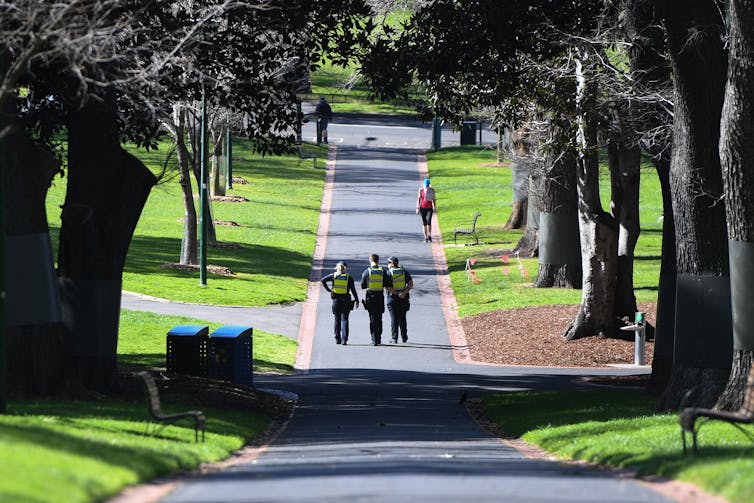 Police have been patrolling parks for weeks to ensure compliance with the Stage 4 lockdown regulations.
ERIK ANDERSON/AP
Police have been patrolling parks for weeks to ensure compliance with the Stage 4 lockdown regulations.
ERIK ANDERSON/AP
Are these surveillance tools effective?
Proponents of these mobile surveillance units argue the perceived risks to privacy and heavy investment are worth it, given the social disorder they prevent and the help they provide police in solving crimes.
However, there is much research now that casts doubt on this assumption.
In one study in 2009, for instance, CCTV cameras were only found to reduce crime by 16% overall (and by only 7% in city and town centres and public housing communities).
The efficacy of these surveillance units in a health emergency has yet to be proven. The cameras would seem to be most useful in providing police with information regarding who is using the parks, and perhaps providing something of a deterrent to those who might consider breaching lockdown restrictions, but not much more.
Are these measures acceptable?
Yes and no. On the one hand, there is no doubt people want the coronavirus restrictions to end. And if these units deter people from breaking lockdown rules, and this, in turn, helps bring the new case numbers down more quickly, people may accept the intrusion in their lives.
On the other hand, some are understandably alarmed at the increasing use of surveillance tools by authorities — dubbed “uberveillance” by sociologists.
Read more: Pandemic policing needs to be done with the public's trust, not confusion
Even advocates for civil liberties appear ambivalent about the curtailment of some basic rights during the pandemic.
Liberty Victoria President Julian Burnside, who has been a fierce defender of privacy rights, surprised many by telling The Age,
It all sounds pretty sensible to me. … We are in a war against the coronavirus, and when you’re in a war with anything, restrictions on your otherwise normal liberties are justifiable.
Liberty Victoria quickly sought to distance itself from the comments.
What protections should be put in place?
There is no doubt parliaments are the most appropriate bodies to determine the extent to which individuals can be subjected to lawful public surveillance.
Indeed, former High Court judge Michael Kirby argues the legislative arm of government needs to step up to the task of scrutinising emergency powers with more vigour.
Otherwise it simply becomes a tame servant of the executive, which is a common weakness of parliamentary democracies of the Westminster system.
But parliaments will only respond if citizens demand this of them, and there are very few signs of that at the moment.
In the meantime, there are a number of legal tweaks that should be undertaken to ensure the government’s spying on the public domain is appropriately measured:
we need to ensure the images and other data that are collected by surveillance units are stored appropriately and discarded quickly when no longer needed
we need to be able to hold police and other surveillance operators to account for any excesses in the manner in which images are gathered and shared
there needs to be a new legal remedy in the event there is a serious invasion of privacy by the inappropriate use or disclosure of images collected by surveillance devices.
True, we have the Office of the Australian Information Commissioner constantly reminding governments of the concerns associated with threats to privacy.
But without civic push-back, little will change. Parliamentarians are unlikely to limit the powers of the executive to allow mobile surveillance units to be parked in public places unless it becomes politically unpopular. One can but wonder when this tipping point may be reached.
Authors: Rick Sarre, Emeritus Professor of Law and Criminal Justice, University of South Australia

















