

Why every teacher needs to know about childhood trauma
- Written by: Emily Berger, Lecturer, Monash University
Mental health issues among children are on the rise due to the impacts of the COVID pandemic, including lockdowns.
Recent reports show there has been a 28% spike in calls to the phone counselling service Kids Helpline between March and July 2020 compared with the same period last year in Victoria, which is under stage 3 and 4 restrictions.
This prompted the state government to fast-track its plan to provide every state secondary school with funding to recruit its own mental-health support practitioner by the end of next year. Victorian Premier Daniel Andrews announced in August more than 1,500 school staff would have additional mental-health training in partnership with Headspace to help identify at-risk students as remote learning continues.
Such moves are important. But in this world of uncertainty, as well as the way the pandemic may be increasing instances of family violence and other types of abuse, all school staff would benefit from having an adequate understanding of the impact of trauma and adversity on children.
Teachers and school leaders would also benefit from knowledge about trauma and adversity when responding to children’s challenging behaviours. In education, such understanding and techniques are known as “trauma-informed pedagogy”.
What is childhood trauma?
Trauma is the response to exposure to a stressful or traumatic event, or a series of such events or experiences.
Most children have nurturing home environments, but a concerning number experience trauma through abuse or neglect in Australia. It’s estimated around 8.9% of children experience physical abuse, 8.6% sexual abuse, 8.7% emotional abuse and 2.4% neglect. The rates could be higher as such experiences are difficult to measure.
Read more: What governments can do about the increase in family violence due to coronavirus
Children may also experience trauma or adversity by observing family violence, parent separation, having a parent incarcerated or with a mental illness, or due to grief from the loss of a loved one. Trauma can occur because of conflict or war, or due to a natural disaster, such as the recent bushfires.
COVID-19 has led to higher amounts of traumatic experiences and adversity in households. Around one-third of Australian families are going through increased financial hardship and, for many women, the pandemic has coincided with the beginning of family violence, or an increase in it.
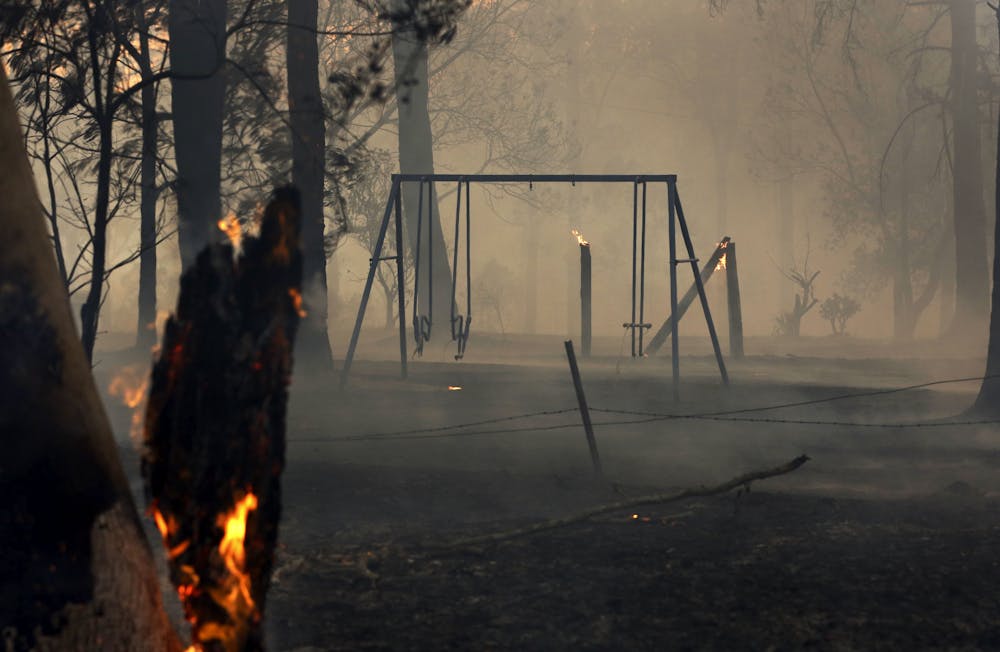 Many kids in Australia have experienced a traumatic event recently, including the recent bushfire season that ravaged communities.
DARREN PATEMAN/AAP
Many kids in Australia have experienced a traumatic event recently, including the recent bushfire season that ravaged communities.
DARREN PATEMAN/AAP
Trauma often has negative effects on children’s development and behaviour. It can increase the risk of depression and suicide attempts, psychotic disorders such as schizophrenia, and alcohol and drug use.
It’s important to note, not all children are negatively impacted by trauma — some even experience posttraumatic growth in which they learn more about themselves and their strengths.
A strong body of evidence shows trauma can affect brains structures linked to learning, and control of emotions and behaviour. These effects can make it difficult for children to learn, make friends and develop positive relationships with teachers.
Read more: How childhood trauma changes our hormones, and thus our mental health, into adulthood
Trauma and adversity can also disrupt children’s impulse control in the classroom and on the playground.
What trauma-informed practice looks like
The Royal Commission into child sexual abuse recommended schools be “trauma-informed”. Being trauma-informed does not mean teachers and schools must be trained to treat trauma. Rather they must understand the impact it can have on children’s lives.
An Australian Institute of Family Studies discussion paper on trauma-informed practice notes:
To provide trauma-informed services, all staff of an organisation, from the receptionist to the direct care worker and the board of directors, must understand how violence impacts on the lives of the people being served so that every interaction is consistent with the recovery process and reduces the possibility of re-traumatisation.
So, for schools to be trauma-informed, school staff need to know about the prevalence and consequences of childhood trauma. Increasing the confidence of school staff about how to work with children impacted by trauma and adversity is also important.
Examples of trauma-informed practice include:
providing teachers with information about how best to teach and support children to regulate their emotions and build positive relationships. This includes getting children to identify their emotions and check in on themselves and others around them to get acquainted with how they and their peers react to situations
assessing and revising school policies and practices that may re-traumatise or trigger anxiety or aggression in students (such as student isolation practices)
providing staff with self-care strategies, such as meditation, to help them respond to their experiences working with children impacted by adversity or trauma
encouraging staff to recognise students’ strengths and help students develop their own learning goals.
Trauma-informed practice can help teachers too
Teachers and school leaders already have high demands on their time, and adding another burden to their work is untenable. But trauma-informed practice is not necessarily an add-on. Rather, it is a different way of working and communicating to improve students’ relationships with school staff, and their school engagement and learning.
Our research with Victorian teachers found they want more support and training to be able to understand and support children with trauma.
Some US research suggests trauma-informed training and processes in schools can improve staff knowledge and confidence in responding to children impacted by trauma and adversity.
Read more: Trauma-informed classrooms can better support kids in care
Evaluations of trauma-informed practice in schools show these programs are having a positive impact. But rigorous research is lacking and more is required. We do know though, teachers responding sensitively to the impact of trauma helps children better engage in school and gives them a sense of belonging. It can also reduce disruptive behaviours and school suspensions.
By developing knowledge about the impact of trauma on children, teachers are likely to develop stronger relationships, and a greater sense of confidence, with these children, and lower classroom disruption. This could lead to increased job satisfaction and reduced risk of burnout.
Authors: Emily Berger, Lecturer, Monash University
Read more https://theconversation.com/why-every-teacher-needs-to-know-about-childhood-trauma-132965


















