Scarabs, phalluses, evil eyes — how ancient amulets tried to ward off disease
- Written by Marguerite Johnson, Professor of Classics, University of Newcastle
Throughout antiquity, from the Mediterranean to Egypt and today’s Middle East, people believed that misfortune, including accidents, diseases, and sometimes even death, were caused by external forces.
Be they gods or other types of supernatural forces (such as a daimon), people — regardless of faith — sought magical means of protection against them.
While medicine and science were not absent in antiquity, they competed with entrenched systems of magic and the widespread recourse to it. People consulted professional magicians and also practised their own forms of folk magic.
Read more: Spells, charms, erotic dolls: love magic in the ancient Mediterranean
Possibly derived from the Latin word “amoliri”, meaning “to drive away” or “to avert”, amulets were believed to possess inherent magical qualities. These qualities could be naturally intrinsic (such as the properties of a particular stone) or imbued artificially with the assistance of a spell.
Not surprisingly the use of amulets was an integral part of life. From jewellery and embellishments on buildings, to papyri inscribed with spells, and even garden ornaments, they were deemed effective forms of protection.
Amulets have been around for thousands of years. Amber pendants from Denmark’s Mesolithic age (10,000-8,000 BC) seem to have been worn as a form of generic protection.
Jewellery and ornaments referencing the figure of the scarab beetle were also popular all-purpose amulets in Egypt, dating from the beginning of the Middle Kingdom (2000 BC).
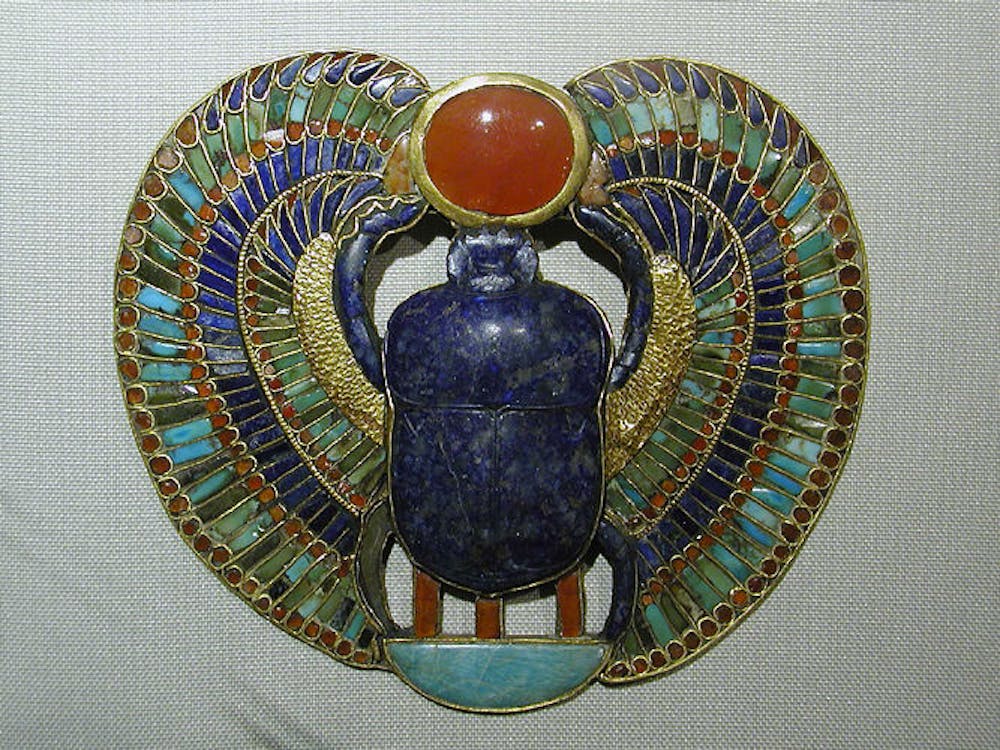 A solar scarab pendant from the tomb of Tutankhamen.
Wikimedia Commons
A solar scarab pendant from the tomb of Tutankhamen.
Wikimedia Commons
Two of the most common symbols of protection are the eye and the phallus. One or both amulet designs appear in many contexts, providing protection of the body (in the form of jewellery), a building (as plaques on exterior walls), a tomb (as an inscribed motif), and even a baby’s crib (as a mobile or crib ornament).
In Greece and the Middle East, for example, the evil eye has a history stretching back thousands of years. Today the image adorns the streets, buildings and even trees of villages.
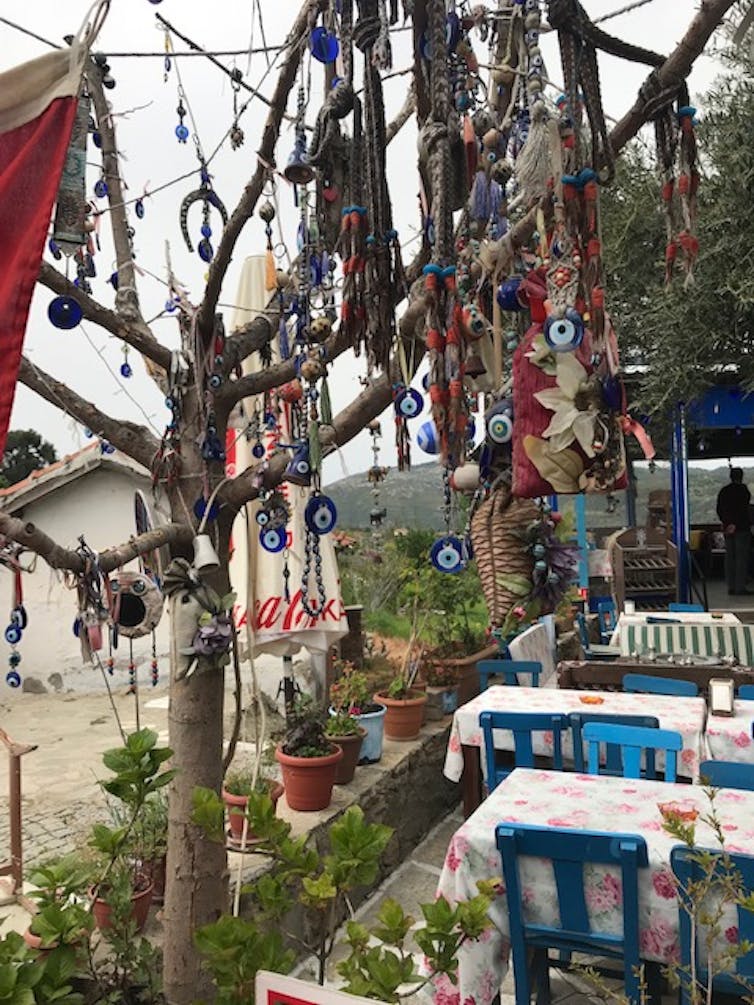 A tree adorned with the evil eye symbol in a Turkish village.
Marguerite Johnson
A tree adorned with the evil eye symbol in a Turkish village.
Marguerite Johnson
The magic behind the evil eye is based on the belief that malevolence can be directed towards an individual through a nasty glare. Accordingly, a “fake” eye, or evil eye, absorbs the malicious intention in place of the target’s eye.
Wind chimes
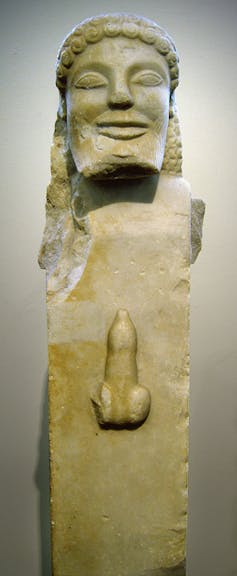 Greek ‘herm’ (circa sixth century BC).
The phallus was a form of magical protection in ancient Greece and Rome. The Greek sculpture known as a “herm” in English functioned as apotropaic magic (used to fend off evil). Such artefacts, featuring a head and torso atop a pediment — often in the shape of a phallus and, if not, definitely featuring a phallus — were used as boundary markers to keep trespassers out.
The implicit threat is that of rape; come near a space that is not your own, and you may suffer the consequences. This threat was intended to be interpreted metaphorically; namely, a violation of another’s property would entail some form of punishment from the supernatural realm.
The phallus amulet was also popular in ancient Italian magic. In Pompeii, archaeologists have uncovered wind chimes called tintinnabulum (meaning “little bell”). These were hung in gardens and took the form of a phallus adorned with bells.
This phallic shape, often morphing into bawdy forms, presented the same warning as the herm statues in Greece. However, the comic shapes in combination with the tinkling of bells also revealed a belief in the protective power of sound. Laughing was believed to ward off evil forces, as was the sound of chimes.
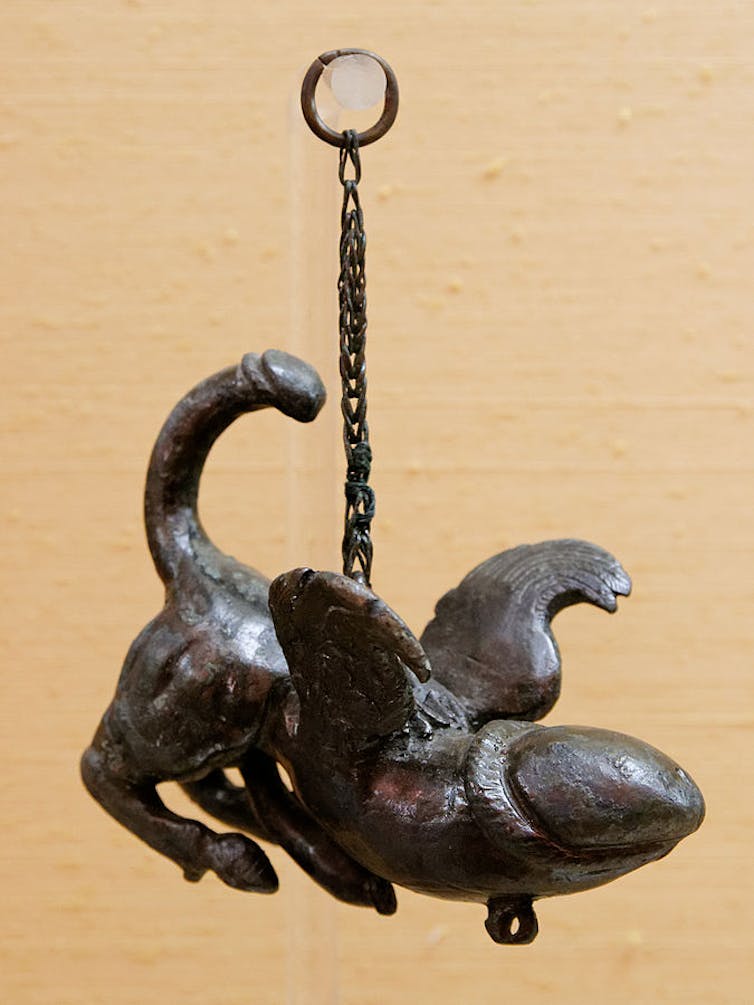 Tintinnabulum from Pompeii (circa first century AD).
Author provided
Tintinnabulum from Pompeii (circa first century AD).
Author provided
One scholarly view of magic is that it functions as the last recourse for the desperate or dispossessed. In this sense, it presents as a hopeful action, interpreted by some modern commentators as a form of psychological release from stress or a sense of powerlessness.
Contemporary ‘magical thinking’
In the context of “magical thinking”, amulets may be dismissed by critical thinkers of all persuasions, but they remain in use throughout the world.
Often combined with science and common sense, but not always, amulets have made a resurgence during the COVID-19 pandemic. The amulets are equally as diverse, coming in all shapes and sizes, and promoted by politicians, religious leaders and social influencers.
A traditional form of adornment and protection in Javanese culture, now popular with tourists, “burnt root” bracelets, known as “akar bahar”, have been sold by community shamans. Indonesia’s Agriculture Minister Syahrul Yasin Limpo, meanwhile, has promoted an aromatherapy necklace containing a eucalyptus potion touted as a preventative against COVID (useless in terms of science but perhaps less dangerous than hydroxychloroquine).
This necklace prompts the question: where does alternative medicine end and magic begin? It is not a new question, since there has been an intersection between magical lore and medical knowledge for thousands of years.
Read more: A murky cauldron – modern witchcraft and the spell on Trump
In Babylon, circa 2000-1600 BC, a condition known as “kuràrum disease” (identified as a ringworm, symptoms of which include facial pustules), was responded to by both magicians and doctors. And in one text there is a “healer” who appears to perform the role of magician and doctor simultaneously.
Other ancient cultures also practised medical magic through amulets. In Greece, magicians prescribed amulets to heal the wandering womb, a condition whereby the womb was believed to dislodge and travel throughout a woman’s body, thus causing hysteria.
These amulets could take the form of jewellery on which a spell was inscribed. Amulets were also used to prevent pregnancy, as evidenced in a recipe written in Greek from around the second century BC, which instructed women to: “take a bean with a bug inside it and fasten it to yourself as an amulet.”
In a contemporary religious context, written amulets replace spells with prayers. In Thailand, for example, Phisutthi Rattanaphon, an Abbot at Wat Theraplai Temple in Suphan Buri, has issued people with orange paper inscribed with protective words and pictures.
Designed to ward off COVID-19, the papers represent the crossover between magic and religion; a paradigm as entrenched as the blurring of magic and medicine in numerous historical and cultural contexts. Thankfully, face masks and hand sanitiser are also available at the temple.
Authors: Marguerite Johnson, Professor of Classics, University of Newcastle