New Zealand invests in growing its domestic recycling industry to create jobs and dump less rubbish at landfills
- Written by Jeff Seadon, Senior Lecturer, Auckland University of Technology
New Zealand’s government recently put more than NZ$160 million towards developing a domestic recycling sector to create jobs as part of its economic recovery from the COVID-19 pandemic.
New Zealanders recycle 1.3 million tonnes of materials each year, but 70% is currently exported. A recent NZ$36.7 million funding boost to upgrade recycling plants throughout the country followed a NZ$124 million injection into recycling infrastructure to grow processing capacity onshore. The investment signals a focus on supporting services that create employment and increase efficiency or reduce waste.
The potential for expansion in onshore processing of recyclable waste is enormous - and it could lead to 3.1 million tonnes of waste being diverted from landfills. But it will only work if it is part of a strategy with clear and measurable targets.
COVID-19 impacts
During New Zealand’s level 4 lockdown between March and May, general rubbish collection was classed as an essential service and continued to operate. But recycling was sporadic.
Whether or not recycling services continued depended on storage space and the ability to separate recyclables under lockdown conditions. Facilities that relied on manual sorting could not meet those requirements and their recycling was sent to landfill. Only recycling plants with automated sorting could operate.
New Zealand’s reliance on international markets showed a lack of resilience in the waste management system. Any changes in international prices were duplicated in New Zealand and while exports could continue under tighter border controls, it was no longer economically viable to do so for certain recyclable materials.
International cardboard and paper markets collapsed and operators without sufficient storage space sent materials to landfill. Most plastics became uneconomic to recycle.
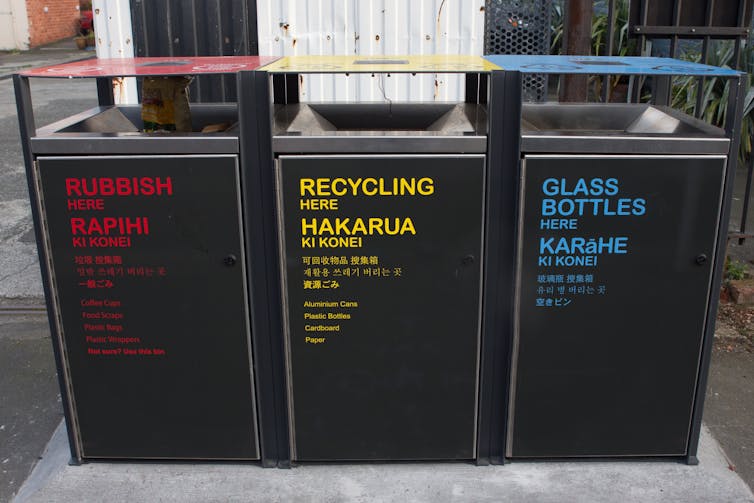 New Zealanders recycle 1.3 million tonnes each year.
Shutterstock/Josie Garner
New Zealanders recycle 1.3 million tonnes each year.
Shutterstock/Josie Garner
In contrast, for materials processed in New Zealand — including glass, metals and some plastics — recycling remains viable. Many local authorities are now limiting their plastic collections to those types that have expanding onshore processing capacity.
Soft packaging plastics are also being collected again, but only in some places and in smaller quantities than at the height of the soft plastics recycling scheme, to be turned into fence posts and other farm materials.
Read more: What happens to the plastic you recycle? Researchers lift the lid
The investment in onshore processing facilities is part of a move towards a circular economy. The government provided the capital for plants to recycle PET plastics, used to make most drink bottles and food trays. PET plastics can be reprocessed several times.
This means items such as meat trays previously made from polystyrene, which is not recyclable from households, could be made from fully recyclable PET. Some of the most recent funding goes towards providing automatic optical sorters to allow recycling plants to keep operating under lockdown conditions.
Regulation changes
The government also announced an expansion of the landfill levy to cover more types of landfills and for those that accept household wastea progressive increase from NZ$10 to NZ$60 per tonne of waste.
This will provide more money for the Waste Minimisation Fund, which in turn funds projects that lead to more onshore processing and jobs.
Last year’s ban on single-use plastic bags took more than a billion bags out of circulation, which represents about 180 tonnes of plastic that is not landfilled. But this is a small portion of the 3.7 million tonnes of waste that go to landfill each year.
More substantial diversion schemes include mandatory product stewardship schemes currently being implemented for tyres, electrical and electronic products, agrichemicals and their containers, refrigerants and other synthetic greenhouse gases, farm plastics and packaging.
An example of the potential gains for product stewardship schemes is e-waste. Currently New Zealand produces about 80,000 tonnes of e-waste per year, but recycles only about 2% (1,600 tonnes), most of which goes offshore for processing. Under the scheme, e-waste will be brought to collection depots and more will be processed onshore.
Landfilling New Zealand’s total annual e-waste provides about 50 jobs. Recycling it could create 200 jobs and reusing it is estimated to provide work for 6,400 people.
But all these initiatives are not enough. We need a coordinated strategy with clear targets.
The current Waste Strategy has only two goals: to reduce the harmful effects of waste and improve resource use efficiency. Such vague goals have resulted in a 37% increase in waste disposal to landfill in the last decade.
An earlier 2002 strategy achieved significantly better progress. The challenge is clear. A government strategy with measurable targets for waste diversion from landfill can lead us to better resource use and more jobs.
Authors: Jeff Seadon, Senior Lecturer, Auckland University of Technology