

Why you should talk to your children about Cambridge Analytica
- Written by: Amanda Third, Principal Research Fellow - Digital, Social and Cultural Research, Western Sydney University
Former Cambridge Analytica employee Christopher Wylie blew the whistle last month. He revealed the data analytics agency harvested Facebook data from more than 50 million individual profiles, matched these with electoral rolls, and then devised an algorithm that can use this data to predict and influence voting behaviours.
It seems it’s a powerful political tool. It reportedly played a role in swaying the Brexit vote towards a “leave” outcome in the UK and sweeping Donald Trump into power in the US.
 Christopher Wylie blew the whistle on Facebook and Cambrige Analytica in March.
Neil Hall/AAP
Christopher Wylie blew the whistle on Facebook and Cambrige Analytica in March.
Neil Hall/AAP
But what are the implications for our kids? Amid dilemmas about big data, the needs, desires and rights of our children don’t often get much attention. And yet, they are the first generation whose whole lives are being tracked digitally, and they will bear the consequences of future data regimes. So, how can we talk to them about what’s going on?
What’s at stake?
Governments and private enterprise have always gathered data about the population. Demographic data – such as age, gender, ethnicity, marital status and income - has long been used to make government initiatives effective. Since the early 20th century, advertisers have used demographic data to sell products to consumers. And we, the people, have long worried about how we are being manipulated.
What’s different today is that public institutions and businesses can now channel psychographic data, like whether someone has hobbies, is self-conscious, attends church, what kind of books they buy and so on. We post or unwittingly give out this kind of information (such as via online quizzes) on social media. When mapped against things like voting behaviours, institutions and businesses can know us even more intimately. And knowledge is power.
Read more: Cambridge Analytica’s 'secret' psychographic tool is a ghost from the past
What issues do we need to discuss with kids?
We need to talk with our children about their privacy, online safety and protecting their data. But if we want them to take steps to protect their data, we need to explain why these things are important. This means talking to them about power: about the value of their data and who might use or misuse it, how, and why.
This is tricky because it means discussing how the world is not always a nice place. So we have to do this carefully, thinking about what is appropriate for children of different ages to know, and being mindful of not scaring them.
A balanced approach is important because, despite the risks, the digital world offers great opportunities to children. When we focus solely on the risks, we potentially inhibit children’s ability to identify and take advantage of the opportunities. So the challenge is to enable them to prevent possible harms while also encouraging them to maximise the advantages.
What age is it appropriate?
While social media platforms generally require users to be 13+, children start to use and share information on social platforms between the ages of eight and 11. This means it’s never too early – or too late – to start the conversation about data with your child.
 Social media platforms usually require users to be over 13, but this doesn’t always stop those younger from using them.
Shutterstock
Social media platforms usually require users to be over 13, but this doesn’t always stop those younger from using them.
Shutterstock
What should parents do?
Know the terrain
Read the papers, reflect on the TV coverage, and talk with work colleagues, friends and other parents. Do these things not to be an “expert”, but to be ready for meaningful conversations with your child. You might also ask your teenager to explain it all to you.
Dialogue between adults and children can help parents assess what their children are doing online and how well they understand the issues. These conversations offer families opportunities to reflect on and reinforce their values.
Get in the fray
Even if you’re averse to social media, get familiar with it so you can speak with your children from experience. Know the platforms they’re using. You don’t have to sign up and friend them, ask them to show you how they work and why they like them.
Also ask them when using these platforms gets difficult – and why, and what they do. Use these conversations to decide together how to handle things.
Tap into evidence-based resources
There is a wealth of evidence-based, practical advice for parents of digital children. Great resources include the eSafety Office’s website (which houses their iParent tool), NetFamilyNews.org, the Raising Children Network, and Common Sense Media.
Check your and your children’s privacy settings
While this is a concrete action parents can take to protect their and their children’s data online, we don’t always do it. Attending to your privacy settings is not a failsafe, but it’s a step in the right direction.
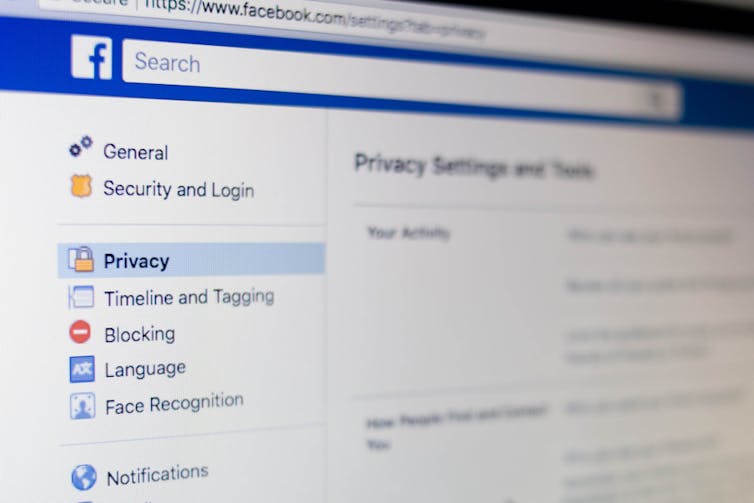 One concrete action you can take is to review your and your child’s privacy settings on Facebook.
Shutterstock
One concrete action you can take is to review your and your child’s privacy settings on Facebook.
Shutterstock
Ask your child to sit with you while you evaluate your own privacy settings. Ask for their opinion about what you should do. Talk about it and then trade places. You might also explore available parental controls.
Decide together what information to share and when
Talk with your child about how you protect your data – and theirs – online. Also discuss what is appropriate to share on which platforms and why. The Office of the eSafety Commissioner’s advice is to restrict sharing details like your address, contact information, and your date of birth.
Read more: We need to talk about the data we give freely of ourselves online and why it's useful
Also talk about the ways our data might be collected without us knowing, such as by taking online quizzes. Set challenges – like refraining from online quizzes or only sharing via social media with certain friends - for a period of time. Discuss the pros and cons of these experiments and then set your rules together.
Model behaviour
It might not always feel like it, but parents are the single most important influence in children’s lives. So, model respectful data sharing practices.
For example, when you take a photo of your child, ask their permission. Same goes before you upload it to social media. Explain who will see it, why you want to do it and ask their permission. By respecting their decisions you model how they should treat others’ data choices.
Read more: Your online privacy depends as much on your friends’ data habits as your own
Seek solutions together
Children often have significant expertise about being online and say they want to be trusted by adults to use the internet wisely. Kids also get a kick out of being the expert in conversations with adults about digital media.
Openly acknowledge the strengths and limits of both your and your children’s knowledge. As the parent, you don’t have to know all the answers. Just be prepared to look for them alongside your child.
Demand more
Behind the scenes, many organisations (like the Office of the eSafety Commissioner) and social media companies are grappling with the thorny questions big data raises. If you are concerned about these issues, make your views known to your politicians, social media companies and networks.
Authors: Amanda Third, Principal Research Fellow - Digital, Social and Cultural Research, Western Sydney University
Read more http://theconversation.com/why-you-should-talk-to-your-children-about-cambridge-analytica-94900


















