a sad farewell to the ABC's 7:45am bulletin
- Written by Alexandra Wake, Program Manager, Journalism, RMIT University
From today, ABC local radio listeners will no longer hear the majestic fanfare theme on local radio at 7:45am, signalling the 15-minute morning news.
Although it might seem a smart managerial decision to reduce reporting costs and respond to audience behaviour, the move overlooks the wide accessibility of radio, especially to low-income and regional Australians. It will also be a huge loss to people struggling with an avalanche of misinformation from online sources.
For more than 80 years, the 7:45am bulletin was a uniquely Australian fixture on local radio. It provided a soundtrack to the major events of our nation, bringing to our ears the sounds of wars, invasions, sporting triumphs, political scandals and disasters. Those 15 minutes were all listeners needed to get on with their day as informed and active citizens in a democracy.
ABC reporters would set up their work to aim for the longer 7:45am radio bulletin, and listeners specifically tuned in for it. There would be a shorter version of the story at 6am, another for 7am, and then a fully formed report (usually featuring the reporters’ own voices) at 7:45am.
Big stories might also feature on the flagship current affairs program AM starting at 8am, and stories with dramatic pictures might be picked up television news bulletins.
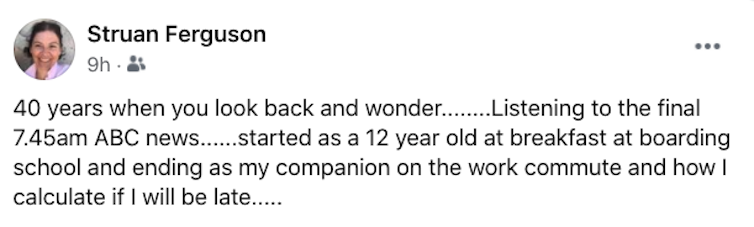 Social media was filled with people talking about the loss of the 7:45am news bulletin.
The 7:45am bulletin had a big emphasis on international news, catching us up on happened while we were sleeping. There would often be the big Washington story of the day (because of how much that country influences our lives), but the bulletin had space to also include important reports from the ABC’s foreign correspondents in countries that we should, or need, to care about. Think PNG, or China and India.
It provided the agenda for the day’s debate at the kitchen table, at the water cooler, in the halls of government, or in corporate boardrooms. Early morning ABC journalists in the capital cities made sure that day’s newspapers scoops were included, while regional reporters and international correspondents tuned in to check their work had made the cut.
Each state had its best newsreaders rostered across the weekday mornings, their voices providing flawless delivery, reassuring warmth and authority, particularly at times of disaster.
The raw emotion of audio captured by reporters in the field — a bird call, a mother’s cry, or a burst of gunfire — could pull at the heart in a way other mediums did not. It could also force action from governments when action was needed.
Read more: Latest $84 million cuts rip the heart out of the ABC, and our democracy
It has been ironic to read the outpouring of concern about the axing of the bulletin on social media, because it is the boom in digital on-demand technology (such as the ABC Listen app), and the resulting ways audiences access news, that has allowed ABC managers to kill off a much-loved bulletin.
While 2020 radio audiences have been up overall this year as people have tuned in for bushfire and COVID-19 coverage, statistics provided by the ABC clearly show listeners have been moving away from the 7:45am bulletin for several years.
Even I, an audiophile, listened to the very last 7:45am bulletin in isolation in my home office, on my computer, some time after it went to air. And I also wanted to hear the last one from Queensland, my home state, rather than Victoria, my adopted home. My husband was listening to another ABC platform, and my teenagers were in their rooms, listening to something on Spotify. Our family represents the very change in demographics the ABC is grappling with.
Read more: Latest $84 million cuts rip the heart out of the ABC, and our democracy
ABC communications noted there would be substantial savings from moving away from a focus on “one 15-minute long, single-use, broadcast-only bulletin at 0745”. At the ABC right now, nothing produced has a single-use — everything needs to be used on a second or third platform. The statement said:
We want to be able to provide quality local news for all of our listeners on all of our platforms. While the majority of our resources are still dedicated to our broadcast services, we need to make sure we have the resource to also serve our growing number of listeners using the digital on-demand services.
Those arguments are strong. But not all 7:45am stories, particularly ones in the region, will make the main state television news, and many stories just don’t have pictures worthy of television, or even an online report. There are also still many Australians who do not have access to digital or online technologies, particularly our elderly and regional residents.
The decision to axe the 7:45am bulletin comes as dozens of experienced journalists have left the ABC. Many of those were senior journalists in behind-the-scenes production roles, who guided and supported younger journalists out in the field, learning their reporting craft with radio stories. It is those experienced journalists who took a role in overseeing the 7:45am bulletin to ensure its quality, and helping the ABC mantain its position as the country’s most trusted news source.
In some ways the ABC management has tried to act like a surgeon, trying to save the body by cutting off a limb. But the 7:45am bulletin wasn’t a limb. It was the beating heart of ABC Radio. The graphs of falling listener numbers only tell part of the story. At a time when so many Australian communities have little or no alternative news outlet, killing off the main news bulletin of the day feels like a dagger in the heart of democracy.
Authors: Alexandra Wake, Program Manager, Journalism, RMIT University
Read more https://theconversation.com/that-was-the-news-a-sad-farewell-to-the-abcs-7-45am-bulletin-146478