ahead of their first TV debate, how much will charisma and eloquence matter?
- Written by Theodore E. (Ted) Zorn, Professor of Organisational Communication and Head of Massey Executive Development, Massey University
When New Zealand Prime Minister Jacinda Ardern was named the “world’s most eloquent leader” last month it raised the question of just how important eloquence is within a politician’s arsenal.
With the first televised leaders’ debate this evening, voters have their first opportunity during the election campaign to compare Ardern’s style with her National Party rival Judith Collins.
While she has a different, more pugnacious style, Collins is also highly articulate, forceful in her speech and quick on her feet. The debate is her first real campaign opportunity to demonstrate those points of difference.
Contrast New Zealand’s two main party leaders with their counterparts in the US presidential campaign and the differences are glaring. Trump and Biden are arguably two of the least articulate candidates in modern American history.
Biden has described himself as a “gaffe machine” and barely a day goes by that Trump doesn’t deliver a helping of nearly indecipherable “word salad”. Little wonder that age and possible dementia are among the commonest criticisms of both candidates.
Those contrasts between the current US and New Zealand candidates also underline that eloquence, while an asset, is neither vital nor sufficient on its own for electoral success.
Still, since success in politics is about generating voter support and governing effectively by persuading people to follow one’s lead, eloquence obviously matters. That has never been more obvious than during the COVID-19 pandemic.
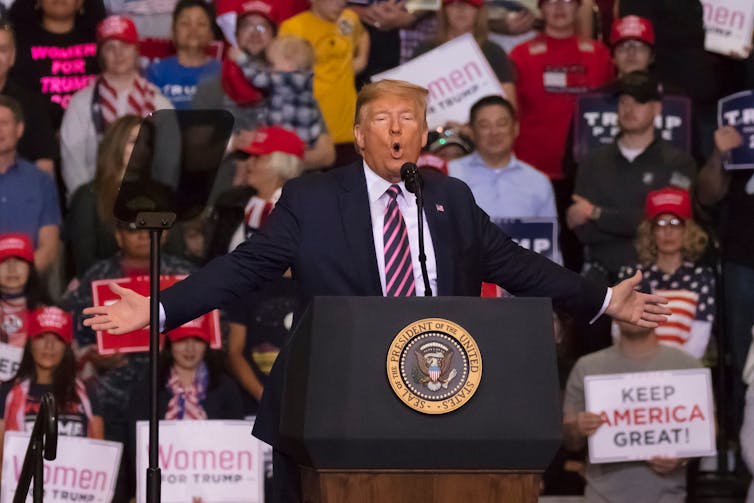 Donald Trump at a rally in August: being conventionally articulate isn’t everything.
www.shutterstock.com
Donald Trump at a rally in August: being conventionally articulate isn’t everything.
www.shutterstock.com
What is eloquence and why does it matter?
Essentially, eloquence is fluent, elegant and persuasive speech. Eloquent speakers can express themselves forcefully and convincingly as the situation demands. While it’s about more than being articulate, clear and coherent, dexterity with vocabulary is an important part of the equation.
It also doesn’t necessarily mean being precise and specific. Research shows US presidents use less “verbal certainty” — emphatically supporting specific courses of action — than CEOs or religious leaders. This tendency to avoid certainty has increased over time, in part due to greater media scrutiny.
Effective political speech often embodies “strategic ambiguity” — communicating ideals or values that leave room for interpretation.
We see this in campaign slogans, of course, such Labour’s current “Let’s keep moving” and Obama’s “Change we can believe in”. But this ambiguity is also often deployed within actual policy proposals (such as Labour’s and National’s plans for reducing debt, which both leave questions unanswered).
Obama’s ideas were often phrased vaguely enough to attract a wide range of followers who believed in many kinds of change. Eloquence is not the same thing as charisma. But as Obama demonstrated, it can play a key role in a leader being perceived as charismatic.
Eloquence in the soundbite age
Eloquence is also a source of power. As historian James McGregor Burns put it, “Words at great moments of history are deeds”. In those critical moments, a leader’s words frame the problem and enact the solution.
Words eloquently expressed can help leaders get things done, inspire people to sacrifice or rise to the occasion.
As has been argued elsewhere, Ardern’s skillful communication contributed to a high level of public buy-in to her plan to eliminate the virus.
In his 1995 book The Inarticulate Society, Tom Schachtman argued eloquence has nearly vanished in the political sphere, replaced by soundbites and images.
But that’s overstating the case. The conditions and expectations for political speech have changed. Politicians have had to adapt to the soundbite society by using pithy, memorable lines that encapsulate key ideas.
The “democratisation” of political discourse means politicians are expected to be less formal and more conversational than they once were. But no fair-minded observer could hear Barack Obama’s famous 2004 convention speech and believe that eloquence is absent in modern politics.
Similarly, Ardern’s speech after the Christchurch mosque shootings demonstrated the importance of eloquence in setting the right tone in traumatic circumstances.
Eloquence can invite backlash
Being eloquent is no guarantee of success, of course. Obama’s opponents would try to spin his skill as an orator as empty rhetoric. Ardern, too, has been criticised for overusing the “team of five million” line.
While eloquence helps create charismatic personas and adoring followings, it can also generate passionate opposition.
Indeed, being inarticulate sometimes has its advantages. Trump’s many incendiary or seemingly incriminating statements might have spelled the end for another politician.
But because his syntax is often so muddled, it creates openings for his handlers to clean up the mess by reinterpreting what he meant to say.
But Trump is perhaps an aberration. Most politicians work hard to develop eloquence. They know the public will judge them in part on their ability to articulate a vision, explain their plans and defend their records.
As Ardern and Collins are no doubt aware ahead of their debate, history often reserves a special place for those able to capture the zeitgeist with their words and ability to deliver them.
Authors: Theodore E. (Ted) Zorn, Professor of Organisational Communication and Head of Massey Executive Development, Massey University