Pro-China nationalists are using intimidation to silence critics. Can they be countered without stifling free speech?
- Written by Yun Jiang, Senior Research Officer, Australian National University
Last month, the University of New South Wales came under harsh criticism after its media team deleted an article and tweet in which Elaine Pearson, the Australia director of Human Rights Watch, expressed concern over China’s curtailment of human rights in Hong Kong.
The tweet enraged some in the Chinese student community in Australia, who organised an aggressive campaign targeting UNSW’s social media channels.
Pearson later said, the incident shook her:
the pro-Chinese Communist Party students certainly don’t have to agree with my remarks. But I was still somewhat shocked at the ferocity of their response, and disappointed at the university’s feeble reaction.
As I have written in a policy brief for China Matters, the rhetoric and actions of pro-China nationalists create two contrasting problems for Chinese people living in Australia.
First, these nationalists are intimidating people who are critical of the Chinese Communist Party, or China more broadly. Second, the Australian media have argued or insinuated that those who merely express support for Chinese policies must be brainwashed or threats to democracy.
Both of these problems disproportionately affect the Chinese diaspora in Australia.
Intimidation and harassment
The Chinese Communist Party, through its propaganda and education system, encourages the conflation of the concepts of “China” with the state, the party and the Chinese people. As a result, criticisms of the Chinese government, its policies, the party or its leaders can be interpreted by some nationalists as an attack on the entire country and its people.
Some responses to these perceived attacks include intimidating those with alternative views. And such abuse can be more extreme when directed at people of Chinese heritage. The term hanjian or “Chinese traitor” is often used by nationalists against those deemed critical of the state.
Read more: Students from China may defend their country but that doesn't make them Communist Party agents
Increasingly, some nationalists use the potential threat of the Chinese government as additional leverage. When they come across someone who disagrees with a Chinese government policy in their classrooms or chat groups, they will often publish his or her personal details online or report them to a Chinese consulate.
There is even an online Chinese government reporting portal that facilitates the work of informants. The portal has seen a 40% increase in reports since last October.
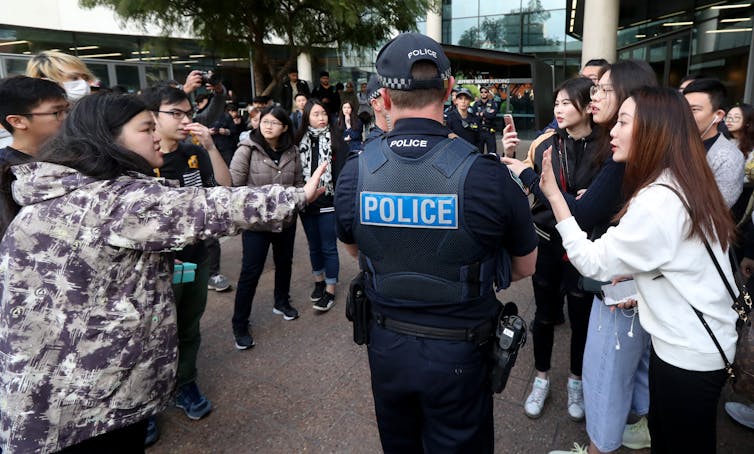 Pro-china and pro-Hong Kong students clashed during a protest outside the University of South Australia last year.
KELLY BARNES/AAP
Pro-china and pro-Hong Kong students clashed during a protest outside the University of South Australia last year.
KELLY BARNES/AAP
This intimidation and harassment can affect people’s families back in China, too. For students, what they say in the classroom in Australia can be reported back to their families or local authorities in China. The families of human rights activists in Australia face even more pressure from authorities.
Because of these threats, people who maintain a strong connection to China may choose to self-censor when speaking publicly or in the classroom, in order to stay within the bounds of what’s acceptable from Beijing’s viewpoint.
Threats to democracy?
Intimidation and harassment of others is no doubt wrong, and in some cases, illegal in Australia. The reporting of people’s personal details or what they have said in classrooms to Chinese authorities is also unacceptable. These actions are detrimental to democracy in Australia, as they serve to restrict freedom of speech.
But not all Chinese nationalists act in these ways. Some may express their patriotism or support for aspects of China’s policies in an email or chat group to other students, for example, without intimidating or threatening anyone.
Yet, just by being supportive or understanding of a Chinese government policy, they are often labelled by commentators in the Australian media as “brainwashed”, or seen as not committed to the values of democracy.
Read more: Why Chinese and Hong Kong students clash in Australia: the patriotic v the protest movement
As Professor Fran Martin of Melbourne University, who studies the social experiences of Chinese students in Australia, has written,
most find the claims [that they are spies for or controlled by the Communist Party] strange, unfair and implausible. Most confusing is the charge that by voicing their political opinions in the classroom, Chinese students are undermining the free speech of others.
Many students feel trapped between China nationalists and popular stereotypes. One Chinese-Australian told a China Matters researcher they cannot speak publicly on sensitive issues such as Taiwan because they would be accused of being a stooge of the Chinese government (if they were pro-unification) or unpatriotic (if they were pro-independence).
Chinese students in Australia have a great opportunity to feel the spirit of democracy and become more politically minded and active. Yet if every time they express their political view, Australian society accuses them of being a threat to democracy, it only serves to alienate them.
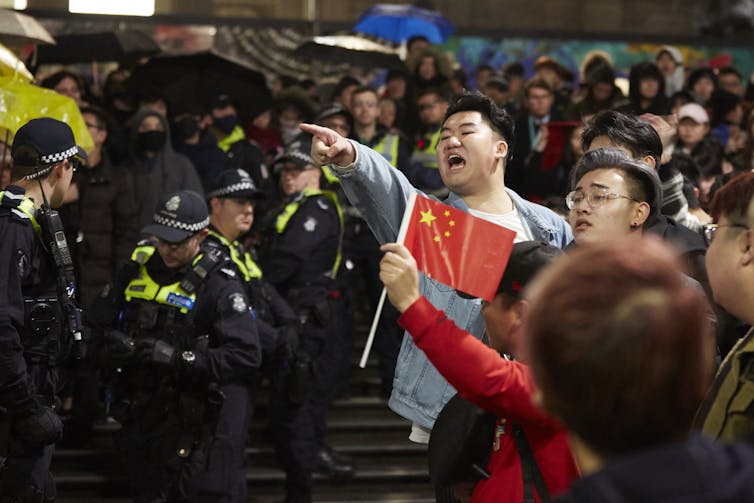 Chinese nationalists countered many pro-democracy rallies in support of Hong Kong in the past year, such as this one in Melbourne.
ERIK ANDERSON/AAP
Chinese nationalists countered many pro-democracy rallies in support of Hong Kong in the past year, such as this one in Melbourne.
ERIK ANDERSON/AAP
What can be done?
There are many things we can do to address both issues. However, any policy response needs to balance protecting the victims of intimidation with the rights of individuals to express their views of China without being labelled as threats to democracy.
The first problem of intimidation and harassment requires stronger enforcement of existing laws and policies. Universities need to take tough actions to punish students who intimidate others, or those who report the views expressed in classrooms, to the Chinese authorities. This should include expulsion.
Read more: Why the Australia-China relationship is unravelling faster than we could have imagined
The Counter Foreign Interference Taskforce should also investigate and punish those who report the details of others to Chinese authorities.
Lecturers should find ways to encourage classroom debate while protecting students from surveillance. Anonymous online discussion is one strategy — students remain anonymous to other students but not to the lecturer. There are other strategies that could work, too.
Democratic resilience is the key to the second problem. Chinese students should be encouraged to express their views, whether they support or oppose the Chinese government.
Rather than blaming these students for their views, Australian society needs to hold institutions accountable when they cave in the face of Chinese government pressure or censor the views of those who are critical of China.
Authors: Yun Jiang, Senior Research Officer, Australian National University