5 experts on the first TV leaders' debate of NZ's election
- Written by Grant Duncan, Associate Professor for the School of People, Environment and Planning, Massey University
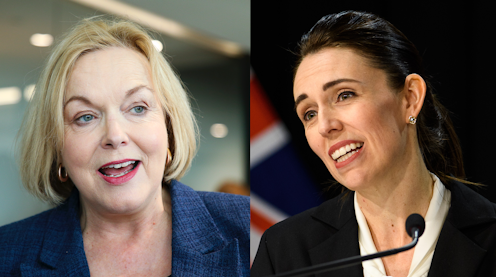
Prime Minister and Labour leader Jacinda Ardern and National Party leader Judith Collins have met for the first televised debate of the 2020 election campaign. With the results of the latest 1 News-Colmar Brunton poll released only an hour earlier, there was much at stake.
While down slightly on previous polls, Labour was still in a position to govern alone — comfortably so if the Greens joined them in a coalition agreement. National was still well behind, clearly bleeding votes to ACT on its right.
Nonetheless, the debate was a fair and largely evenly matched contest, covering the COVID-19 response, border control, health, housing, employment, income inequality and climate change.
Our five experts watched the debate closely for what it revealed about policy, performance and the likely tone of the campaign to come.
Genuine differences in substance and style
Grant Duncan, Associate Professor for the School of People, Environment and Planning, Massey University
Leaders debates are like reality TV. “Who gets voted off the island? Jacinda or Judith?” Fun to watch, but they misrepresent how elections work.
In their proportional representation system, New Zealanders do not vote for prime ministers; they vote for representatives — one local representative, and one party of representatives.
Read more: Ardern versus Collins: ahead of their first TV debate, how much will charisma and eloquence matter?
Despite misleading impressions, however, the first debate between the leaders of the two largest parties revealed genuine differences of style and substance. The debate delivered on substantial issues, from climate change to housing the poor.
Collins was quick to call out “nonsense” and often looked fed-up. She criticised the Ardern government for failing to reduce material hardship for the poor, even though her own plan to “stimulate the economy” with tax cuts would most benefit middle- to higher-income earners. She would raise housing supply through reforming laws that affect developers.
Ardern was reserved but sincere. She acknowledged that it’s been a tough time for New Zealanders, but backed public investment in people and their well-being. She saw climate change innovation as an opportunity for farmers and agriculture, not a cost.
Both leaders showed substance, but different styles. National will go for stimulus through tax cuts; Labour will stimulate through raising incomes for the lowest earners. I’d call it a draw.
Big questions on climate and inequality go unanswered
Bronwyn Hayward, Professor of Politics, University of Canterbury
In the 2017 TVNZ election debates, no one was asked about climate change once. Thankfully it was raised early this time by Ardern and hammered home in questions — but the answers left a lot to be desired.
Collins played to her base, repeating the claim that New Zealand is so small, whatever it does won’t make a difference (it will), and that farmers feel bagged by the Greens and Labour (they do). It was left to Ardern to offer more substance and collaborative pathways forward: incentives for reducing emissions, cleaning up rivers (including urban rivers).
But beyond a bit of banter about electric vehicles, neither leader had a policy to fundamentally reduce our transport emissions. Pumped hydro schemes may help create jobs and provide stable energy supply over dry years, but neither tackled how we will afford the costs that are coming for homes and infrastructure exposed to sea level rise.
COVID-19 consumes us right now but climate change hasn’t gone away and neither has inequality. Again no one really answered the question posed by head girl of Aorere College, Aigagalefili Fepulea'i Tapua'i, about the stress on low-income school communities where students have to choose between study or taking a job to help their family.
There were gestures towards answers. Collins made the most direct connection, saying, “My husband is Samoan and had to leave school”, but had no solution. Ardern gestured towards raising the lowest incomes but didn’t make a firm commitment beyond saying, “I am not done with child poverty.”
The futures of young New Zealanders hang on what happens next.
Ardern as hard to pin down as ever
Morgan Godfery, Māori Research Partnerships Manager, University of Otago
“Optimism, and that’s what Labour will bring,” the prime minister said in her opening statement, which is strangely and typically, well, contentless. It’s part of the paradox that is Jacinda Ardern — she’s the global left’s standard bearer, the most popular New Zealand prime minister in living memory, a policy leader against the coronavirus, and yet it’s almost impossible to pin down her politics beyond that optimism.
Ardern promised 8,000 new homes are coming down the line, and that’s ostensibly leftist policy and politic. Yet the waiting list for public housing is 20,000 people long. Is 8,000 left enough? It’s certainly left — or centre! — enough to win.
Especially against a strangely flat and staggered National Party leader. People expect Judith Collins to go hard, because of course it’s a brand she cultivates, but it was a jarring juxtaposition: the hard woman (Collins) against the kind and optimistic prime minister. The advocate for a “border protection agency” (Collins) against the person who’s protected the borders (Ardern). It was hard to pin down, then, precisely what Collins was angry at. Other, of course, than the fact she’s leading the losing side.
Questions remain around National’s border policy
Siouxsie Wiles, Associate Professor in Microbiology and Infectious Diseases, University of Auckland
It’s no secret that I am supportive of the current government’s elimination strategy when it comes to dealing with COVID-19. The main thing I was looking to hear in the leader’s debate was a commitment from both Jacinda Ardern and Judith Collins that whatever government they lead would stick with that strategy.
The prime minister did that and reiterated the importance of a tightly managed and controlled border. In response, Collins brought up the need for “someone to be in charge”. With a National-led government that would be the job of a new border protection agency. I’m all in favour of an agency dedicated to defending us from pandemic threats, but focusing solely on our border won’t achieve that. Any agency should have a much broader remit that also addresses what makes us vulnerable to pandemics.
Collins also raised not letting anyone board a plane to New Zealand unless they test negative. This policy will certainly stop some infectious people from being able to travel but it won’t catch all of them. I really worry it’ll discriminate against those who can’t afford to, or aren’t able to, access testing. To me this policy runs the very real risk of stranding New Zealanders overseas while not really increasing the security of our border.
Both leaders will want to lift their game
Richard Shaw, Professor of Politics, Massey University
These are as much performances as debates. Ardern edged Collins on leadership performance, looking and sounding like someone with a 32% lead over her opponent in the preferred prime minister ratings and whose party has a 17% buffer over its major opposition: measured, polite and committed to staying clear of the tit-for-tat.
Given the polls, Collins needed to force the issue: it showed in her regular interjections (some of which were to good effect) and willingness to take the contest to Ardern (occasionally not so successfully).
On the issue of policy fluency (your own but also the other side’s), a close call went — perhaps, maybe — narrowly to Collins. As to eloquence — verbal dexterity and rhetorical flow — Ardern had the edge on her opponent (especially in her closing statement), although Collins in pugnacious mode had an energy that Ardern lacked.
These presentational dimensions of politics matter, especially at a time when voters are looking for an emotional compact with leaders. Given the context, Collins may sleep the easier of the two tonight, but both will be looking to lift things a notch or several when they next meet.
Authors: Grant Duncan, Associate Professor for the School of People, Environment and Planning, Massey University