The new 15-minute test has potential, but standard tests are still the best way to track COVID-19
- Written by Katherine Gibney, NHMRC early career fellow, The Peter Doherty Institute for Infection and Immunity
Testing remains a vital component of Australia’s success in managing COVID-19.
We need to diagnose people infected with SARS-CoV-2, the virus that causes COVID-19, as early as possible so they can be isolated from others and their contacts quarantined. Testing also helps us understand to what degree the virus is present in the population, so we can tailor public health measures accordingly.
If you’ve had a COVID-19 test, in all likelihood you received a PCR test. That’s the one with the throat and nose swabs, and is regarded as the “gold standard” in COVID-19 testing.
But now the Therapeutic Goods Administration (TGA) has approved a new kind of COVID-19 test, which can produce results in as little as 15 minutes, as opposed to a day or more for standard tests.
So is this new rapid test set to revolutionise COVID-19 testing in Australia? Not quite yet.
The traditional tests
Nucleic acid tests, or PCR tests, can detect ribonucleic acid (RNA) of SARS-CoV-2 from a day or two before symptoms start, and for a week or more afterwards, as symptoms resolve. Of course, some people will test positive without ever having symptoms.
PCR tests have been the backbone of SARS-CoV-2 testing worldwide. Because of the vast global experience with PCR tests and their high performance, they’re considered the most reliable COVID-19 test.
PCR tests require specialised laboratory equipment and trained scientists and technicians to test the specimens; processing and testing take several hours.
Since January, we’ve performed an astonishing 7.4 million SARS-CoV-2 PCR tests in Australia, which has needed a massive upscaling of capacity in laboratories nationally.
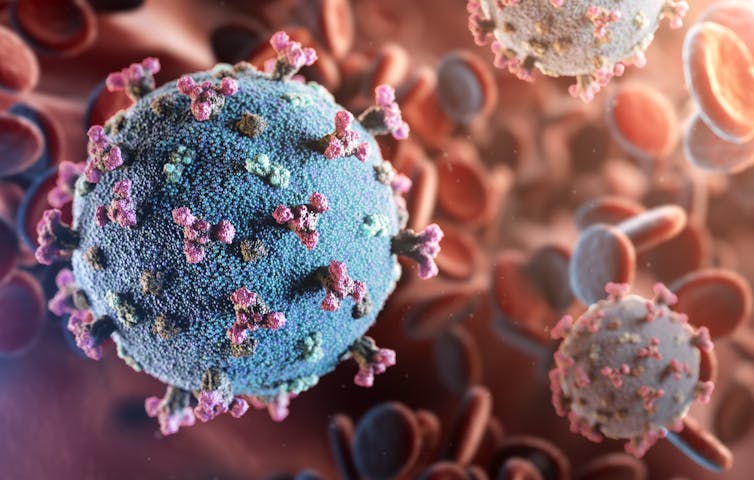 PCR tests detect SARS-CoV-2 viral RNA.
Shutterstock
PCR tests detect SARS-CoV-2 viral RNA.
Shutterstock
At times, demand for PCR testing has exceeded capacity, occasionally resulting in delays of up to several days in getting results back to patients. Meanwhile, laboratories swamped with COVID-19 tests may be limited in their capacity to perform their routine business, including diagnostic testing for other infectious diseases.
As people are required to isolate until they receive a negative test result and their symptoms resolve, these delays may come at a cost to the person waiting, their family, and the economy.
Recognising these costs may lead some people to choose not to be tested, Victoria has offered financial compensation for people without leave entitlements awaiting test results.
But delayed case confirmation also increases the time to identification and quarantine of contacts, undermining public health efforts.
What can we expect from the antigen test?
Rapid antigen tests can diagnose COVID-19 in 15 minutes. They’re relatively inexpensive and require a swab from the nose.
These tests detect viral antigens, proteins on the surface of SARS-CoV-2. The immune system recognises these proteins as foreign, and responds by making antibodies to SARS-CoV-2 (“anti-gen” means antibody generator).
Antigen tests perform best early in the infection when the amount of virus in a person’s system is highest. For a person with symptomatic COVID-19, this would be in the first week of symptoms. So they only pick up current infections – unlike antibody tests, which can detect if a person was previously infected with SARS-CoV-2.
Four SARS-CoV-2 rapid antigen tests have been licensed for use in Australia in the past two months.
Unfortunately, rapid antigen tests for COVID-19 appear to be less sensitive than PCR tests, meaning they may give a negative result in someone who does actually have COVID-19. One of the recently licensed rapid antigen tests may give a false negative result in up to 18.3% of people with COVID-19 diagnosed by PCR.
Read more: Explainer: what's the new coronavirus saliva test, and how does it work?
While a positive rapid antigen test result is more reliable, widespread use of these tests in asymptomatic people will result in some false positive results — that is, a positive test result in someone who doesn’t have COVID-19.
At this stage, national COVID-19 guidelines don’t include information on antigen tests. So a person with a positive antigen test would need to undergo a PCR test to be counted in Australia’s official COVID-19 case numbers.
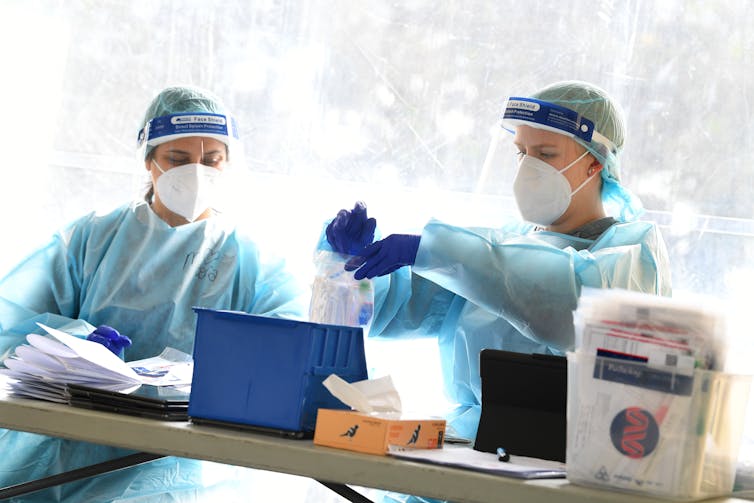 Our capacity to process COVID-19 tests has been challenged at times during the pandemic.
James Ross/AAP
Our capacity to process COVID-19 tests has been challenged at times during the pandemic.
James Ross/AAP
Considering the pros and cons
We’re faced with a trade-off between the potential benefits of the rapid antigen tests — the ability to test larger numbers of people, consuming fewer laboratory resources, and quicker results — and the potential to miss a few cases because of the lower test sensitivity.
Despite the lower sensitivity, increasing testing rates might result in an overall net increase in the proportion of COVID-19 cases diagnosed, and therefore a public health benefit by preventing onward transmission from these cases.
One possible strategic use of these tests may be in screening people without symptoms to detect asymptomatic and pre-symptomatic infection that might otherwise go undetected. This could include people in workplaces where ongoing exposure to colleagues and the public is unavoidable, including sectors of the food supply chain or other essential services.
Read more: Why can't we use antibody tests for diagnosing COVID-19 yet?
Because of the lower test sensitivity for the rapid antigen test, a PCR test remains most appropriate for people with symptoms, those at greater risk of poor outcomes from COVID-19, and people working in high-risk settings like aged care and health care.
While rapid antigen tests show promise, we’ll need to evaluate their efficacy in Australia before we can determine their role in our fight against COVID-19.
Authors: Katherine Gibney, NHMRC early career fellow, The Peter Doherty Institute for Infection and Immunity