Budget's $1bn research boost is a welcome first step. Billions more, plus policy reforms, will be needed
- Written by Frank Larkins, Professor Emeritus and Former Deputy Vice Chancellor, University of Melbourne
The federal budget injection of an extra A$1 billion of new money as a one-off allocation into the Research Support Program for 2021 is welcome news for the university research community. The stated goal is to ease some of the financial pain caused by the COVID-19 pandemic and loss of international student fee revenue that has cross-subsidised research. Universities have been facing research funding shortfalls of up to A$7.6 billion over five years from 2020 until 2024.
Without new funding, universities would have to manage a potential reduction of 11% in the research workforce. That put the jobs of nearly 6,000 research students and staff researchers in jeopardy.
The extra A$1 billion funding from January 2021 provides a critical stop-gap. It will help recover some of the lost research momentum. But what will happen after 2021?
Ongoing additional government support of about A$1 billion a year will be essential to at least 2024. Without such funding, institutions won’t be able to employ the world-class researchers and research students they need to remain internationally competitive.
Only with continued funding will research institutions be able to strengthen the national higher-level skills base, create knowledge and support innovation for wealth and job creation. These are the building blocks for the economic prosperity and social well-being of all Australians.
The Research Support Program mechanism being used to allocate the A$1 billion is performance-based: 47% of the funding is determined on relative research income performance and 53% on engagement income performance.
This means the strongest-performing research universities with the largest revenue losses should get the most funding. These block grants will fund essential infrastructure, such as libraries, laboratories, consumables and computing centres, and the salaries of research staff who are not supported by competitive grants and other government research grants.
Read more: As universities face losing 1 in 10 staff, COVID-driven cuts create 4 key risks
Universities can expect some spillover research support from budget measures announced for other research institutions. The new funding for specific programs at the Commonwealth Scientific and Industrial Research Organisation (CSIRO) – A$459 million over four years – and the Australian Nuclear Science and Technology Organisation (ANSTO) – $238 million over four years – presents further opportunities for research collaboration with universities.
The restoration of research and development (R&D) tax concessions to industry worth A$1.8 billion and other measures should counter declining business R&D investment. This could boost industry research partnerships with universities.
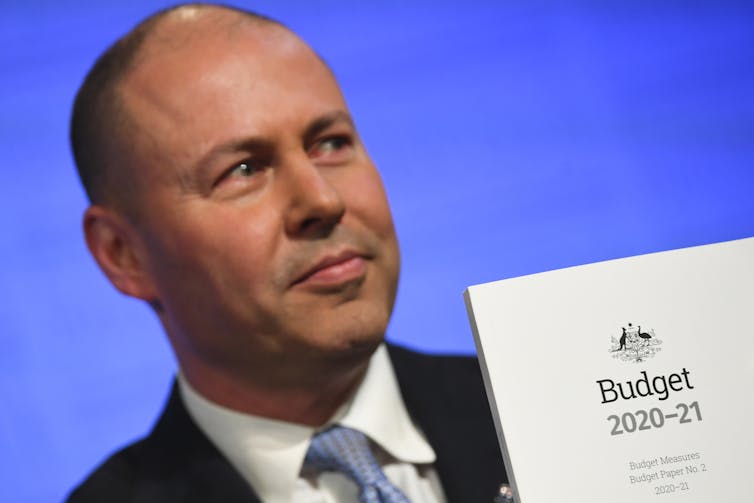 Treasurer Josh Frydenberg is providing funding relief for university research in 2021, as well as other budget measures that are likely to help.
Lukas Coch/AAP
Treasurer Josh Frydenberg is providing funding relief for university research in 2021, as well as other budget measures that are likely to help.
Lukas Coch/AAP
University research activities are but one component of the greatest policy and financial crises that universities have faced in living memory. All parties will require other initiatives beyond increased government funding to overcome these challenges. Here are six initiatives Australia should pursue.
1. Develop a more coherent national research policy with priorities applicable to all research sectors. This framework would benefit universities, enabling them to invest in their research strengths and to reduce under-performing programs.
2. The Australian government should acknowledge the full economic costs of research and develop a national policy for awards, grants and contracts. Failure to properly fund the real costs has been the major reason universities have had to use discretionary student fee income to cross-subsidise research. This vexed question has remained unresolved for decades in Australia. The US and the UK governments have had policies in place for many years that provide templates for Australia to follow.
3. New and emerging student markets need to be developed and existing markets restored as fast as possible in partnership with federal and state governments. Some cross-subsidisation of research from discretionary revenue will be most important for many more years.
4. Research administration costs must be reduced. There is too much bureaucracy involved in accounting for performance, and too many grant programs have low success rates.
5. Universities need to make substantial savings in spending on general operations. They also have to identify new sources of revenue growth to sustain research.
6. Universities must increase collaboration with other research sectors, including independent research institutes, government research agencies and industries, both national and international. Deeper and broader collaboration will help sustain research programs.
A rapid research sector recovery is of paramount importance. A sustainable research sector underpins job creation, economic prosperity and social well-being.
There is no more timely example of the benefits of long-term research investment than the pioneering research Australians are doing to develop a COVID-19 vaccine. This is only possible because of our world-class capacity for medical research, which has been established over several decades.
Authors: Frank Larkins, Professor Emeritus and Former Deputy Vice Chancellor, University of Melbourne