Facebook is removing QAnon pages and groups from its sites, but critical thinking is still the best way to fight conspiracy theories
- Written by Shane Satterley, PhD Candidate, Griffith University
Facebook has announced a ban on groups and pages identified with the rapidly growing QAnon conspiracy movement, which will cover both Facebook itself and the Facebook-owned Instagram.
QAnon is a far-right conspiracy theory that alleges, among other things, that US President Donald Trump is battling Satan-worshipping paedophiles and a global child sex-trafficking ring run by Democrats. While the movement began in the US, it has begun to attract followers in other countries, including Australia.
Facebook’s ban escalates a policy announced in August that aimed to ban QAnon groups promoting violence, and comes as the social media giant attempts to slow the spread of disinformation on its platform in the lead-up to the US presidential election on November 3.
Twitter also banned “so-called ‘QAnon’ activity” in July. After Facebook’s latest move, some QAnon adherents were quick to claim the ban itself was more evidence of a cover-up.
Read more: Why QAnon is attracting so many followers in Australia — and how it can be countered
Can social media suppress ‘dangerous’ ideas?
Facebook’s action raises important questions. Will it work? Will taking down these pages stop the spread of “potentially dangerous” ideas?
There is some evidence it will. In 2015, Facebook blocked accounts and deleted posts associated with the Islamic State of Iraq and Syria (ISIS). Thereafter, the group’s propaganda did not seem to pop up as often elsewhere online (although it has not disappeared entirely).
However, if groups are banned from Facebook or other platforms, they may still find ways to propagate material. This can create a “black market” of ideas out of public view, where any idea, no matter how objectionable, can go completely unchecked.
Should social media suppress ‘dangerous’ ideas?
Another question is whether Facebook should be banning “potentially dangerous” groups and pages, and therefore ideas, from its platforms. This is a harder question to answer.
Platforms such as Facebook sit in a grey area in relation to freedom of expression. Banning somebody from a platform does not infringe on their legal right to express themselves — it just means they will have to do it elsewhere.
However, Facebook and other platforms such as Instagram and Twitter are among the main avenues for public expression, and are used not only by everyday individuals but also large organisations and even elected representatives. So the removal of certain groups or ideas should be at least concerning. This is particularly true for those like QAnon which do not directly call for violence (though the group has been linked to some violent incidents).
Read more: Netflix's The Social Dilemma highlights the problem with social media, but what's the solution?
The value of free expression
Trump has said he has heard followers of QAnon are “people who love our country”. Like other far-right groups, QAnon is ultra-nationalistic, so Trump is likely correct.
QAnon’s ultra-nationalism is important when we talk about the Facebook ban because one of the founding principles of the United States as a nation is the idea people should be free to express any idea they like, including conspiracy theories, ideas associated with religious cults and hateful propaganda.
Key texts that informed the foundation of the US, such as the introduction to The Age of Reason by Thomas Paine, Areopagitica by John Milton and and John Stuart Mill’s On Liberty, all make similar arguments on freedom of expression.
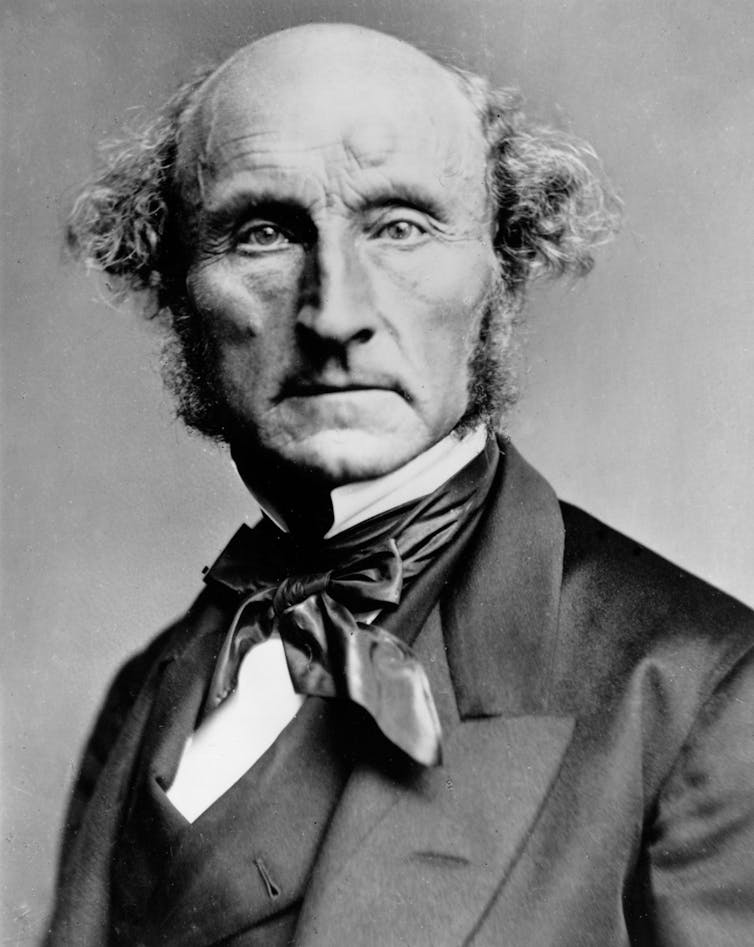 English philosopher John Stuart Mill argued for the important of the right to free expression, especially of heretical ideas.
London Stereoscopic Company - Hulton Archive
English philosopher John Stuart Mill argued for the important of the right to free expression, especially of heretical ideas.
London Stereoscopic Company - Hulton Archive
They argue that when we deny an idea the chance to be expressed, we do ourselves a disservice because we deny ourselves a chance to hear it. It is not just the right of the expresser to think and say; it is the right of the listener to hear and think.
From this point of view, ideas expressed by QAnon or any other fringe group should sharpen our ability to think critically about what we claim to know. If someone puts forward a seemingly crazy idea, they should be heard because they could be correct or hold kernels of truth to their ideas — if not, they need to be publicly refuted for the benefit of everyone.
John Stuart Mill argued “the greatest harm done is to those who are not heretics, and whose whole mental development is cramped, and their reason cowed, by the fear of heresy”. The heretical view is therefore the most salient of all views because in its heresy enhances our individual and collective ability for critical thinking.
No simple solutions
Do these centuries-old principles still hold in the age of social media? Platforms like Facebook appear perfectly suited to the promotion and dissemination of conspiracy theories like QAnon. In their relentless quest for our attention, the platforms take advantage of the human tendency to find salacious and infuriating articles and ideas more captivating than nuanced, balanced and factual material.
There is no simple solution or shortcut to mitigating potentially dangerous ideas. They need to be openly refuted but to do this requires time and engagement with the ideas themselves but importantly first, an ability for critical thinking.
Read more: To combat conspiracy theories teach critical thinking – and community values
Who will do this work? It may be an indictment on our educational systems if it can be shown that we are not producing enough critical thinkers. Perhaps this is a place to start, so we do not have to rely on Silicon Valley to tell us what crazy ideas we can read, because those ideas will find it hard to find a home to begin with.
In the meantime perhaps Facebook can use its algorithms and tremendous resources to find a way to promote critical thinking and to incentivise nuanced and balanced discourse — adding to the global discussion rather than merely subtracting.
Authors: Shane Satterley, PhD Candidate, Griffith University