

Our cities are full of parks, so why are we looking to golf courses for more open space?
- Written by Wendy Walls, Lecturer in Landscape Architecture, University of Melbourne
The recent opening of a golf course to the public in the inner north of Melbourne caused a flurry of excitement. Since then, thousands of visitors have explored the expanse of manicured rolling greens, fairways and rough. Under COVID restrictions that require Melbournians to stay within 5km of their homes, access to a very large and beautiful open space has provided welcome relief from the well-worn tracks up and down local creeks and around local ovals.
But beyond just exploring somewhere new, the meticulously crafted landscape of the Northcote public golf course offers a rare experience in Melbourne’s ever more densely developed inner suburbs.
Read more: 340,000 Melburnians have little or no parkland within 5km of their home
The past six months of lockdowns have sparked many discussions about our cities and lifestyles. And the importance of local parks has come to the fore. There are issues of equity in access to parks, walkability, housing, and the measured health and well-being effects of being outdoors.
These target-driven discussions fit with the dominant planning methods of Australian cities. From walking times to tree cover targets, function has long dominated quality when defining urban open space. But this planning approach to open space significantly limits how parks are conceived.
Why the pressure on golf courses?
Now, as people swarm to urban parks and gardens in record numbers, we need to give open space the same status as other valued urban assets such as roads and rail. And we need to work out what government, the private sector, design professionals and the community can contribute to create better public open space over the next decade.
Read more: Twitter posts show that people are profoundly sad – and are visiting parks to cheer up
Returning to the Northcote golf course, a community group is lobbying for ongoing community access. It’s part of a wider discussion about the future of urban golf courses across Australia. In Sydney, the Inner West Council recently voted down a hotly debated plan to give over half the Marrickville golf course to public green space. In Brisbane, the Victoria Park Golf Course is being converted to public parkland.
Urban golf courses are in the spotlight because of their rarity as large green open spaces with mature plantings. The golfing community is under pressure to justify why so much precious city space is being reserved for their sport.
This discussion masks the underlying issue of inadequate urban planning. Successive governments have failed to set aside enough open space to cater for population growth.
For decades, the planning of our cities has occurred through growth models that give priority to economic development. Missing are significant large parks – the modern equivalents of the much-loved colonial layers of the Domains in Sydney and Melbourne, Hyde Park, Royal Park or Kings Park – to offset this growth.
The issue of open space quality becomes even more pressing when we turn to the outer suburbs. Lacking access to bays and beaches, the outer suburbs no longer have the “Australian dream” of the quarter-acre block as a counterbalance. Houses are constructed gutter to gutter, cars crowd the front yards, and the local park is often a footy oval with a playground.
Read more: Vanishing Australian backyards leave us vulnerable to the stresses of city life
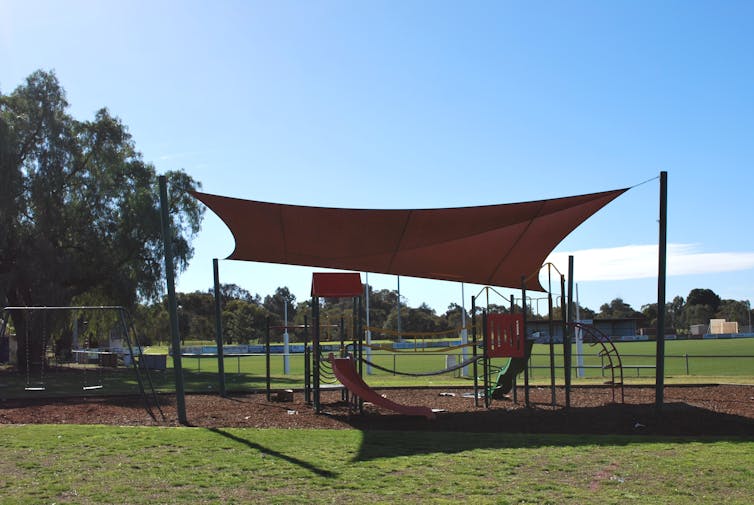 For many suburbs, their most substantial public open space is a football oval and playground.
Mattinbgn/Wikimedia Commons, CC BY-SA
For many suburbs, their most substantial public open space is a football oval and playground.
Mattinbgn/Wikimedia Commons, CC BY-SA
Time to make open space a priority
COVID and the slowing economy provide an important opportunity to rethink our models for open space.
Read more: Reclaiming the streets? We all can have a say in the 'new normal' after coronavirus
We need to challenge the binaries of competing values – public versus private, environment versus community – that structure our cities. Our parks should not emerge through a debate over the best use of limited green space: biodiversity, community gardens, bike paths, wetlands, sport facilities, playgrounds and dog walking. None of these agendas are wrong, but there is a limit to how much space can be shared.
There are, of course, many examples of councils wanting to add more open green space. But it is important to have larger-scale and longer-term perspectives that can operate independently of local and state politics.
Global examples of open-space governance reveal shifts towards alternative funding models and public-private relationships for delivering quality, not just quantity. For example, in New York, the NGO Design Trust for Public Space works across government, community groups and the private sector to guide public space development. In Australia, the appointment of a minister for public spaces in Sydney and the Living Melbourne strategy both acknowledge the importance of overarching spatial governance.
Read more: New minister for public spaces is welcome – now here are ten priorities for action
The private sector is responsible too. Enabling large and high-quality open space across our cities means reviewing our expectations of funding and exploring new models led by the private sector. This includes not just funding construction but finding cash for ongoing park maintenance.
COVID has highlighted why the scale of open space is important. It’s needed for maintaining distance between users but also for providing a sense of escape from increasing urban density, compounded by the many hours spent indoors.
Read more: A radical nature-based agenda would help society overcome the psychological effects of coronavirus
It is widely recognised that an experience of nature is valuable for health and well-being. It’s now time to link this directly to a diversity of high-quality park experiences.
All parks have not been created equally. Let’s use this moment to determine a more ambitious future for our urban open spaces.
Authors: Wendy Walls, Lecturer in Landscape Architecture, University of Melbourne


















