

How a university can embed Indigenous knowledge into the curriculum and why it matters
- Written by Maggie Walter, Pro Vice Chancellor (Aboriginal Research and Leadership) and Distinguished Professor of Sociology, University of Tasmania
We seek the wisdom of Aboriginal leaders with their deep knowledge of Country as we explore how to be a university with place at the centre of its thinking. – Acknowledgement of Country, University of Tasmania Strategic Plan, 2019-2024
The University of Tasmania is Indigenising its curriculum. Other universities, in Australia and overseas, are also taking this path. This is in line with recommendations of the 2012 Behrendt Review and commitments made in the Universities Australia Indigenous Strategy 2017-2020.
 The University of Tasmania and others are acting on the Indigenous Strategy of Universities Australia.
Universities Australia
The University of Tasmania and others are acting on the Indigenous Strategy of Universities Australia.
Universities Australia
Interpretations of what Indigenising the curriculum means, and how best to achieve it, vary widely. Universities Australia reports in detail how different Australian universities are approaching the task.
The University of Western Australia, for example, is ensuring all faculty staff are trained to deliver Aboriginal content as part of its program to Indigenise its Juris Doctor program. At UTAS, we use the definition of Canadian Mohawk scholar Marlene Brant Castellano:
Indigenizing education means that every subject at every level is examined to consider how and to what extent current content and pedagogy reflect the presence of Indigenous peoples and the valid contribution of Indigenous knowledge.
We incorporate Indigenous knowledge into the curriculum as an integral, interwoven aspect of students’ degrees. Under the foundation principle of Indigenous leadership, we have developed our process based on five key criteria.
place-based: Indigenous peoples and knowledge systems primarily in focus are Palawa, the Tasmanian Aboriginal people
Indigenous knowledge-based: Indigenous scholarship and expert Indigenous voices are prioritised, helping students learn from rather than about Indigenous peoples
partnership-based: Indigenous and non-Indigenous academics collaboratively and equally share content development and teaching
progression-based: Indigenous content is built to form a coherent body of knowledge across courses
experientially based: students directly engage with Indigenous knowledge, which includes guided on-Country experiences.
Read more: To address the ecological crisis, Aboriginal peoples must be restored as custodians of Country
How do we meet these criteria?
Our flagship Indigenous Lifeworlds units demonstrate how these criteria can be implemented. These will be offered in 2021 to all first-year Bachelor of Arts students. There are two versions: humanities (story, history, country) and social science (sovereignty, justice, society).
The place-based criterion draws on an array of electronic and document resources related to Palawa. For instance, records of Tasmania’s history of colonisation are easily found in texts and archives. A selection of Palawa cultural practice materials, such as firestick burning or mutton-birding, is also available.
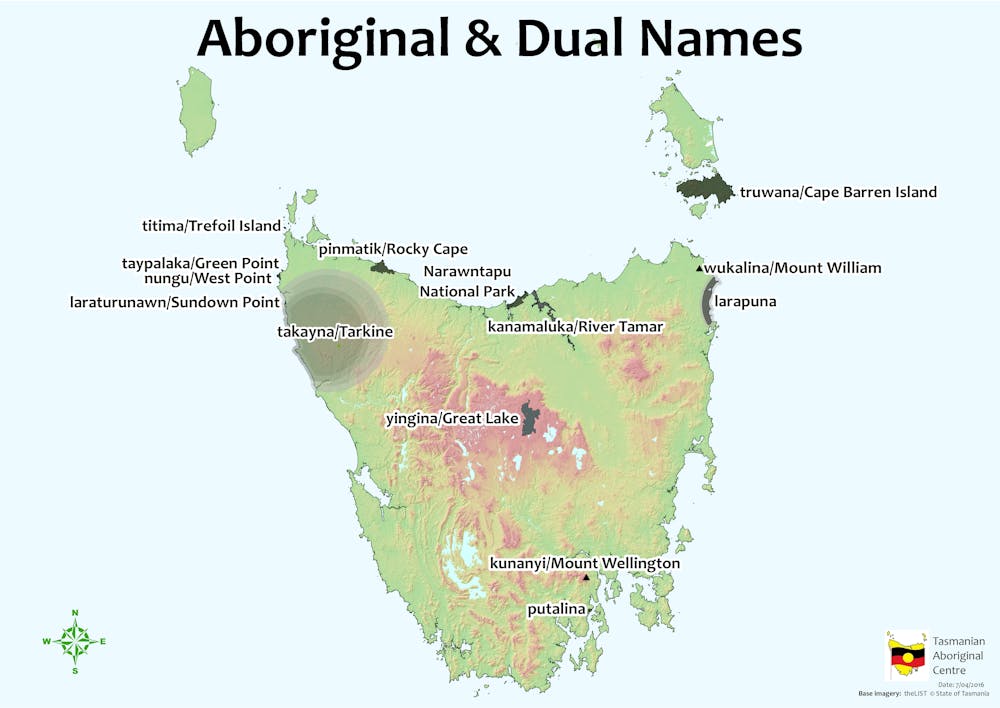 There are 14 official Aboriginal or dual names in Lutruwita (Tasmania). These names are in palawa kani, the revived language of Tasmanian Aborigines.
Tasmanian Aboriginal Centre
There are 14 official Aboriginal or dual names in Lutruwita (Tasmania). These names are in palawa kani, the revived language of Tasmanian Aborigines.
Tasmanian Aboriginal Centre
But not all sources are of equal value. Nor do they cover the breadth of topics needed for an undergraduate unit.
The second criterion, Indigenous Knowledge as foundational, guides resource choices. Indigenous scholarship, particularly Palawa scholarship, is prioritised for inclusion. We use the voices of Palawa expert knowledge holders to fill identified content gaps.
Read more: Friday essay: Dark Emu and the blindness of Australian agriculture
All resources, whether published scholarship or commissioned, need to be curated appropriately. For this task we are using Traditional Knowledge (TK) Labels.
TK labels are electronic tags that allow Indigenous protocols and educative and culturally relevant information to be attached to resources. This information might include the significance to the local community and any restrictions on use. Our use of TK labels on curriculum material is the first time they have been used in this way, nationally and internationally.
The third criterion of teaching as a collaborative partnership between Indigenous and non-Indigenous academics facilitates a shared responsibility for Indigenisation and two-way scholarship and teaching mentorship.
The progression-based criterion avoids the common trap of curricula being restricted to a limited and often repeated trope of Indigenous content.
Read more: New coins celebrate Indigenous astronomy, the stars, and the dark spaces between them
Our development of a central pool of curated resources, including instructions for best usage, supports criteria 4 and 5. There are records of when and where that resource has been used.
Access to this collection reassures lecturers they are using quality, appropriate content. The breadth of the categorised content helps lecturers develop their units within the broader building of students’ understanding of Indigenous knowledge across their studies and degrees.
Country is integral to Palawa knowledge, identity and well-being. This relationship to Country forms a central learning component. To learn from personal experience of Palawa knowledge, students complete a series of virtual tours of Country.
The unit culminates in a physical Walking on Country experience at culturally important sites. Guided by Palawa Elder and knowledge holders, students directly share traditional stories and knowledge of Country, its historical significance and meaning within Palawa worldviews.
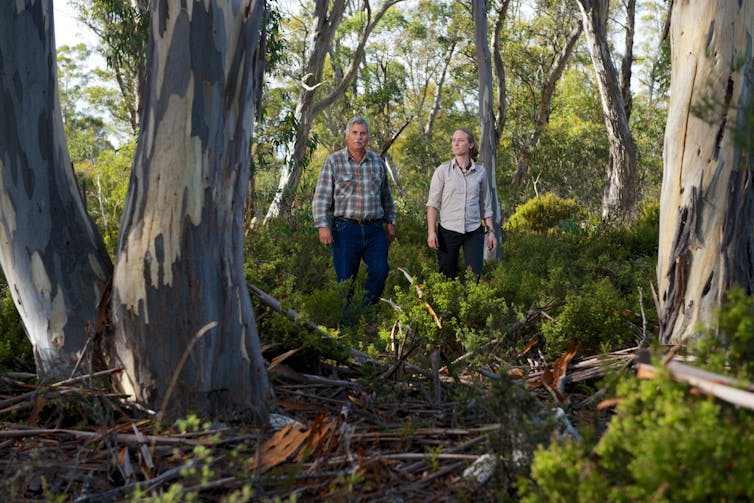 Being on Country (this property is in the Central Highlands) helps students grasp its significance and meaning within Palawa worldviews.
Matthew Newton/Tasmanian Land Coservancy/AAP
Being on Country (this property is in the Central Highlands) helps students grasp its significance and meaning within Palawa worldviews.
Matthew Newton/Tasmanian Land Coservancy/AAP
Read more: Dramatic and engaging, new exhibition Linear celebrates the art in Indigenous science
Increasing cultural competency
Indigenous knowledge systems, like Western knowledge systems, are complex and sophisticated. They are increasingly recognised as presenting viable alternatives in addressing contemporary issues. Indigenous knowledge also equips our medicine, education, law and social work students (among others) to be culturally competent professionals.
Embedding the vibrant and thriving realities of Palawa life, perspectives and community into the curriculum locates our students’ knowledge journey in this place, our place, Lutruwita/Tasmania.
Authors: Maggie Walter, Pro Vice Chancellor (Aboriginal Research and Leadership) and Distinguished Professor of Sociology, University of Tasmania

















