

For the first time, Closing the Gap has a higher education target – here's how to achieve it
- Written by: Ian Anderson. Palawa, Deputy Vice-Chancellor Student and University Experience, Australian National University
The new National Agreement on Closing the Gap has a higher education target for the first time.
It’s also the first time an agreement between governments on Indigenous issues was negotiated and signed by Indigenous Australians. The Coalition of Aboriginal Peak Organisations represented Indigenous Australians.
Read more: We have 16 new Closing the Gap targets. Will governments now do what's needed to meet them?
Endorsed by the National Cabinet on July 30 this year, the ten-year agreement replaces the 2008 National Indigenous Reform Agreement.
To reach the higher education target, universities and vocational education providers must overcome the educational and social barriers Indigenous students face. Higher education providers can also have an impact on all the agreement’s target areas as well as the reform agenda set out in the agreement.
What is the target?
The higher education target is for 70% of Indigenous Australians between 25 and 34 years of age to have a tertiary qualification by 2031.
In 2016, 42.3% of Indigenous Australians in this age group had tertiary qualifications at the target’s required level. The proportion had more than doubled from 18.9% in 2001. By contrast, however, 72% of non-Indigenous Australians had such qualifications in 2016.
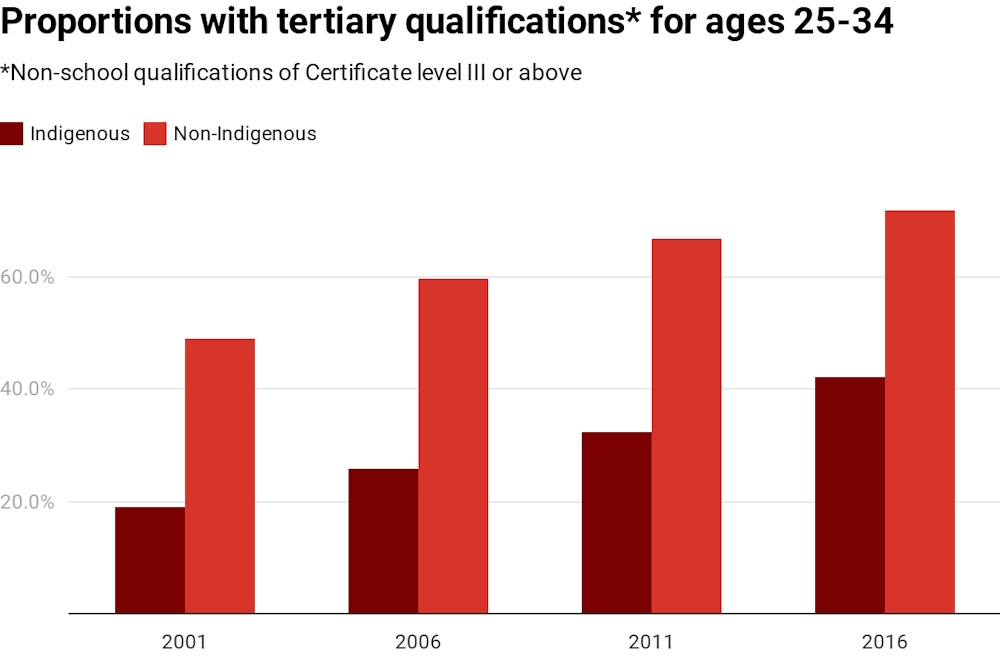 Data: Australian Census of Population and Housing, 2001-2016, Closing the Gap, CC BY
The target includes all university qualifications and those in vocational education above Certificate III level. Tertiary qualifications at these levels prepare Indigenous Australians for jobs.
Helping students take the next step
Year 12 completions are one factor with an impact on tertiary outcomes. It is encouraging to see growing numbers of Indigenous students completing high school. In 2020 this target was on track.
However, schools need to ensure Indigenous students who complete Year 12 are academically equipped for further university education and/or vocational training. More focus is needed on educational attainment in schools. Options for Indigenous students can also be broadened, including stronger pathways in secondary school mathematics and science.
Many Indigenous students are the first in their family to enter higher education. To support their journey, universities and vocational education providers need to develop long-term relationships with schools and Indigenous communities.
Read more:
After coronavirus, universities must collaborate with communities to support social transition
What higher education providers can do
Indigenous university enrolments continue to grow. In fact, Indigenous enrolments increased by about 100% over the decade from 1996.
Data: Australian Census of Population and Housing, 2001-2016, Closing the Gap, CC BY
The target includes all university qualifications and those in vocational education above Certificate III level. Tertiary qualifications at these levels prepare Indigenous Australians for jobs.
Helping students take the next step
Year 12 completions are one factor with an impact on tertiary outcomes. It is encouraging to see growing numbers of Indigenous students completing high school. In 2020 this target was on track.
However, schools need to ensure Indigenous students who complete Year 12 are academically equipped for further university education and/or vocational training. More focus is needed on educational attainment in schools. Options for Indigenous students can also be broadened, including stronger pathways in secondary school mathematics and science.
Many Indigenous students are the first in their family to enter higher education. To support their journey, universities and vocational education providers need to develop long-term relationships with schools and Indigenous communities.
Read more:
After coronavirus, universities must collaborate with communities to support social transition
What higher education providers can do
Indigenous university enrolments continue to grow. In fact, Indigenous enrolments increased by about 100% over the decade from 1996.
 Source: AIHW analysis of Department of Higher Education Statistics Collection, Author provided
However, Indigenous attrition rates continue to be high. This is a key issue that demands attention.
Source: AIHW analysis of Department of Higher Education Statistics Collection, Author provided
However, Indigenous attrition rates continue to be high. This is a key issue that demands attention.
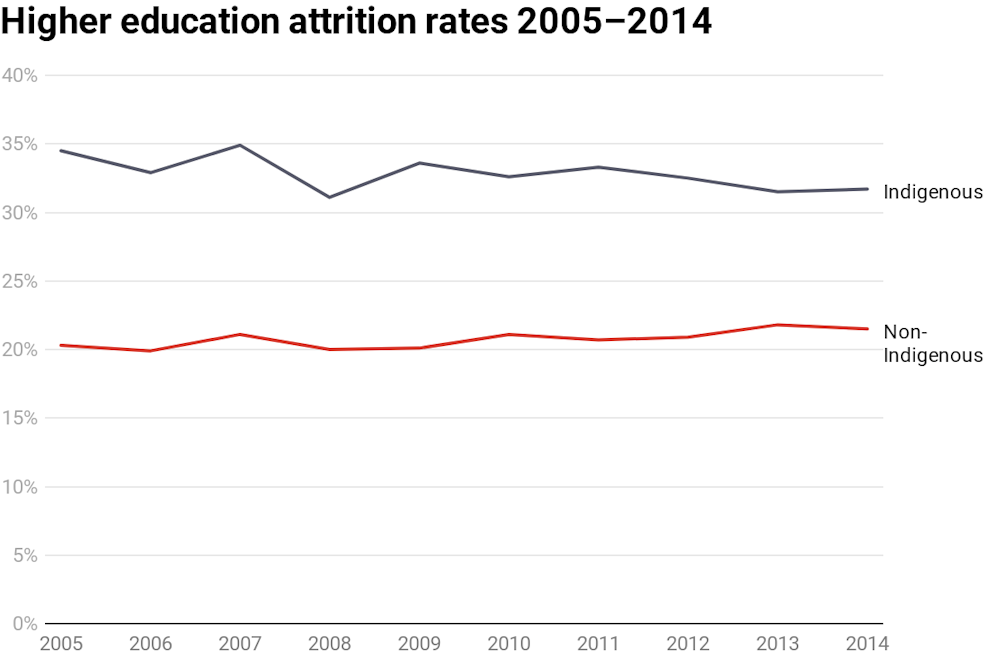 Source: AIHW analysis of Department of Higher Education Statistics Collection, Author provided
A number of things can be done to improve university completions and lower attrition rates. Targeted education support is sometimes needed for Indigenous students who have gaps in their earlier education. Universities should also continue to provide appropriate social and cultural support.
The university sector has already taken some important steps to address these issues. It’s important to maintain the momentum for reform, particularly while we respond to the challenges posed by COVID-19.
Indigenous students are enrolled in vocational education at a higher rate than their non-Indigenous peers. However, enrolments tend to drop off significantly above Certificate III level. There is, however, some evidence this pattern is changing.
Educational strategies to improve literacy and numeracy will improve progression to higher levels of vocational education. Strong regional links between employers and vocational education will help ensure training lines up with jobs.
Leading change in other ways
Higher education providers also can contribute across all priorities in the Closing the Gap agenda. The new agreement has 16 targets. The targets cover: health, early childhood and child protection, education, housing, employment, community safety, language and land.
Higher education providers can better equip all their students to engage with these priorities over their professional lives. Embedding Indigenous knowledge in curricula is a key to this. So too is research undertaken to investigate Indigenous disadvantage and identify strategies to improve the quality and impact of Indigenous services.
Read more:
How a university can embed Indigenous knowledge into the curriculum and why it matters
The agreement has a particular focus on Indigenous-led initiatives.
An important reform is shared decision-making between governments and Indigenous Australians. The agreement also outlines reforms to strengthen the Indigenous community-controlled services sector. Finally, there is a focus on Indigenous-led evaluation and data management.
To that end, it is important that universities and vocational education providers think about how they can lead change. They should consider how they invest in Indigenous leaders within the sector. They should also consider the quality of the Indigenous partnerships they develop.
The National Agreement on Closing the Gap presents some new challenges for higher education providers. The first is to focus on improving educational outcomes for Indigenous Australians. However, these providers have a broader contribution to make; their role in producing the knowledge and workforce for change is equally important.
Source: AIHW analysis of Department of Higher Education Statistics Collection, Author provided
A number of things can be done to improve university completions and lower attrition rates. Targeted education support is sometimes needed for Indigenous students who have gaps in their earlier education. Universities should also continue to provide appropriate social and cultural support.
The university sector has already taken some important steps to address these issues. It’s important to maintain the momentum for reform, particularly while we respond to the challenges posed by COVID-19.
Indigenous students are enrolled in vocational education at a higher rate than their non-Indigenous peers. However, enrolments tend to drop off significantly above Certificate III level. There is, however, some evidence this pattern is changing.
Educational strategies to improve literacy and numeracy will improve progression to higher levels of vocational education. Strong regional links between employers and vocational education will help ensure training lines up with jobs.
Leading change in other ways
Higher education providers also can contribute across all priorities in the Closing the Gap agenda. The new agreement has 16 targets. The targets cover: health, early childhood and child protection, education, housing, employment, community safety, language and land.
Higher education providers can better equip all their students to engage with these priorities over their professional lives. Embedding Indigenous knowledge in curricula is a key to this. So too is research undertaken to investigate Indigenous disadvantage and identify strategies to improve the quality and impact of Indigenous services.
Read more:
How a university can embed Indigenous knowledge into the curriculum and why it matters
The agreement has a particular focus on Indigenous-led initiatives.
An important reform is shared decision-making between governments and Indigenous Australians. The agreement also outlines reforms to strengthen the Indigenous community-controlled services sector. Finally, there is a focus on Indigenous-led evaluation and data management.
To that end, it is important that universities and vocational education providers think about how they can lead change. They should consider how they invest in Indigenous leaders within the sector. They should also consider the quality of the Indigenous partnerships they develop.
The National Agreement on Closing the Gap presents some new challenges for higher education providers. The first is to focus on improving educational outcomes for Indigenous Australians. However, these providers have a broader contribution to make; their role in producing the knowledge and workforce for change is equally important.
Authors: Ian Anderson. Palawa, Deputy Vice-Chancellor Student and University Experience, Australian National University


















