

Assisted dying will become legal in New Zealand in a year — what has to happen now?
- Written by: Jeanne Snelling, Lecturer, University of Otago
The preliminary results of New Zealand’s referendum on the End of Life Choice Act were conclusive. Some 65.2% of voters supported the law coming into force, while 33.8% opposed it.
Although around 480,000 special votes are still to be counted, the margin is so great there is no chance these will alter the final outcome. Consequently, the End of Life Choice Act 2019 will come into force on November 6 2021, one year after the official vote is announced next week.
It will then become lawful to offer assisted dying (AD) to terminally ill individuals who meet the legislation’s eligibility criteria. The delay in the law taking effect provides a 12-month window to implement the necessary arrangements for AD to take place.
One significant issue yet to be determined is whether AD services will be specifically funded, and if so how. The Ministry of Health will need to resolve this over the next year.
In the meantime, what needs to happen next? Immediate priorities for the Director-General of Health under the legislation are:
to appoint a Registrar (assisted dying)
to establish the Support and Consultation for End of Life in New Zealand (SCENZ) Group
to appoint an End of Life Review Committee.
The role of the Registrar (assisted dying)
The Registrar (assisted dying) plays a core role in monitoring and reporting on compliance with the Act. They will also direct any complaints about AD to the appropriate bodies.
The Act, administered by the Ministry of Health, requires adherence to strict regulatory processes. These must be documented in prescribed forms submitted to the Registrar before AD may be performed.
Approving and issuing these prescribed forms falls to the Director-General of Health.
Read more: As NZ votes on euthanasia bill, here is a historical perspective on a 'good death'
What SCENZ will do
Curiously, the Act does not prescribe the composition of the SCENZ Group. It simply requires that the Director-General appoint members with the necessary knowledge and understanding to perform its functions.
The group essentially has two roles:
to determine standards of care and advise on the required medical and legal procedures for the administration of medication for AD
to provide practical assistance if requested.
The second role is largely administrative and facilitative. SCENZ is required to curate and maintain a list of health practitioners willing to be involved in AD, which includes:
doctors willing to act as replacement medical practitioners should a person’s own doctor be unwilling to participate in AD due to conscientious objection
medical practitioners willing to provide an independent second opinion on a person’s eligibility for AD
psychiatrists willing to provide specialist opinions on a person’s capacity, should either or both the attending or independent medical practitioners not be satisfied that the person requesting AD is competent
pharmacists willing to dispense the necessary drugs.
Given these functions, the SCENZ group will presumably be comprised of suitably qualified medical practitioners and pharmacists as well as individuals with knowledge of the relevant law and tikanga Māori, although its final composition remains to be seen.
Read more: Assisted dying referendum: people at the end of their lives say it offers a 'good death'
Compliance and review
The Director-General of Health must also appoint a three-person End of Life Review Committee. This body is tasked with evaluating reports of assisted deaths to determine if the statutory requirements are being complied with. It can refer cases to the Registrar if it is not satisfied.
The Act requires the committee to be comprised of one ethicist and two health practitioners, one of whom must be practising end-of-life care.
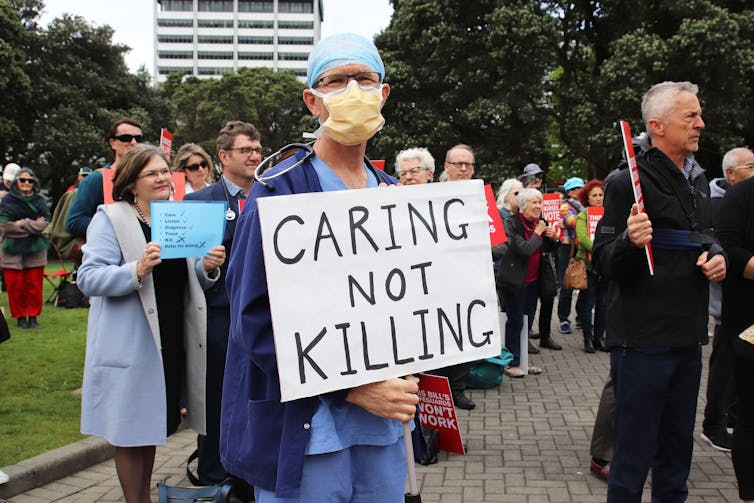 The no vote: an early protest against the assisted dying referendum, outside parliament in 2019.
GettyImages
The no vote: an early protest against the assisted dying referendum, outside parliament in 2019.
GettyImages
Role of the Medical Council
Given the medical profession will have primary responsibility for providing AD, it’s likely its professional body, the Medical Council of New Zealand, will need to begin formulating and consulting on clinical practice standards for medical practitioners involved in providing or facilitating AD.
While the council publishes generic standards of professional practice, including standards for obtaining informed consent and cultural safety, specific guidance should be developed for AD.
The standards should incorporate the legal obligations imposed on medical practitioners under the Act. These include the prohibition on initiating a discussion of AD with a patient, and the legal obligation to inform a patient of their right to a replacement medical practitioner if their doctor objects to AD.
Read more: In places where it's legal, how many people are ending their lives using euthanasia?
The Medical Council could also provide guidance on clinical practice issues that may arise, including ways of identifying coercion, or how to manage difficult conversations with patients (such as when they are found to be ineligible under the Act).
Objection and obligation
Significantly, the Act doesn’t require health institutions to provide AD services. Hospice New Zealand has already signalled it will not provide AD, as it is contrary to its philosophy “neither to hasten nor to postpone death”.
However, a recent High Court decision notes that although institutions may choose not to provide AD, medical practitioners will still be required to discharge their obligations under the Act — including the obligation to provide information to patients.
Although an organisation may elect not to provide AD, it may employ medical practitioners who are willing to. Provisions will need to be made to enable such practitioners to provide AD outside their own organisation. This is an area that will require careful navigation.
Authors: Jeanne Snelling, Lecturer, University of Otago


















